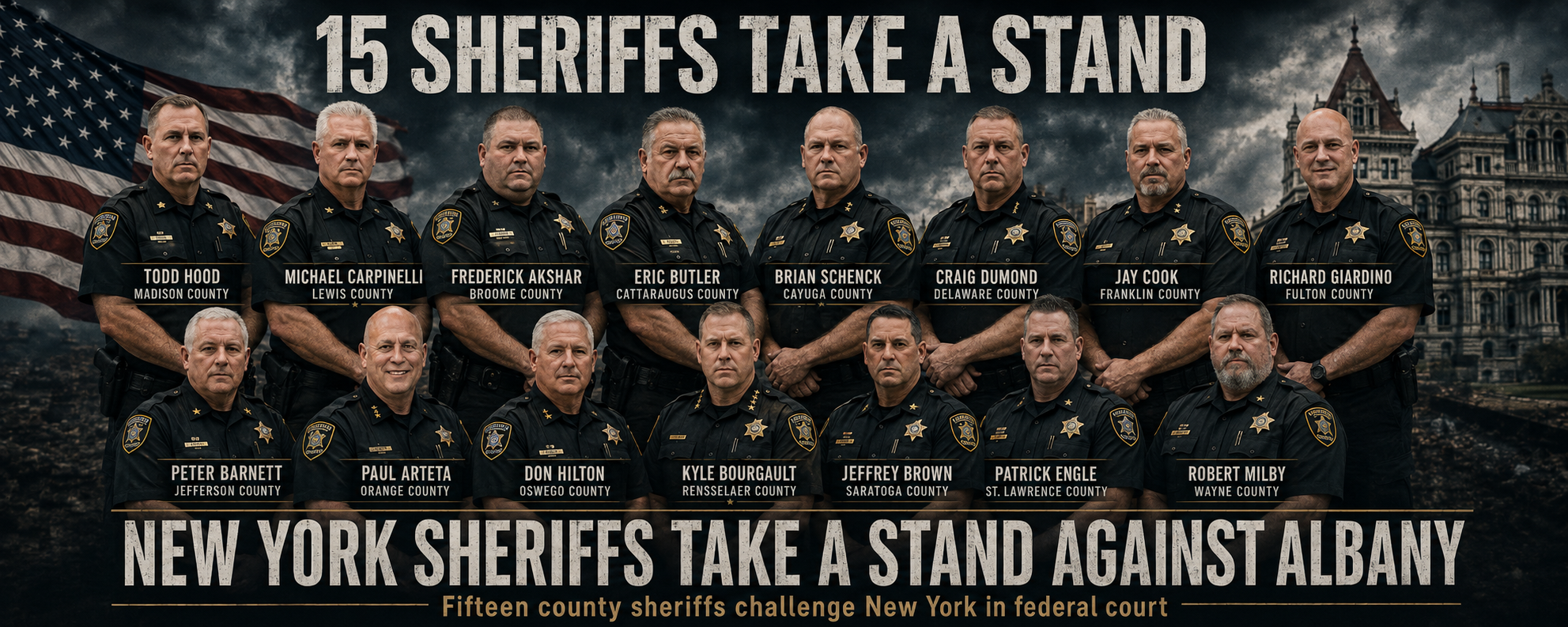
Fifteen New York sheriffs are taking the state to federal court over its new restrictions on cooperation with ICE. Madison County Sheriff Todd Hood and Lewis County Sheriff Michael Carpinelli are among them, and their challenge has my support.
By James Lacey | Opinion
There are political disagreements, and then there are disagreements that go directly to the structure of government itself. The lawsuit now being brought by fifteen New York county sheriffs against Governor Kathy Hochul, Attorney General Letitia James and the State of New York belongs in the second category. This is certainly a dispute about immigration enforcement, but reducing it to another argument over ICE misses the more consequential question underneath it. The case asks who should possess the authority to decide how an independently elected county sheriff cooperates with the federal government, particularly when Congress has expressly created a mechanism for that cooperation.
On August 25, fifteen county sheriffs filed suit in the United States District Court for the Northern District of New York challenging New York's newly enacted Local Cops, Local Crimes Act. The case, Bourgault et al. v. Hochul et al., No. 1:26-cv-01637, was brought with representation from the Federation for American Immigration Reform. The sheriffs also sought emergency injunctive relief against enforcement of provisions terminating existing federal immigration partnerships.
This is not a distant fight involving officials from the other end of the state. Madison County Sheriff Todd Hood is one of the plaintiffs. So is Lewis County Sheriff Michael Carpinelli, whom I have personally had the opportunity to meet. The other plaintiffs include sheriffs from Broome, Cattaraugus, Cayuga, Delaware, Franklin, Fulton, Jefferson, Orange, Oswego, Rensselaer, Saratoga, St. Lawrence and Wayne counties. For those of us in Central and Northern New York, these are the men elected by communities not substantially different from our own. This lawsuit therefore deserves to be understood as more than another Albany-versus-Washington political confrontation. It is also Albany against elected county officials who contend that the state has intruded upon their authority to operate their own law-enforcement agencies. I support the sheriffs bringing this challenge.
That does not require pretending that the legal question is simple. It is not. Section 287(g) of the federal Immigration and Nationality Act expressly authorizes the federal government to enter written agreements with states and their political subdivisions under which qualified state or local officers may perform specified immigration functions after appropriate training and under federal supervision. The statute also contains language requiring those functions to be exercised to the extent consistent with state and local law, language that will inevitably be significant as the courts determine the limits of New York's authority here. The proper response to that legal tension, however, is not to pretend it does not exist. It is precisely why this case belongs before a federal judge.
New York's law is now codified as Executive Law § 170-k. Its purpose is clear. The state has prohibited covered state and local law-enforcement agencies from entering into or remaining in certain arrangements involving federal civil immigration enforcement, including the 287(g) partnerships at the center of this dispute. The enacted state budget legislation described the Local Cops, Local Crimes Act as prohibiting 287(g) agreements and federal intergovernmental service agreements for immigration-enforcement purposes.
Governor Hochul and Attorney General James have defended that policy aggressively. In their public statement responding to the sheriffs' lawsuit, they argued that local public-safety resources should be devoted to combating local crime rather than performing ICE's work, and they dismissed the sheriffs' action as a frivolous use of taxpayer resources. They have maintained that New York has the authority to establish these limits and that law-enforcement agencies must comply with state law while the litigation proceeds. That is their argument, and they are entitled to make it. I do not find it persuasive.
The slogan "Local Cops, Local Crimes" sounds almost deliberately unobjectionable until one examines what it actually means in practice. A sheriff discovers that a person already passing through the criminal-justice system is wanted by federal immigration authorities. The federal government has established a statutory framework through which local officers can cooperate with those authorities. The county's elected sheriff concludes that such cooperation serves the interests of public safety. Albany then intervenes and says the sheriff may not maintain that formal relationship because the state government has determined that civil immigration enforcement is not an appropriate local function. That is a legitimate policy position, but it is hardly self-evidently the only legitimate one.
There is an enormous conceptual difference between deputies roaming communities searching for people solely because of suspected immigration violations and a sheriff's office communicating and cooperating with federal authorities regarding individuals who are already lawfully in custody. The latter is precisely the distinction emphasized by some sheriffs in defending their partnerships. Reporting on the dispute indicates that sheriffs have argued their cooperation was concentrated on people already being held on criminal matters rather than indiscriminate immigration sweeps through their communities.
That distinction matters because political rhetoric has a habit of collapsing several fundamentally different activities into the single word "ICE." Once that happens, meaningful discussion becomes almost impossible. Deportation after a civil immigration violation, detention of a criminal suspect, honoring a federal warrant, transferring someone already incarcerated, housing a federal detainee and allowing locally trained personnel to exercise delegated immigration functions are not automatically identical exercises of government power. Good law should recognize those differences instead of treating every form of federal-local cooperation as though it were the same thing.
There is also an institutional question that should concern New Yorkers even if they disagree with these sheriffs on immigration policy. The sheriff is not simply another Albany bureaucrat waiting for instructions from a state agency. In most New York counties, the sheriff is independently elected by the people. That office has its own constitutional and historical status, and the plaintiffs are specifically arguing that New York has interfered with the independence and authority of elected sheriffs while impairing agreements they voluntarily entered with the federal government. Whether those arguments ultimately prevail is for the courts to decide, but they are substantial enough that they deserve adjudication rather than ridicule.
The confrontation has already moved beyond abstract legal briefing. Attorney General James and Governor Hochul announced a separate state lawsuit against Rensselaer County Sheriff Kyle Bourgault after he refused to terminate his department's 287(g) agreement. The state is seeking an order compelling compliance with the new law. We are therefore watching a genuine collision among elected county law-enforcement officers, state executive power and federal immigration authority unfold in real time.
There is another reason I support the lawsuit. Government power should be tested when reasonable constitutional questions are raised about its boundaries. That principle should not change depending on which party controls Albany, which administration controls Washington or which particular law someone happens to favor. If the state believes it possesses the constitutional authority to nullify these agreements, it should be capable of defending that position in federal court. If the sheriffs believe New York has exceeded its authority or impermissibly interfered with federally authorized cooperation, they should be able to make that argument just as forcefully.
Litigation is not an act of insubordination. It is one of the mechanisms built into our constitutional system for resolving competing claims of governmental authority.
It is also worth remembering what the federal statute actually represents. Congress did not accidentally create 287(g). Federal law expressly provides a procedure through which state or local officers can be trained and authorized to perform certain immigration functions pursuant to written agreements and federal supervision. New York has now chosen to restrict its political subdivisions from participating in that system. The resulting constitutional question is more sophisticated than either "New York must obey ICE" or "local police should only enforce local crimes." Federalism rarely fits comfortably on a bumper sticker.
My position is nevertheless clear. When a county's elected sheriff believes cooperation with federal law enforcement is necessary to protect the community he was elected to serve, Albany should face an extremely high burden before substituting its political judgment for his. When fifteen sheriffs from geographically and politically diverse counties are willing to attach their names and offices to a federal lawsuit making that argument, New Yorkers should pay attention.
I particularly take notice when the plaintiffs include officials from my own part of the state. Todd Hood represents neighboring Madison County. Michael Carpinelli represents Lewis County, and having had the opportunity to meet Sheriff Carpinelli personally makes his participation something more tangible to me than another name buried on a federal docket. I do not claim to speak for either man, and their legal arguments must ultimately stand on their own merits. What I can say is that I support their willingness, and the willingness of the other thirteen sheriffs, to force this question into the open.
This case should not be reduced to whether someone likes Donald Trump, Kathy Hochul, ICE, FAIR or any particular sheriff. The more durable question is whether local elected officials retain meaningful discretion in the administration of their offices when state political leadership objects to their cooperation with the federal government.
Fifteen New York sheriffs believe Albany has crossed that line. They have asked a federal court to decide. They have my support in doing so.