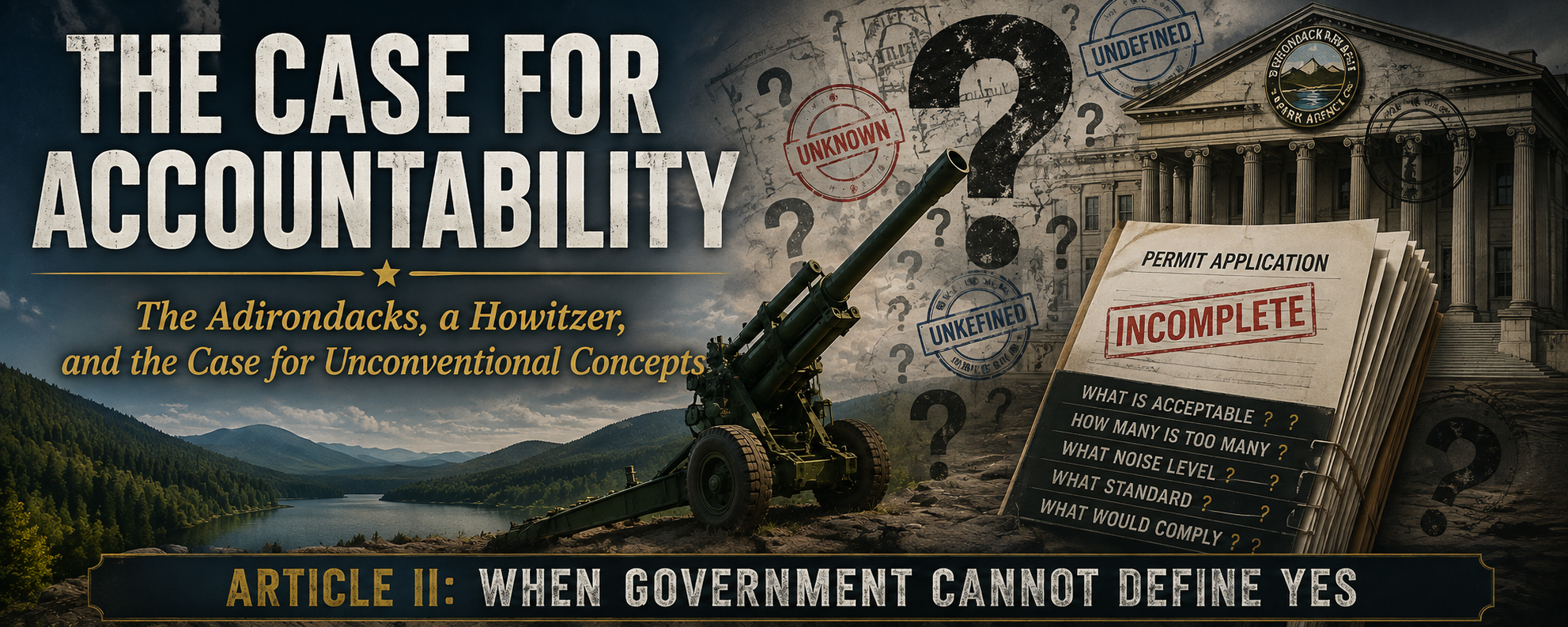
The Adirondacks, a Howitzer, and the Case for Unconventional Concepts
Article II: When Government Cannot Define Yes
The easiest way to misunderstand the dispute involving Unconventional Concepts, Inc. is to reduce it to a fight between a defense contractor that wants to fire a howitzer and environmental interests that want to protect the Adirondacks. That description may be convenient, but it avoids the more difficult question raised by the application. After years of regulatory review, technical submissions, public opposition, and administrative proceedings, can the government identify a set of conditions under which the proposed activity would be acceptable? If it cannot, then the problem is no longer simply whether UCI has satisfied the government. The problem is whether the government can define what satisfaction means.
That distinction matters because regulation cannot function fairly when the regulated party is required to pursue a standard that remains undefined. Government is entitled to impose demanding requirements. It is entitled to demand environmental studies, safety analyses, engineering documentation, operational restrictions, noise limitations, monitoring, reporting, and other reasonable conditions authorized by law. It is also entitled to reject evidence it finds technically inadequate, provided it can explain why that evidence is inadequate and what legal or technical standard has not been satisfied. What becomes far more difficult to defend is a process in which an applicant is repeatedly required to answer objections without being given a meaningful path toward resolution. This is where the account provided to me by Michael Hopmeier, president of UCI, becomes important.
Hopmeier has stated that UCI attempted on several occasions to approach both the Adirondack Park Agency and the other parties involved in the dispute to determine whether some mutually acceptable operating arrangement could be reached. According to him, those attempts were rejected. He has also alleged that the opposing parties have declined to provide measurable parameters describing what they would consider acceptable operation. His examples are straightforward. If thirty shots are considered excessive, would twenty be acceptable? If a projected sound level is considered unacceptable, what sound level would be acceptable? If a particular operating procedure creates a concern, what modification would resolve it?
These are Hopmeier's claims, and they should be treated as claims unless and until the underlying correspondence, hearing record, or other documentation establishes precisely what occurred. That evidentiary distinction is important. Accountability cannot mean automatically accepting the applicant's version of events simply because the government is the more powerful party. But neither should allegations concerning government conduct be dismissed merely because they come from the regulated party. They should be tested against the record. If the record substantiates Hopmeier's account, the implications are significant.
Negotiation does not require an agency or an opposing party to surrender its position. It does not require environmental organizations to endorse a project they believe should be prohibited. It does not require the APA to manufacture a compromise where the governing law provides none. But if the objections concern the magnitude of an activity rather than the fundamental legality of that activity, then numbers matter. Thirty versus twenty matters. One hundred seventy decibels versus one hundred fifty matters. Frequency matters. Duration matters. Location matters. Monitoring matters. Engineering controls matter. Those are precisely the variables through which environmental and operational concerns are normally translated into enforceable conditions. The alternative is an objection without a limiting principle.
If thirty shots are too many, but no smaller number can be identified as potentially acceptable, then the dispute may not actually be about thirty shots. If the anticipated noise is too great, but no acceptable threshold can be articulated, then the dispute may not actually be about a particular noise level. If additional technical information is demanded but no amount of technical information can resolve the objection, then the dispute is no longer primarily technical. At some point, government has an obligation to identify whether it is regulating the manner in which an activity occurs or opposing the existence of the activity itself. Those are two very different positions, and they should not be allowed to blur together.
If the actual position is that no amount of limited howitzer testing should occur at the proposed location under any circumstances, then that position should be stated plainly and defended under the applicable law. There is nothing inherently improper about taking a categorical position when the law and evidence support one. But a categorical objection should not masquerade indefinitely as a technical disagreement over operating details. If there is no version of the project that opponents would accept, continually debating the particulars of the project risks creating the appearance of a negotiation when there is actually nothing to negotiate. This question becomes even more important because of the technical nature of the proposed work.
Artillery testing is not an area in which most people possess professional expertise. Neither are acoustics, internal ballistics, projectile behavior, range design, environmental noise propagation, or the engineering analysis required to evaluate a testing operation. That does not mean ordinary citizens are prohibited from having concerns. People who live near a proposed activity have every right to ask questions, object, participate in public proceedings, and demand that government protect their legitimate interests. Expertise is not a prerequisite for citizenship. Expertise does become important, however, when technical claims are used to justify technical conclusions.
Hopmeier has alleged that parties opposing the application have acknowledged limitations in their relevant technical expertise while declining to retain outside expertise capable of independently evaluating aspects of UCI's proposal. Again, that is an allegation that should be measured against the record rather than simply accepted because UCI made it. But if substantiated, it raises another accountability question: on what technical basis are conclusions being reached?
There is nothing wrong with saying, "I do not know." In a complex regulatory proceeding, that may be the most responsible answer available. The next step, however, should be finding someone who does know. Government has access to specialists, consultants, academic institutions, engineers, scientists, and technical professionals. If an application presents questions beyond an agency's internal expertise, obtaining competent assistance is not an admission of weakness. It is evidence of responsible administration.
The opposite approach is considerably more dangerous. If government lacks the expertise necessary to evaluate a technical claim but nevertheless acts as though the claim has been disproven, the regulatory process ceases to be evidence-driven. The same principle applies to UCI. The company cannot simply declare its operation safe and expect that declaration to end the inquiry. Its engineering claims should be examined, tested, challenged, and, where necessary, contradicted by competent evidence. The standard should apply in both directions.
That is what due process looks like in practice. It is not merely the existence of hearings, notices, submissions, deadlines, and lawyers. Procedure is important, but procedure alone does not guarantee fairness. A process can contain enormous amounts of procedure while still failing to answer the substantive questions at its center. Meaningful process requires that evidence matter, standards remain intelligible, objections be capable of examination, and decisions eventually be made.
The history of the application makes that obligation particularly important. Years have already been consumed getting to this point. The APA issued six Notices of Incomplete Permit Application before ultimately determining that the application was complete in September 2025. That does not, by itself, prove misconduct. Complex applications can legitimately require substantial additional information, and an applicant can contribute to delay by submitting incomplete or inadequate material. Any serious examination of this matter must consider that possibility. But six incomplete notices over nearly four years also cannot simply be treated as an irrelevant administrative detail.
Each notice should be capable of scrutiny. What information was requested? Why was it necessary? What did UCI provide in response? Did the next notice identify genuinely new deficiencies, unresolved deficiencies from the prior submission, or questions generated by the additional information? Were the Agency's requests consistent with the applicable statutory and regulatory requirements? Did UCI respond adequately and promptly? Did the scope of the requested information remain reasonably connected to the decision the APA was required to make? Those questions matter because the phrase "incomplete application" can conceal as much as it reveals.
If UCI repeatedly failed to provide information reasonably necessary for the Agency to conduct its review, that fact would substantially weaken any argument that the government alone caused the delay. If, on the other hand, UCI repeatedly answered the Agency's requests only to encounter additional requirements without a clear endpoint, that would tell a very different story. Accountability requires examining the sequence rather than accepting either side's characterization of it.
The same principle should govern the current proceeding. Opponents of the application should be required to substantiate their claims. UCI should be required to substantiate its claims. The APA should be required to explain the standards it applies and the conclusions it reaches. Nobody should receive an evidentiary exemption because of institutional status, political sympathy, environmental credentials, private ownership, or involvement in national-defense work.
That is especially important because the imbalance between the parties is structural. UCI can run out of money. It can lose customers. It can abandon the project. Its personnel can move elsewhere. Its investors can decide that New York is not worth the uncertainty. The State of New York does not face those pressures in the same way. The APA will continue to exist regardless of whether this application survives another year. That difference creates a responsibility that accompanies governmental power. When government controls the clock, delay is not neutral.
Every additional month imposes consequences on somebody, even if those consequences never appear in an administrative order. Every additional consultant costs money. Every additional legal filing costs money. Every additional engineering analysis costs money. Every additional year of uncertainty affects investment decisions and business planning. A regulator therefore does not need to formally prohibit an activity to make that activity impossible. In some circumstances, enough process can accomplish the same result.
This is why the concept of regulatory attrition deserves serious attention. It should not be used casually, and it should not become a rhetorical label attached to every permit dispute that takes longer than an applicant would prefer. Complex environmental reviews sometimes take time because the issues genuinely are complex. But when a proceeding extends across years, government should be prepared to demonstrate why those years were necessary.
The burden of explaining governmental action belongs to government.
That principle does not guarantee UCI a favorable decision. It guarantees something more fundamental: the expectation that decisions affecting private parties will be tied to identifiable standards, supported by evidence, and reached through a process capable of producing an answer.
There is also a broader economic consequence that reaches beyond the parties presently involved. Businesses watch how other businesses are treated. Engineers, manufacturers, investors, entrepreneurs, and research organizations do not evaluate a state's business climate solely by reading its tax rates or economic-development brochures. They evaluate risk. Regulatory predictability is part of that calculation. A company does not necessarily need weak regulation. It needs regulation it can understand.
There is a tremendous difference between being told that an activity requires specific environmental controls and being unable to determine whether any controls will ever be enough. The first can be incorporated into a business plan. The second cannot. Uncertainty becomes its own cost, and eventually that cost influences where investment, research, manufacturing, and jobs occur. That should matter in New York.
It should also matter to the people seeking to represent the communities affected by decisions like this one. Government accountability is not accomplished by automatically siding with a constituent against an agency, nor is it accomplished by automatically defending the agency because environmental protection is politically popular. Accountability requires asking uncomfortable questions of everyone involved.
What standard is UCI required to meet? Has that standard remained consistent? Has UCI actually met it? If it has not, precisely where has it failed?
If the project could become acceptable through additional restrictions, what restrictions? If no version of the project is acceptable, why not? What evidence supports that conclusion? And after years of proceedings, who is responsible for ensuring that those questions finally receive answers?
Those are the questions I believe should now define this dispute. They are more important than the spectacle of the howitzer because they apply to every person who may someday find themselves across a table from government.
The government does not owe UCI a yes. It does not owe UCI a compromise. It does not owe UCI immunity from environmental law, public opposition, or rigorous technical scrutiny.
But government does owe the people it regulates something fundamental: a comprehensible standard, a fair process, an evidence-based decision, and accountability for how it uses the enormous power entrusted to it. If government cannot tell an applicant what yes looks like, then sooner or later we have to ask whether the process was ever designed to permit yes at all.
That question is no longer just UCI's problem.
It is ours.