There are years of a man’s life that disappear so completely into repetition that memory ceases to preserve them as individual days and instead compresses them into an atmosphere, into weight, into sensation—the smell of wet pavement before dawn, the sting of fluorescent light against sleepless eyes, the dull hydraulic ache in the knees after fourteen consecutive hours standing on concrete, the ritual humiliation of microwaving food at strange hours while the rest of civilization sleeps beyond the factory walls. Time during those years is not remembered chronologically. It is sedimentary. It accumulates in layers inside the body. Inside the spine. Inside the face. And of all things Inside a pair of boots.
The boots began simply enough. Black leather work boots bought in the spring of 2021, though even that date is deceptive because the machinery that produced them had already begun turning months earlier. October 1st, 2020: the first entry into the plant as a temporary worker. Then December 5th: the first ending. Then April 5th, 2021: the return, temporary again, drawn back into the industrial organism as if gravity itself had acquired payroll authority. By May 5th the boots entered fully into circulation, at first reserved only for the plant, because distinctions still existed then. There remained some fragile illusion that one life ended where another began. The boots belonged to steel, machinery, chemical residue, forklifts, loading areas, concrete corridors vibrating faintly with industrial motion. The nursing home belonged to another reality entirely: aging bodies, institutional silence, televisions glowing endlessly in common rooms, the slow managed decline of human beings beneath fluorescent lights designed not for comfort but maintenance.
For a month the transition between worlds remained ceremonial. The boots came off after the plant. The uniform changed. One identity dissolved and another took its place. But exhaustion is a solvent stronger than symbolism. Eventually there was no longer sufficient energy to maintain separation between selves. The uniform stayed on. The boots stayed on. The industrial worker walked directly into the nursing home still carrying the smell of machinery and sweat and plant dust, and something profound collapsed psychologically at that moment because the barriers separating labor from labor, exhaustion from exhaustion, role from role, dissolved into a single continuous state of mechanical endurance. The days no longer possessed edges. Only continuation.
The schedule bordered on biological absurdity. Nursing home from 3:30 in the afternoon until 11:30 at night. Plant work beginning at 5:00 in the morning until after 3:00 PM. Some weeks climbed toward one hundred and twenty hours, a number so extreme it ceases to sound real even while living inside it. Sleep became fragmented mathematics rather than rest. Life reduced itself to transit between obligations. The human organism entered survival mode so completely that personality itself narrowed. Hunger became fuel intake. Conversation became efficiency. Emotion became weather systems passing through an exhausted nervous system too depleted to fully process them.
And over all of it hovered the exhaustion—not ordinary tiredness, not inconvenience, but something environmental, something total, a black atmospheric pressure settling permanently over consciousness. Exhaustion ceased being a condition and became geography. The mind adapted in disturbing ways. Human beings can normalize almost anything when repetition removes alternatives. Entire weeks vanished into industrial rhythm: alarm clocks before dawn, cold air in parking lots, steel-toed footsteps echoing through hallways, caffeine entering the bloodstream like emergency medicine, muscles operating beyond willingness simply because necessity outranked preference. Eventually the extraordinary transformed into routine. The body stopped protesting because protest wasted energy.
Yet beneath the exhaustion there existed another emotion, colder and far more sustaining: hatred.
Not theatrical hatred. Not emotional instability. Hatred sharpened into principle. Hatred for incompetence. Hatred for watching others drift lazily through responsibilities while some people carried impossible burdens simply because they possessed the capacity to endure them. The modern workplace produces a unique psychological violence in competent people forced into proximity with indifference. To labor at maximum exertion while witnessing mediocrity rewarded with comfort generates a corrosive internal pressure difficult to articulate to those who have never lived inside it. That hatred became propulsion. Fuel. A private ethical system organized around discipline, output, resilience, skill. If others lacked urgency, then urgency itself became sacred. If others avoided burden, then burden became proof of worth. Labor ceased being merely economic and transformed into existential measurement.
And strangely—almost paradoxically—there was contentment there too.
Not happiness. Happiness is too light a word for those years. Something harder. The contentment that emerges when existence becomes stripped down to absolute necessity. Modern life fractures people with excess choice, endless distraction, limitless ambiguity about meaning and identity and purpose. But under those schedules there was no ambiguity whatsoever. The mission each day was brutally clear: survive the hours. Continue functioning. Keep moving. The simplicity itself became anesthetic. Exhaustion erased existential confusion by replacing it with mechanical certainty.
The boots absorbed all of it.
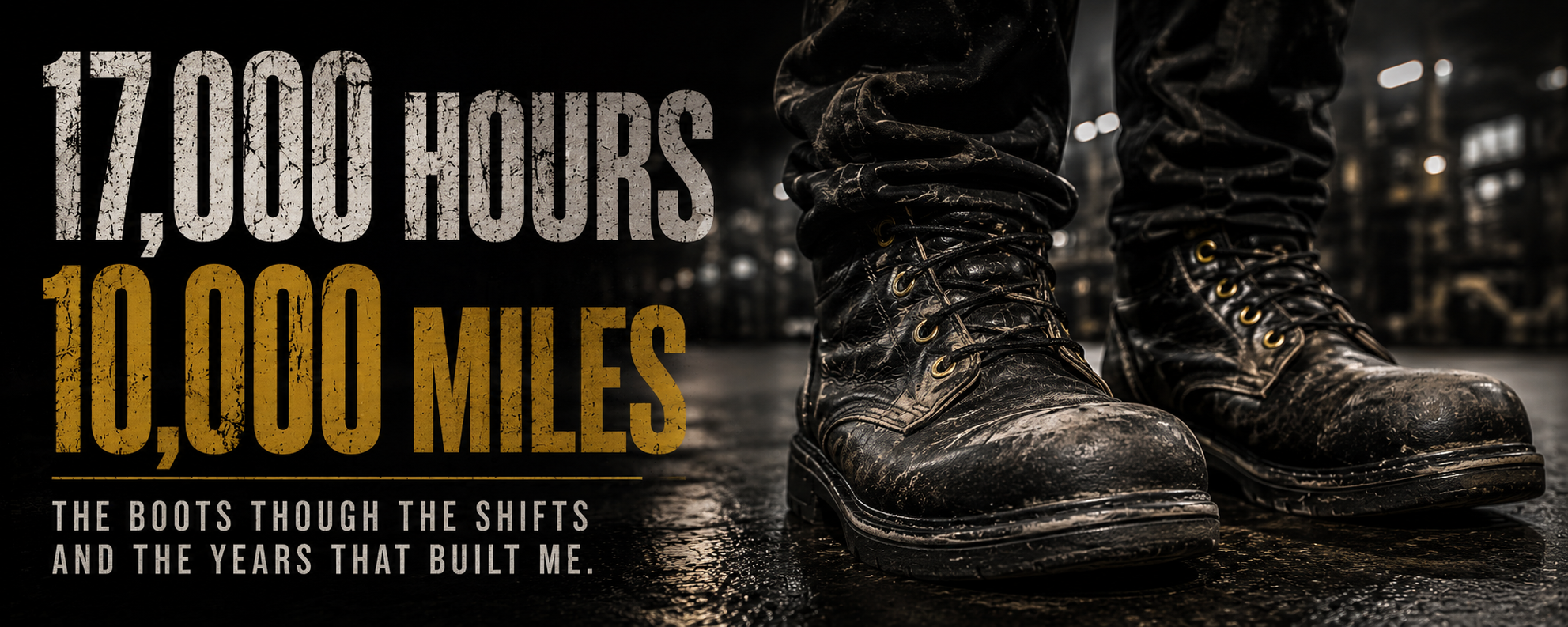
The leather folded and hardened according to the architecture of thousands of shifts. The toe boxes flattened from repetition. The soles compressed beneath accumulated miles walked across factory floors, parking lots, nursing home corridors, break rooms, locker rooms, industrial staircases. The laces snapped repeatedly and were replaced five, six times over the years, each replacement another quiet refusal to stop. Most boots never survive long enough to acquire identity. These did. Somewhere beyond ten thousand hours they ceased functioning merely as objects and became evidence.
July 5th, 2022 ended the plant chapter. Two months later the nursing home ended too. But the boots remained, carried forward into yet another industrial landscape when employment at Indium began September 19th. By then the boots already appeared ruined to outside observers—ragged leather, deep creases, visible deterioration accumulated through years of relentless use. There was a brief intermission during the summer of 2024 when newer company shoes entered rotation, cleaner and more socially acceptable, but they lacked gravity. They possessed no memory. Eventually the old boots returned because utility was no longer the point.
They had become symbolic.
People judged them. Coworkers noticed the deterioration, the visible exhaustion stitched into every crease and abrasion. Modern culture associates wear with failure. Newness signals status. Preservation signals control. But those boots inverted the logic entirely. Their damage represented endurance. Their ugliness represented survival. Every crack in the leather documented hours worked that could never be recovered. Every scar represented continued movement beneath conditions that might have psychologically or physically broken someone else.
An estimated seventeen thousand hours now exist inside those boots. Perhaps more. The number itself becomes abstract at that scale. Nearly two uninterrupted years of human existence spent standing inside leather and rubber. Tens of thousands of miles walked across concrete while much of society remained asleep, entertained, distracted, unaware. Enough accumulated labor to consume a measurable fraction of a human life. Enough repetition to alter personality permanently.
And still the boots remain—not as fashion, not even as equipment anymore, but as an artifact. A physical archive of exhaustion, discipline, resentment, endurance, competence, isolation, survival. Proof that certain years truly happened. Proof that the body carried burdens the mind can barely reconstruct afterward. Proof that labor, repeated long enough, does not merely exhaust a person but reshapes the internal structure of their consciousness until objects themselves begin carrying memory more faithfully than the human mind ever could.