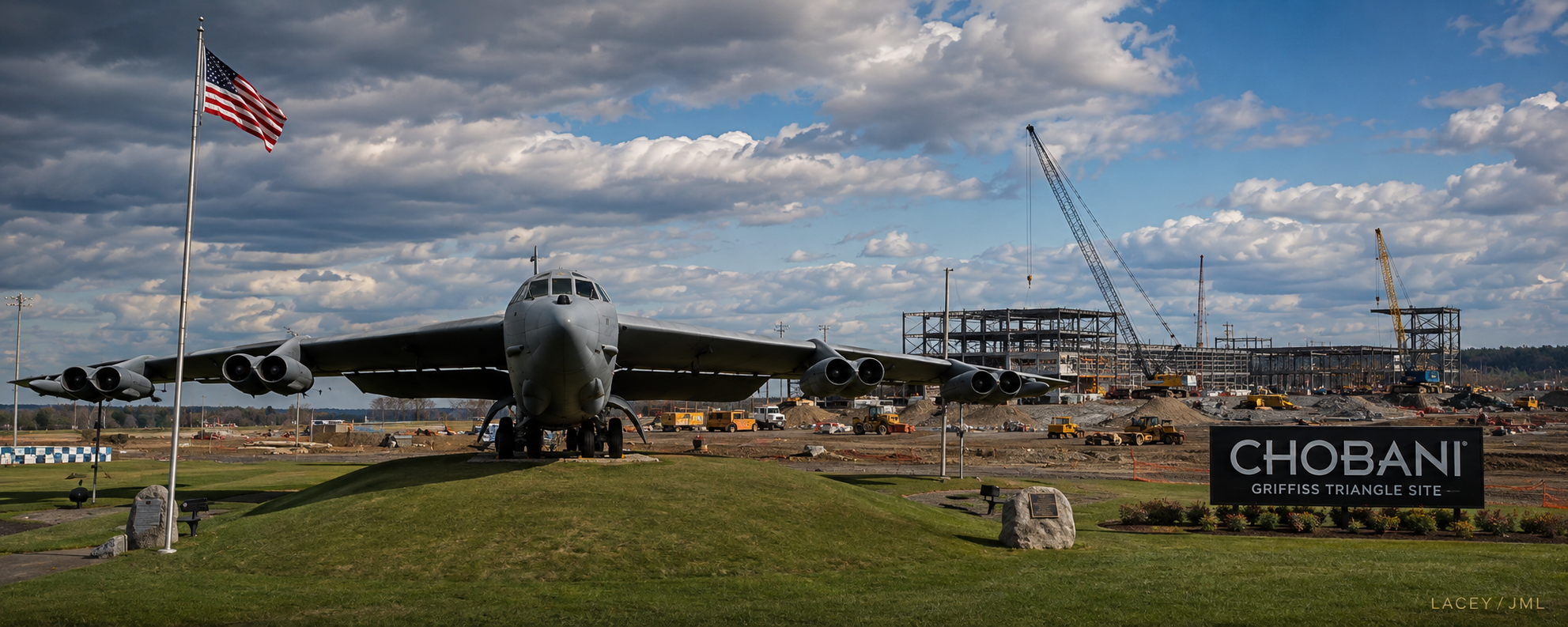
Rome, New York, is preparing for one of the largest food-manufacturing investments in American history, and the scale of what is coming to Griffiss is difficult to appreciate until the numbers are placed together.
For most Americans, Chobani is something encountered in the refrigerated aisle of a grocery store. In Rome, New York, it is becoming something considerably larger. The company is preparing to build a manufacturing complex at the Griffiss Triangle Site that was originally announced as a $1.2 billion investment, with more than 1,000 permanent jobs, as many as 28 production lines and the capacity to produce more than one billion pounds of dairy products every year. For me, this is not a distant economic-development announcement occurring somewhere else in the country. It is being built in my own backyard.
The project is particularly striking because of where it is happening. The Triangle Site sits within the sprawling redevelopment of the former Griffiss Air Force Base, a place whose economic identity was once inseparable from military aviation and the thousands of jobs associated with the base. When Griffiss realigned and the active-duty base largely closed in the 1990s, Rome was forced to spend decades figuring out what came next. The answer has gradually taken shape through defense research, cybersecurity, unmanned aircraft, advanced technology, Griffiss International Airport and private industry. Chobani now represents a very different kind of manufacturing anchor, but one potentially large enough to alter the economic geography of the city again.
When Governor Kathy Hochul and Chobani announced the project in April 2025, the company described a 1.4-million-square-foot facility on the Griffiss Triangle parcel. It was billed as the largest investment ever made in a natural-food manufacturing facility in the United States. The plant was expected to create more than 1,000 full-time jobs and nearly double Chobani's New York workforce.
The project has since grown and evolved. By 2026, Oneida County was publicly referring to Chobani's planned Rome operation as a 2-million-square-foot dairy processing facility occupying approximately 253 acres at the Triangle Site. County infrastructure work has included the reconstruction of Perimeter Road, a new State Route 825 roundabout, a sound barrier, a 12-inch natural-gas main, a sanitary sewer pump station and force main, and electrical improvements providing another 50 megawatts of power to the site. Those numbers alone tell you that calling this a "yogurt factory" does not quite capture what is being built.
At full development, Chobani plans for the Rome campus to contain as many as 28 production lines and process approximately 12 million pounds of milk per day. The company has said the facility will be capable of producing more than a billion pounds of finished dairy products annually. Chobani already purchases more than a billion pounds of raw milk from New York farms each year, and Oneida County said the company's total New York milk purchases could eventually reach an estimated six billion pounds annually as the Rome operation reaches full capacity. That makes this project an agricultural story every bit as much as it is a manufacturing story.
New York remains one of the largest dairy states in the country. State officials reported roughly 3,000 dairy farms producing 16.1 billion pounds of milk annually when the Chobani project was announced. New York is already the country's leading producer of yogurt, as well as a major producer of milk, cream cheese, sour cream and cottage cheese. A plant capable of consuming milk on the scale proposed for Rome therefore creates demand that extends well beyond the city limits. It reaches farms throughout the Mohawk Valley and potentially much farther across Upstate New York.
That demand could produce opportunities for farmers, truckers, equipment suppliers, veterinarians, construction companies, maintenance contractors, packaging manufacturers and the enormous logistical network required to feed an operation of this size. It could also force expansion throughout the agricultural supply chain. A billion-dollar processing plant cannot run because somebody builds a building and switches on the lights. Milk has to be produced, collected, chilled, transported, tested, processed, packaged, stored and shipped continuously. The scale requires infrastructure far outside the factory walls. For a region that understands manufacturing, that distinction matters.
The construction schedule has changed
There is, however, an important update to the original story. Anyone driving around Griffiss and expecting the gigantic manufacturing buildings to immediately rise out of the ground following the April 2025 groundbreaking may understandably have wondered why progress appeared slower than expected. Chobani addressed that concern this August.
The company has reaffirmed its commitment to Rome, but the buildout is now expected to occur in phases. Chobani Chief Impact Officer Nishant Roy explained that the company redirected some near-term investment toward existing facilities so it could increase production more rapidly in response to growing demand. He nevertheless emphasized that Chobani had not abandoned Rome.
According to the company's latest reported plans, the Rome operation is expected to be developed through three major phases. Phase One could begin as soon as spring 2027, although the current window extends into summer 2028. That first stage is expected to bring approximately four to six production lines into operation and employ roughly 300 to 450 people. Phase Two would add another seven to ten lines, with Phase Three completing the planned buildout toward 28 lines. More significantly, Chobani's eventual employment estimate has increased. Rather than simply exceeding 1,000 employees, the fully developed Rome campus could now employ as many as 1,800 people.
That delay deserves to be reported accurately, but so does the distinction between a delayed building schedule and a cancelled project. At the moment, the evidence points toward the former. Considerable infrastructure construction is already occurring specifically to support the Chobani site, while Chobani itself has continued revising and expanding its long-term plan for Rome. What people are currently seeing around Griffiss is therefore largely the industrial groundwork required before a manufacturing campus of this magnitude can operate.
The electrical requirement alone illustrates the scale. Oneida County is preparing an additional 50 megawatts of electrical service for the Triangle Site. The county is also constructing new natural-gas and sewer infrastructure and substantially altering the roadway network around State Route 825. Rome's wastewater system presents another major engineering challenge. The city's treatment facility currently handles an average of approximately six million gallons per day, while Chobani is expected to add roughly three million gallons of average daily discharge when operating at scale. A $1.5 million federal appropriation announced in January was directed toward wastewater upgrades associated with the development. This is heavy industrial infrastructure, even if the product coming out the other end happens to be yogurt rather than steel.
The public investment matters too
A project this large also deserves examination beyond the ribbon-cutting speeches. Chobani is investing an enormous amount of private capital, but taxpayers are participating in the development as well.
New York awarded more than $23 million through the FAST NY program for infrastructure and transportation work at the Griffiss Triangle Site. Empire State Development also agreed to provide Chobani with up to $73 million in performance-based Excelsior Jobs Program tax credits, tied to the company's employment commitments. Oneida County had previously invested more than $6 million preparing the Triangle Site for major development. Federal money is supporting wastewater upgrades, while state and county resources are being used for roads and utility infrastructure. That does not automatically make the investment good or bad. It makes it something taxpayers should understand.
Economic-development incentives are ultimately a bargain. Government provides infrastructure, tax treatment or financial assistance because officials believe the resulting private investment, payroll, secondary businesses and expanded tax base will ultimately generate more economic value than the public cost. With Chobani, that argument rests on an unusually large amount of private capital and potentially 1,000 to 1,800 permanent manufacturing jobs, in addition to construction employment and agricultural demand.
The proper standard should be straightforward. Chobani should be expected to build what it has committed to build, jobs tied to incentives should actually materialize, public spending should remain transparent, and local residents should be able to see whether the promised economic return occurs.
At the same time, neighbors should not be treated as an afterthought simply because the project is economically important. Residents near the development have raised understandable concerns about noise, traffic and the physical scale of the operation. Revised plans approved by Rome's Planning Board moved portions of the facility farther from nearby homes, consolidated buildings and incorporated measures intended to reduce noise. The new Route 825 project includes a sound wall in addition to the roundabout. Those accommodations are part of what responsible industrial development looks like. Economic growth and neighborhood quality of life do not have to be mutually exclusive, but reconciling them requires competent planning.
A manufacturing project Rome can actually see
There is something particularly significant about seeing this kind of investment arrive in Rome. For decades, many communities across Upstate New York became accustomed to the opposite story. Plants closed. Manufacturing moved. Major employers downsized. Young workers were told that the opportunities their parents and grandparents once found locally might require leaving the region entirely.
The Chobani project does not erase that history, nor can one factory repair every economic problem facing Central New York. But a private company committing more than a billion dollars to construct one of the largest food-manufacturing facilities in America represents movement in the opposite direction. It means production. It means machinery.
It means industrial maintenance, electrical work, automation, instrumentation, quality control, food science, logistics, warehousing, trucking and skilled trades. It means thousands of construction workers building something that is intended to remain after construction is finished. It means a market for an agricultural product New York already knows how to produce extremely well.
There is also an appealing symmetry to the location. Chobani itself was born out of industrial reuse. Founder Hamdi Ulukaya started the company in New York after purchasing a former yogurt factory in South Edmeston in 2005. Two decades later, a company that began by reviving an abandoned Upstate manufacturing operation has selected land at a former Air Force base for the largest investment in its history.
Griffiss once existed to support aircraft, strategic deterrence and national defense. Today the former base hosts advanced research, aviation, technology and private industry. Adding a massive food-manufacturing campus may appear unrelated to that history, but economically the principle is remarkably similar. A community requires productive institutions, skilled people, infrastructure and employers capable of sustaining thousands of families.
What happens next matters more than the announcement
The Chobani story in Rome has now reached the point where announcements need to become steel, concrete, equipment and jobs. The groundbreaking happened. Trees have been cleared. Roads, utilities and site infrastructure are being built. Plans have been revised. The proposed campus has grown. Chobani says it remains committed to Rome, although the company's latest schedule pushes major phased construction into 2027 and potentially beyond. That makes the next several years considerably more important than the ceremony that started the project.
If Chobani ultimately builds out the Rome campus close to its proposed scale, the result will not simply be a large yogurt factory. It could become one of the defining industrial projects in the modern history of Rome and Oneida County, a manufacturing operation approaching two million square feet, drawing millions of pounds of New York milk every day and supporting perhaps 1,800 direct jobs before its broader economic effects are counted. And from where I sit, there is something unusual about watching an investment of that magnitude unfold practically in my backyard.
Most billion-dollar industrial projects are statistics we read about in another city or another state. This one comes with construction equipment on roads we actually drive, utility work we can see, farmers and workers who may eventually supply it, and a skyline at Griffiss that will physically change as the buildings rise.
The important thing now is to watch it closely, hold both Chobani and government to the commitments being made, and recognize the scale of the opportunity if they deliver. Because Rome is not merely getting another employer. It is preparing to become one of the largest dairy-manufacturing centers in the United States.