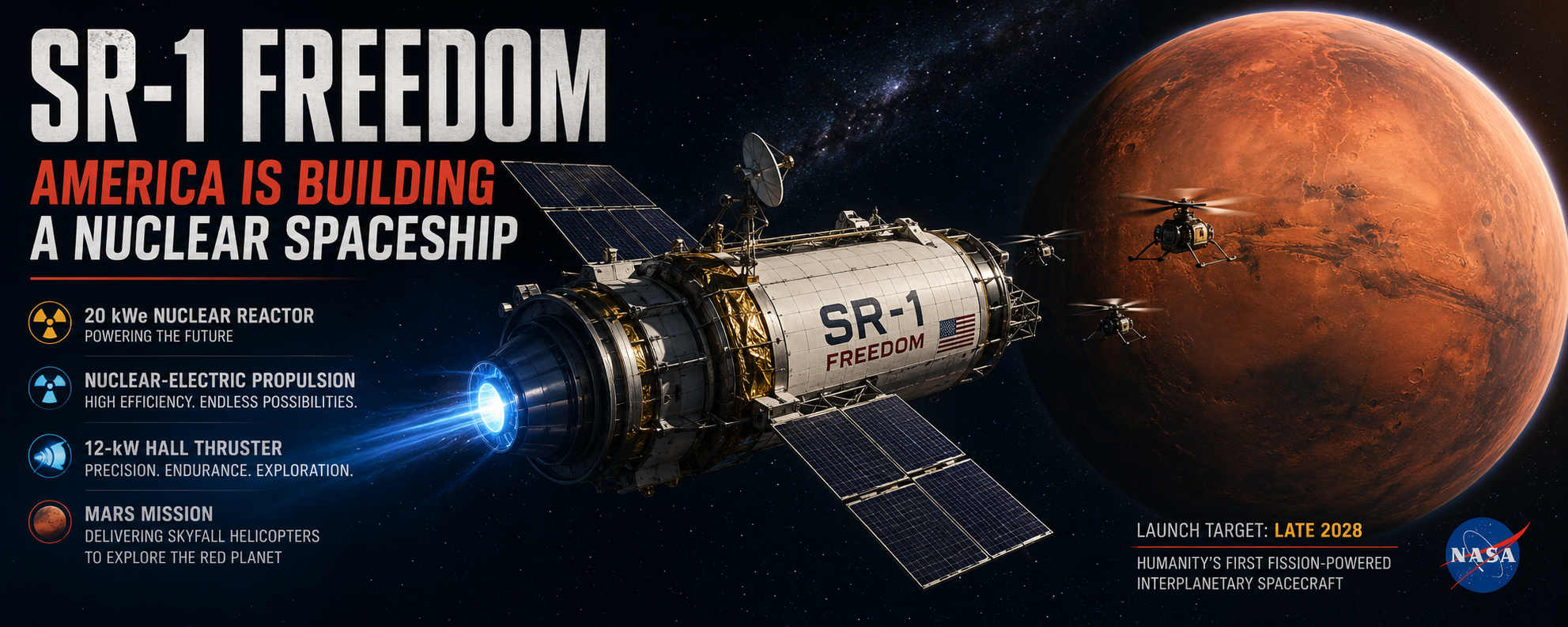
For most of my life, the phrase “nuclear spaceship” has sounded like something belonging to the distant future, a technology discussed in engineering studies, science fiction, abandoned Cold War programs, or ambitious presentations describing what humanity might someday build if we became serious about operating beyond Earth. That is why Space Reactor-1 Freedom matters to me. SR-1 Freedom is not another conceptual spacecraft drawn to illustrate what might be possible in 2045 or 2060. NASA is now targeting an actual mission to Mars in late 2028, using a spacecraft powered by a nuclear fission reactor and propelled through deep space using nuclear-electric propulsion. NASA describes SR-1 as humanity’s first fission-powered interplanetary spacecraft and the first spacecraft intended to use a nuclear fission reactor for propulsion beyond Earth orbit. Its mission is simultaneously technological, scientific and industrial. It is supposed to fly a reactor, operate that reactor in deep space, convert nuclear heat into electrical power, feed that power into high-efficiency electric propulsion, travel to Mars, deliver a scientific payload, and continue operating long enough to establish the flight heritage needed for much larger nuclear spacecraft in the future.
The spacecraft NASA presently describes is approximately 12,000 kilograms, or about 26,455 pounds, and its nuclear system uses high-assay low-enriched uranium, commonly called HALEU. NASA lists a 20-kilowatt-electric closed-Brayton-cycle power conversion system as the nuclear power plant aboard SR-1. That distinction between thermal power and electric power is important. A reactor does not simply produce electricity inside the fuel. Fission releases heat. The spacecraft then has to capture that heat, move it through a power-conversion system, generate usable electricity, condition and distribute that electricity, and reject the remaining waste heat into space. NASA’s current architecture uses a closed Brayton cycle for that conversion process. In simplified terms, the reactor heats a working fluid, that fluid drives rotating machinery connected to an electrical generator, the fluid is cooled and recirculated, and large radiating surfaces dispose of heat that cannot be converted into useful electrical work. This is fundamentally the same thermodynamic problem faced by terrestrial power plants, except that in space there is no atmosphere, no cooling tower, no river and no convenient mass of air into which excess heat can be dumped. Every unwanted watt ultimately has to leave primarily through thermal radiation, making the radiator system almost as fundamental to a nuclear-electric spacecraft as the reactor itself.
This is one of the reasons I think SR-1 deserves far more attention than simply calling it “a nuclear probe to Mars.” The reactor is only one component in what is really an integrated nuclear spacecraft architecture. NASA’s own nuclear-electric-propulsion development work divides the problem into several major technological elements: the reactor, power conversion, electrical power management and distribution, electric propulsion, and heat rejection. If any one of those systems fails to scale, nuclear-electric propulsion does not scale. A megawatt reactor is not particularly useful aboard a spacecraft if the generator weighs too much, if the radiators become enormous, if the power electronics cannot survive years of operation, or if the thrusters cannot reliably process the electrical energy. SR-1 is therefore less about proving that uranium can undergo fission in space, something humanity has understood for decades, and much more about proving that the entire nuclear-electric chain can function as an operational spacecraft.
NASA is also taking advantage of hardware that has already consumed years of development rather than designing every component from zero. SR-1 incorporates the Power and Propulsion Element architecture originally developed for the Gateway lunar station. That spacecraft bus was built around high-power electric propulsion and provides communications, power management, attitude control and propulsion infrastructure. NASA’s current SR-1 mission page lists the Power and Propulsion Element at 48 kilowatts of electrical power while separately listing the reactor’s closed-Brayton conversion system at 20 kilowatts electric. Those numbers describe different parts and operating capabilities of the vehicle and should not simply be added together as though SR-1 had a continuously available 68-kilowatt nuclear power plant. The existing PPE architecture also includes large solar arrays and was originally designed as a solar-electric spacecraft. What matters for SR-1 is that NASA can take a spacecraft already engineered around tens of kilowatts of electric propulsion and integrate a fission source into it, dramatically reducing the number of completely new systems that have to be invented before the 2028 Mars opportunity.
The propulsion system is where SR-1 becomes particularly interesting. NASA lists the 12-kilowatt Advanced Electric Propulsion System, or AEPS, Hall-effect thruster as part of the vehicle. AEPS grew out of NASA’s long-running work on high-power solar-electric propulsion and was originally developed for Gateway. At its full 12-kilowatt operating point, published test data place the thruster at roughly 0.59 newtons of thrust and approximately 2,700 to 2,800 seconds of specific impulse. That thrust number immediately illustrates how different electric propulsion is from the rocket engines people normally imagine. Half a newton is tiny. A person could easily produce more force with one hand. A chemical upper-stage engine may produce tens or hundreds of thousands of newtons. A launch vehicle engine produces millions. A Hall thruster does not compete by producing enormous instantaneous force. It competes by using propellant extraordinarily efficiently and continuing to accelerate the spacecraft for durations that would be impossible for a conventional chemical rocket.
A Hall-effect thruster does not burn xenon the way a chemical rocket burns hydrogen, methane or kerosene. Xenon is supplied to the thruster as propellant, ionized into electrically charged particles, and accelerated through electromagnetic fields to extremely high exhaust velocities. The familiar blue plume associated with Hall thrusters comes from this ionized xenon plasma. Momentum flowing out of the spacecraft produces an equal and opposite force on the vehicle. Because the exhaust velocity is so high, a comparatively small mass of xenon can impart a tremendous cumulative change in spacecraft velocity. The spacecraft accelerates slowly, but it can continue accelerating for thousands upon thousands of hours. The result is a propulsion system optimized not for violently escaping a launch pad but for steadily reshaping a trajectory across interplanetary distances.
That brings me to the most important misconception surrounding SR-1 Freedom. Nuclear-electric propulsion, or NEP, is not the same thing as nuclear-thermal propulsion, or NTP. They both use nuclear fission, but after that they are fundamentally different machines. In a nuclear-thermal rocket, the reactor itself effectively takes the place of the combustion chamber. Instead of burning hydrogen with oxygen, liquid hydrogen is pumped through an extremely hot reactor core. The reactor transfers tremendous thermal energy directly into the hydrogen, converting it into an extremely hot expanding gas. That gas is then expelled through a conventional rocket nozzle. The result is a high-thrust nuclear rocket capable of producing acceleration much closer to what we associate with traditional rocket engines while potentially achieving roughly twice the propellant efficiency of high-performance chemical propulsion. Nuclear thermal propulsion is the technological descendant of programs such as Project Rover and NERVA, where the United States spent years developing reactors hot enough to function as rocket engines. NASA still considers NTP attractive for crewed Mars missions because high thrust can shorten critical maneuver periods and potentially reduce transit times while allowing abort options that are difficult to achieve with purely low-thrust propulsion.
Nuclear-electric propulsion inserts an entire power plant between the reactor and the rocket exhaust. The reactor heats a working fluid. The power conversion machinery turns that heat into electricity. Power electronics condition the electricity. The electrical system feeds the Hall thruster. The Hall thruster ionizes xenon and accelerates those ions electromagnetically. Nuclear energy therefore never directly heats the propellant leaving the electric thruster. This has an enormous consequence. Nuclear-electric propulsion can achieve specific impulses measured in the thousands of seconds and consume dramatically less propellant for a given mission than conventional chemical propulsion, but the thrust is low. Nuclear thermal propulsion trades some of that extreme efficiency for vastly greater thrust. NTP is closer to a nuclear rocket engine. NEP is closer to a flying nuclear power station feeding an electrically driven propulsion system. SR-1 Freedom belongs firmly in the second category.
This distinction also means that nobody should look at SR-1 Freedom’s 2028 flight and conclude that NASA has suddenly built the engine that will carry astronauts to Mars in a few weeks. That is not what this spacecraft is. A roughly 20-kilowatt-electric reactor is a technology demonstrator compared with the power levels that serious crewed nuclear-electric Mars vehicles would likely demand. NASA’s own technology work discusses future human-scale NEP architectures in the megawatt-electric class. One megawatt is 1,000 kilowatts, meaning that the power levels considered for future crewed vehicles could eventually be tens of times greater than the reactor aboard SR-1. NASA has explicitly described SR-1 and its follow-on work as foundations for scaling toward hundreds of kilowatts and ultimately megawatt-class systems during the 2030s. The achievement is therefore not that SR-1 itself is the final Mars ship. The achievement is that America is finally attempting to fly the first rung of the ladder required to build one.
That scaling potential is exactly why nuclear electricity matters so much beyond Mars. Solar-electric propulsion already demonstrates much of the basic physics behind electric propulsion, but solar power becomes progressively weaker as a spacecraft moves away from the Sun. Solar intensity follows the inverse-square law. At twice Earth’s distance from the Sun, a solar array receives roughly one quarter of the solar energy. At Jupiter, the available sunlight is only a small fraction of what the same array would receive near Earth. Engineers can compensate with increasingly enormous arrays, but eventually mass, deployment complexity, radiation, pointing requirements and sheer geometry become serious constraints. Fission does not care whether the spacecraft is orbiting Earth, flying past Mars or operating in the darkness beyond Jupiter. A reactor can provide substantial continuous power independent of sunlight, which means nuclear power can simultaneously support propulsion, communications, radar, scientific instrumentation, computing, thermal control and other high-energy spacecraft systems. NASA specifically identifies high-power missions beyond Jupiter as one of the areas where nuclear-electric propulsion becomes particularly valuable.
The reactor also changes how we should think about the spacecraft after the primary Mars objective has been completed. A conventional planetary probe is normally designed around a finite quantity of chemical propellant and an electrical power system whose available energy may decline considerably over time. A functioning fission reactor creates the possibility of a spacecraft whose useful electrical lifetime and propulsion capability can extend for years, provided the reactor fuel, rotating machinery, radiators, electronics, thrusters and propellant supply remain healthy. NASA has specifically included “reactor extended performance” among SR-1 Freedom’s objectives. That wording may sound bureaucratic, but technically it is one of the most consequential parts of the mission. Demonstrating a reactor for a few hours is one problem. Demonstrating that a compact reactor, conversion system and electric propulsion plant can operate reliably through an interplanetary mission is another. Deep-space nuclear propulsion only becomes transformative when engineers can trust these machines to operate for years without anyone standing next to them with a toolbox.
The 2028 mission itself is not simply an empty propulsion demonstration. SR-1 Freedom is headed for Mars with SkyFall, a separate NASA science mission built around three helicopters descended from Ingenuity. Ingenuity was originally intended as a short technology demonstration and ultimately completed 72 flights on Mars. SkyFall takes that proof of concept and moves toward operational aerial exploration. NASA currently plans for the three helicopters to carry cameras, ground-penetrating radar, atmospheric sensors and other instrumentation capable of examining terrain, measuring weather and searching for evidence of subsurface ice. The objective is not merely to collect interesting pictures. Water ice is one of the critical resources for future human Mars operations because water supports crews directly and can potentially be processed into oxygen and propellant. Aerial reconnaissance could also survey potential exploration zones far faster than a rover constrained to crawl across the surface.
The mission profile is more elaborate than a simple one-way dash followed by immediate landing. NASA currently lists launch in late 2028, an initial Mars encounter during 2029 and the SkyFall landing sequence following a later Mars approach in fall 2030. The SR-1 mission concept includes multiple Mars flybys and deployment of the SkyFall entry system, which will then enter the Martian atmosphere. SkyFall itself is designed around a remarkable mid-air deployment concept. Rather than carrying the helicopters all the way to the surface on a conventional lander platform, the entry vehicle will descend under atmospheric and rocket braking, then release the three rotorcraft while still above the surface. The helicopters will separate, fly away and land independently. This combines two major technology demonstrations in one architecture: interplanetary nuclear-electric transport and a new form of aerial Mars delivery.
Safety is another area where nuclear spacecraft are frequently misunderstood. SR-1 is not intended to sit on the launch pad operating as a critical nuclear reactor. NASA’s space-nuclear approach is to launch reactors in a non-operating condition and initiate fission only once the spacecraft has reached an appropriate trajectory or nuclear-safe orbit from which an accidental return to Earth is no longer credible. Before activation, the reactor has not accumulated the highly radioactive fission products created during sustained nuclear operation. NASA officials have specifically described this distinction when explaining SR-1 and future space reactors. The launch therefore involves nuclear material, which obviously requires careful containment and regulatory approval, but it is not equivalent to launching a running nuclear power plant. The reactor becomes a radiologically much different object only after the chain reaction has begun in space.
There is also important historical context here. America has been working on nuclear space propulsion for approximately seven decades. Project Rover began during the 1950s, followed by the Nuclear Engine for Rocket Vehicle Applications program, better known as NERVA, during the 1960s and early 1970s. Engineers built and ground-tested formidable nuclear thermal rocket reactors. The United States also developed space-reactor technology through the SNAP program and launched SNAP-10A in 1965, the first and so far only American fission reactor flown in space. Later generations produced SP-100, Project Prometheus, renewed nuclear thermal programs and numerous reactor studies. The engineering work never entirely disappeared, but the flight programs repeatedly did. NASA itself now acknowledges that America spent decades investing in space nuclear technology without establishing an operational nuclear spacecraft fleet. SR-1 Freedom is supposed to break that cycle by forcing the technology out of the paper-study phase and into actual flight.
That is one of the reasons the 2028 date matters almost as much as the reactor. NASA is deliberately tying the program to a real Mars launch opportunity rather than allowing nuclear-space development to become another indefinite research effort. The schedule is extremely aggressive. SR-1 was publicly announced in 2026 and NASA is targeting a Mars launch before the end of 2028. The agency is consolidating nuclear programs under its Space Reactor Office, coordinating with the Department of Energy, reusing mature hardware where possible and pursuing a rapid acquisition strategy intended to move the system toward flight. Whether every element of that schedule survives engineering, regulatory, testing and budget realities remains something worth watching closely. Space reactors are not simple machines, and an interplanetary nuclear spacecraft assembled on this timetable represents a formidable systems-engineering challenge. Nevertheless, the difference between this effort and decades of earlier nuclear-space studies is that NASA has now attached the technology to an identified spacecraft, a defined science payload and a specific planetary launch opportunity.
The industrial implications may ultimately be larger than SR-1 itself. NASA explicitly says one of the mission’s objectives is to establish flight heritage, create regulatory and launch precedent, stimulate the supply chain and develop the American workforce required for future space reactors. Nuclear spacecraft require specialized fuel production, reactor manufacturing, high-temperature materials, radiation-hardened controls, turbines or other power-conversion machinery, power electronics, heat exchangers, radiators, electric thrusters, xenon handling systems, safety analysis, launch infrastructure and an entire ecosystem of engineers and suppliers capable of building them repeatedly. A country does not acquire that industrial capacity by publishing another study. It acquires it by manufacturing hardware, discovering what breaks, fixing it, qualifying suppliers, developing standards and then ordering the next machine. This is how aviation matured, this is how chemical rocketry matured, and nuclear spaceflight will be no different.
SR-1 is therefore connected directly to another project that I think could be equally important, Lunar Reactor-1. NASA intends to use data and industrial experience from SR-1 to support a fission surface-power reactor for the Moon. A lunar base cannot depend entirely upon solar arrays if America intends to operate continuously through extended periods of darkness or inside permanently shadowed regions near potentially valuable ice deposits. Fission surface power offers a fundamentally different operational model. Instead of designing every lunar operation around sunlight and battery endurance, a base with dependable nuclear electricity can run excavation equipment, communications systems, habitats, laboratories, environmental control, resource-processing plants and eventually industrial machinery continuously. NASA is presently targeting LR-1 for launch readiness around 2030, with SR-1 serving as the earlier flight demonstration that allows reactor and power-conversion hardware to accumulate experience before the additional difficulty of landing a nuclear plant on another world is introduced.
Beyond LR-1 lies the architecture that interests me most: progressively larger nuclear spacecraft. Twenty kilowatts becomes 100 kilowatts. Hundreds of kilowatts become megawatts. A single Hall thruster becomes banks of high-power electric engines. Robotic probes become heavy cargo transports. Cargo transports eventually inform crewed vehicles. At the same time, nuclear thermal propulsion can continue developing as a complementary technology rather than a competitor. NASA itself treats NTP and NEP as complementary capabilities because they solve different problems. Nuclear thermal propulsion offers much greater thrust. Nuclear electric propulsion offers extraordinary propellant efficiency and continuous electrical power. A mature Mars architecture may eventually use elements of both, perhaps high-thrust propulsion for demanding departure or capture maneuvers combined with high-power electric propulsion for portions of long-duration interplanetary transportation. NASA is already studying combinations of NEP, NTP and chemical propulsion for future unrefueled crewed and cargo Mars architectures.
There is a broader engineering lesson here that I believe is easy to lose when space programs are discussed only in terms of destinations. Mars is not the technology. The Moon is not the technology. The real objective is developing the transportation, energy, manufacturing and logistical systems that make those destinations routinely reachable. Chemical rockets solved the first problem by giving humanity enough thrust to leave Earth. They remain exceptionally good at that job, and NASA still expects chemical launch vehicles to carry nuclear spacecraft away from Earth because the thrust-to-weight advantages of chemical propulsion remain difficult to beat during launch. What nuclear power changes is everything that happens afterward. Once a spacecraft is safely away from Earth, there is no reason every future mission should remain constrained by propulsion and power systems optimized around the technologies available during the opening decades of the Space Age.
I see SR-1 Freedom as important precisely because it is not the enormous nuclear Mars cruiser that people might imagine when they first hear the words “nuclear spaceship.” It is smaller, less powerful and in many ways more practical than that. The reactor produces about 20 kilowatts of electricity, roughly the scale of power that can be understood in terrestrial terms without invoking a giant electrical station. The AEPS Hall thruster produces less than one newton of thrust at full power. The spacecraft is uncrewed. Its Mars mission is fundamentally a flyby and payload-delivery operation rather than a human expedition. Those limitations are not reasons to dismiss it. They are the reason the mission has a plausible path to flight. Someone has to build the first operational reactor-powered interplanetary spacecraft before anyone builds the hundredth. Someone has to accumulate the thermal data, radiation data, operating hours, power-conversion history, thruster life, regulatory experience and manufacturing knowledge that later engineers will take for granted.
If SR-1 Freedom launches in 2028 and performs as intended, the most important image from the mission may not ultimately be one of Mars. It may simply be an American spacecraft moving silently through interplanetary space while a uranium reactor aboard it continuously generates heat, a Brayton-cycle system turns part of that heat into electricity, power electronics feed thousands of watts into a Hall thruster, and xenon ions leave the spacecraft at tremendous velocity. There will be no towering chemical flame and no violent acceleration. The spacecraft will simply keep pushing, hour after hour, day after day, using nuclear energy to propel itself between worlds.
That is a nuclear spaceship.
And after decades of America designing them on paper, cancelling them, restarting the research and studying them again, we are finally trying to build and fly one.