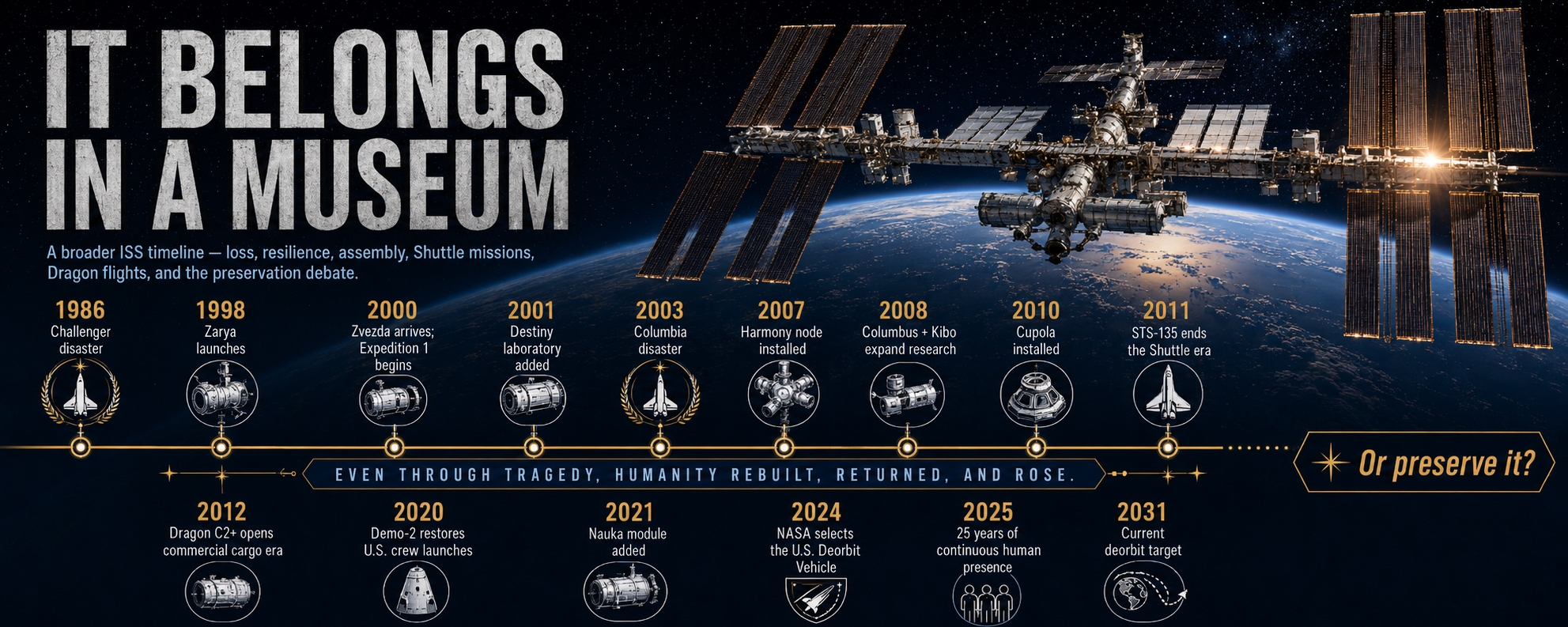
It Belongs in a Museum
NASA has already chosen the official ending for the International Space Station, and the ending it has chosen is not preservation, retirement, transformation, or inheritance, but managed destruction. SpaceX has been hired to build the vehicle that will help deliver that ending: a machine whose highest purpose will not be exploration, construction, rescue, expansion, or discovery, but the deliberate deorbiting of the largest structure humanity has ever assembled beyond Earth. It is a strange and almost tragic symbol of the age that the same commercial space power that made reusable rockets ordinary, lowered the cost of launch, restored American crewed access to orbit, and opened the door to a new industrial era in space is now being tasked with building the spacecraft that will help drag the first great monument of permanent human life beyond Earth down into the atmosphere and scatter what survives into the Pacific Ocean.
There is, of course, a responsible argument for controlled deorbit. No serious person should want the ISS abandoned to decay until gravity, drag, orbital mechanics, and chance decide where its remains will fall. The station is too large, too complex, and too heavy to be treated like a dead satellite. Its reentry cannot be left to luck. NASA is right to worry about public safety, debris footprints, liability, and the consequences of pretending that a structure the size of a football field can simply be ignored when it reaches the end of its operational life. The question is not whether the ISS needs a plan. It does. The question is whether the only plan worthy of serious funding, institutional seriousness, and national will should be a plan to destroy it.
That is where the country should pause. Controlled destruction may be better than uncontrolled destruction, but it is still destruction. It is still the deliberate erasure of one of the most important artifacts ever produced by the human species. The ISS is not merely an old laboratory, not merely a pressure vessel with solar arrays, docking adapters, radiators, scientific racks, hatches, cables, sleeping quarters, exercise machines, and aging electronics. It is the first great physical proof that humanity learned how to live beyond the planet continuously. Since the beginning of permanent occupation, there has been an unbroken human presence in orbit: men and women sleeping, eating, working, repairing, experimenting, exercising, communicating, and looking down at Earth from a place that did not exist until engineers, welders, machinists, programmers, astronauts, contractors, taxpayers, and nations decided to build it. To reduce that achievement to an object awaiting disposal is an act of civilizational smallness disguised as practicality.
The International Space Station belongs in a museum. Not as a metaphor, not as a slogan, and not as a sentimental phrase attached to a press release after the fact, but as a serious policy objective. If SpaceX can be asked to build a vehicle capable of pulling the ISS down, then SpaceX should also be asked what it would take to push it up. If NASA and Congress are prepared to spend public money to guarantee the station’s destruction, then the American people deserve to know whether that same technological base could first be used to explore preservation, orbital storage, partial salvage, module conversion, commercial leasing, or a true museum concept in space. Before the country pays to burn one of humanity’s greatest machines, it should demand proof that every serious alternative has been exhausted.
This is not an argument for fantasy, negligence, or orbital hoarding. The ISS cannot simply be left where it is as a monument to good intentions. Its orbit will decay. Its systems will continue to age. Its structure has endured decades of thermal cycling, docking loads, vibration, micrometeoroid impacts, internal wear, and the accumulated punishment of survival in low Earth orbit. It was built as a living and working station, not as a dead monument. Preserving it would require engineering discipline, not romance. It would need to be boosted into a safer orbit, stabilized, vented where necessary, powered down or selectively powered, monitored, legally reassigned or jointly governed, protected from becoming a debris hazard, and placed under a plan that recognizes both its historic value and its physical danger. None of that would be easy, but the ISS itself was never easy. Its existence is the answer to those who treat difficulty as an argument for surrender.
America preserves historic ships that no longer sail into battle. It preserves aircraft that no longer fly combat missions. It preserves Apollo capsules, rockets, engines, suits, control rooms, flags, notebooks, launch towers, and fragments of machines that once carried national ambition into the unknown. We do not preserve these things because they remain useful in the narrow commercial sense. We preserve them because civilizations are judged not only by what they build, but by what they refuse to casually destroy. A society that burns its own monuments because preservation is inconvenient is not acting with maturity. It is confessing that it has lost the ability to distinguish between obsolete equipment and sacred inheritance.
The ISS is that inheritance. It is the orbital equivalent of a cathedral, not because it is religious in function, but because it represents the concentration of labor, money, intelligence, danger, sacrifice, national prestige, and transcendent aspiration into a structure larger than any one generation. It was assembled piece by piece in a place where nothing was ever meant to be built. Every module, truss segment, solar array, radiator, hatch, seal, cable, and docking mechanism had to survive not only launch, but installation in orbit. Astronauts had to work outside the station in vacuum, wearing their own atmospheres on their backs, fastening together the skeleton of a future most people could only watch through screens. The station is a machine, but it is also a witness. It witnessed the first era when human beings stopped merely visiting space and began living there.
That is why the language of disposal feels so inadequate. To call the ISS a platform approaching retirement is technically correct but morally incomplete. The same could be said of an old battleship, a moon capsule, or the first aircraft to cross an ocean. At some point, all great machines become outdated. Their purpose changes. Their engines quiet. Their crews leave. Their systems fail to meet modern standards. But when a machine has carried enough history, it stops being merely a machine. It becomes an artifact, and artifacts impose obligations. They remind a civilization what it dared to attempt, what it risked, what it learned, and what it once believed was worth doing even when the cost was high.
There is also a blunt commercial argument, one the space industry should understand perfectly. If low Earth orbit is becoming the next real estate boom, then the ISS is the most prestigious property ever built off-world. The growing commercial-space economy already speaks in the language of leased volume, private stations, research racks, tourism, sovereign customers, manufacturing zones, media rights, brand partnerships, and orbital destinations. Very well. If orbit is becoming a market, then the ISS should be treated as the most valuable address in that market. Sell the berths. Lease the modules. Auction preserved research space. License museum access. Create camera feeds, remote-tour rights, education partnerships, sovereign plaques, university sponsorships, private maintenance contracts, and heritage modules. Let nations preserve the sections they helped build. Let companies compete for the right to maintain, document, stabilize, or exhibit parts of it. Let the old station become the first great piece of space real estate whose value is not derived from novelty alone, but from history.
Yes, taken to its absurd conclusion, this could turn the International Space Station into the most expensive WeWork café ever imagined: a floating, inaccessible, overbuilt, government-born monument leased out by the cubic meter to institutions, sponsors, researchers, tourists, media companies, and status-hungry billionaires desperate to attach their names to the first age of permanent human life in space. Fine. Even that would be preferable to spending nearly a billion dollars to destroy it without first making a serious attempt to preserve it. A ridiculous museum is still better than a noble artifact deliberately turned into debris. A commercialized relic is still better than no relic at all. A preserved orbital landmark, even one wrapped in the vulgar economics of the age, would still carry more dignity than a controlled burn over the Pacific carried out because bureaucracy found disposal cleaner than imagination.
The better version would not be vulgar at all. It would be a public-private preservation project, a human heritage site in orbit, a place no longer meant to house crews permanently but meant to remain visible, documented, stabilized, and symbolically alive. Future spacecraft could visit from a safe distance. Future commercial stations could point cameras toward it. Students could watch sunlight pass over its old solar arrays. Museums on Earth could maintain live exhibits connected to external cameras and internal archival footage. Astronauts might one day conduct ceremonial fly-arounds, inspections, or limited preservation missions if the engineering allowed it. The Cupola, that extraordinary window through which astronauts watched Earth turn beneath them, could remain not as an operating workstation, but as the most famous window humanity ever installed above its home planet.
The answer may still be no. That has to be admitted honestly. The engineering may prove brutal. The propellant requirements may be too high. The structural margins may be too uncertain. The legal ownership may be too tangled. The cost may be indefensible. A higher orbit may create a future debris problem rather than solve one. Safing the station may require more work than the remaining value can justify. Some modules may be too old, too fragile, too contaminated, too politically complicated, or too expensive to maintain. It is possible that, after a rigorous public analysis, controlled deorbit will remain the only responsible option.
But that conclusion should be earned. It should not be assumed. The country should not sleepwalk into the destruction of the ISS because the institutions responsible for it narrowed the question before the public understood what was being lost. NASA, Congress, SpaceX, the international partners, commercial station developers, museums, universities, and the aerospace industry should be forced to confront the full moral and technical question: can any part of the ISS be saved, raised, transferred, stabilized, converted, leased, archived, visited, or preserved before the entire station is committed to atmospheric destruction?
Maybe the answer is a full orbital museum. Maybe the answer is only partial preservation. Maybe a specific module can be detached and saved. Maybe a commercial vehicle can boost the whole station into a graveyard orbit where it can be tracked and studied. Maybe only the Cupola, a laboratory module, or certain internal artifacts can be recovered or preserved. Maybe the realistic solution is a hybrid: remove what can be removed, document everything else in extraordinary detail, and deorbit only after salvage and preservation have been attempted. But the worst answer is the lazy one: burn it because that is the plan, and accept the plan because it is already funded.
The ISS deserves more than that. It deserves more gratitude. It deserves more than a disposal contract and a commemorative video. It deserves the same seriousness in retirement that it received in construction. It deserves to be treated not merely as the end of one program, but as the physical record of the moment humanity first made space a place of residence rather than visitation.
There is something deeply revealing about a civilization’s instinct at the end of a great project. One civilization asks how to preserve the monument. Another asks how to dispose of the asset. One sees inheritance. The other sees liability. One thinks in centuries. The other thinks in budget cycles. If America still intends to be a spacefaring nation rather than merely a customer of space services, it should choose the first instinct. It should look at the station and see not trash, not inconvenience, not an aging platform to be removed from the books, but the first great relic of the orbital age.
Before that challenge is narrowed to one company, one agency, one contract, or one nation, it should be widened back to the scale of the endeavor itself. Space was never opened by machinery alone. It was opened by human beings willing to climb into capsules, shuttles, stations, test vehicles, pressure suits, launch towers, and experimental machines with full knowledge that history rarely advances without cost. We have lost people going upward. We have lost crews in fire, in breakup, in reentry, in training, in testing, and in the long dangerous apprenticeship by which every frontier is purchased. Their names belong behind every clean diagram, every launch contract, every polished mission patch, every livestreamed ascent, and every ordinary phrase about access to orbit. The fact that humanity kept going after those losses is not proof that the losses were small; it is proof that the calling was large. We mourned, investigated, rebuilt, redesigned, and still went back, not because we were careless with life, but because we understood that retreating forever from danger would have dishonored both the dead and the future they helped make possible. The International Space Station exists inside that inheritance. It is not merely a platform assembled after tragedy; it is part of the answer to tragedy, proof that the work continued, that courage did not end at the edge of grief, and that human beings, wounded but unbroken, still boldly went.
SpaceX should not only be asked how to bring the ISS down. SpaceX should be asked what it would take to keep it up. NASA should not only prepare for a controlled reentry. NASA should prepare a public preservation analysis. Congress should not only fund the machinery of destruction. Congress should demand to know whether the most important human-made object in orbit can be saved before it is sacrificed to procedural certainty. But even that is still too small a frame, because the ISS is not merely an American question, a NASA question, a SpaceX question, or a contract-management question. It is a human question. It is a challenge to every nation that helped build it, every astronaut who lived aboard it, every engineer who maintained it, every company now profiting from the space economy it helped make possible, every university that studied from it, every museum that claims to preserve civilization’s achievements, and every generation that inherited the courage of those who went before. If the first great outpost of humanity beyond Earth can be preserved, then preserving it is not only SpaceX’s opportunity to rise to the occasion. It is humanity’s obligation to rise with it.
If the ISS must die, let history show that we tried to save it first. Let the record show that we did not casually burn the greatest structure ever built in space because demolition was easier to administer than preservation. Let future generations know that when the first permanent human outpost beyond Earth reached the end of its working life, someone still had the sense to say what should have been obvious from the beginning.
It belongs in a museum.