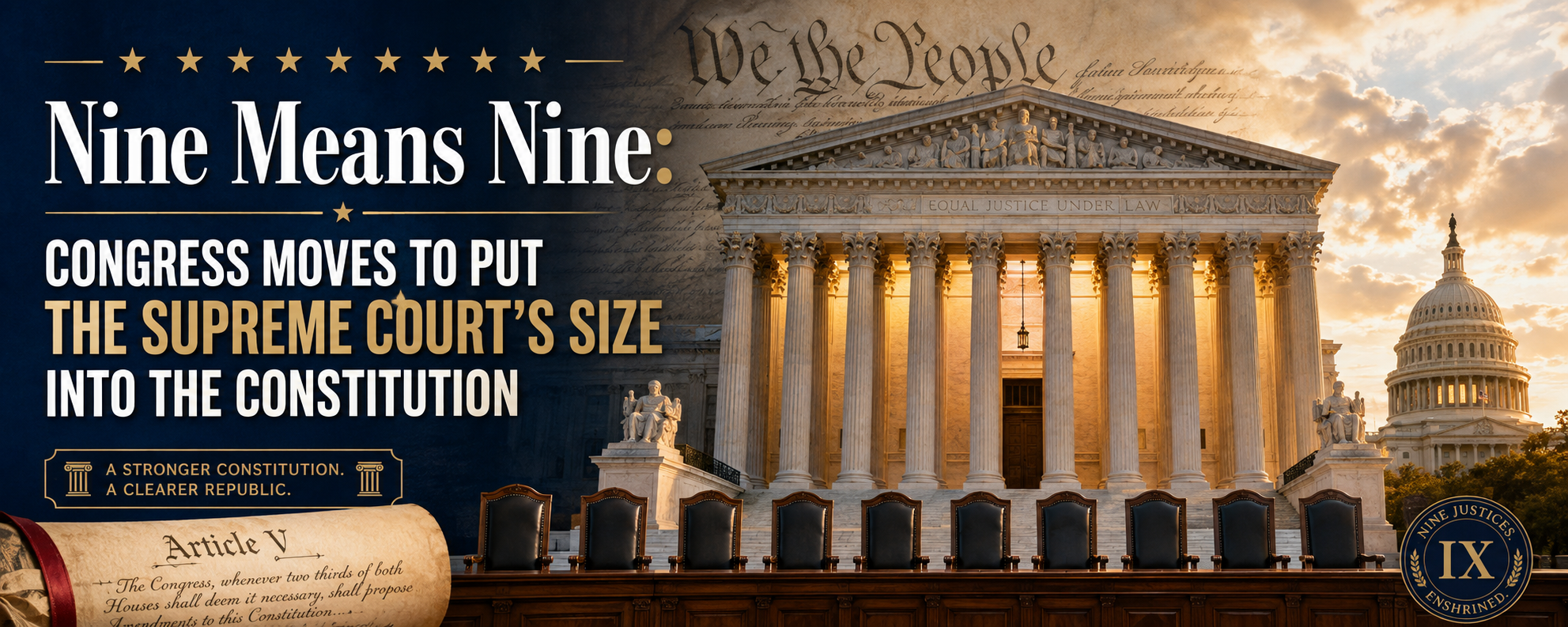
Speaker Mike Johnson says the House will vote on a constitutional amendment fixing the Supreme Court at nine justices, turning a 157-year institutional norm into constitutional law and forcing Congress to confront a fundamental question about the future independence of the judiciary.
The latest fight over the United States Supreme Court is not really about the number nine. It is about whether the composition of the highest court in the country should remain vulnerable to whatever congressional majority happens to control Washington at a particular moment. On September 1, House Speaker Mike Johnson announced that the House would move forward with a constitutional amendment fixing the Supreme Court permanently at nine justices. Johnson said the measure would be placed on the House floor September 2 and framed the vote as a direct response to renewed Democratic calls to expand the Court. “We will keep the nine,” Johnson said. The announcement immediately generated attention because a constitutional amendment would do something fundamentally different from ordinary legislation. It would not merely preserve the present Court. It would remove from future congressional majorities the ordinary statutory power that has historically allowed Congress to change its size.
There is an important factual distinction in the breaking coverage. Republicans are not starting from a blank sheet of paper and introducing an entirely new proposal on September 2. The measure already exists. House Joint Resolution 1 was introduced by Representative Andy Biggs of Arizona on January 3, 2025, considered by the House Judiciary Committee, reported favorably by that committee on June 3, 2026 by a 15 to 8 vote, and formally placed on the House Calendar in July. House floor materials now list H.J. Res. 1 among the measures prepared for consideration. The constitutional language itself is strikingly short. It states that the Supreme Court shall consist of nine justices, specifically one Chief Justice and eight Associate Justices. The resolution also provides a seven-year period in which three-fourths of the states must ratify the amendment.
That simplicity is part of what makes the proposal significant. This is not a sprawling judicial reform package containing term limits, jurisdiction stripping, mandatory retirement ages, ethics provisions, appointment schedules or complicated mechanisms for restructuring the federal judiciary. It addresses one question and essentially one question only: how many seats exist on the Supreme Court? Federal law currently answers that question through 28 U.S.C. § 1, which provides for a Chief Justice and eight Associate Justices, with six constituting a quorum. Because nine is presently a matter of statute rather than constitutional command, a future Congress could theoretically pass another statute creating additional seats. H.J. Res. 1 would take that power away from ordinary legislation and place the number itself beyond the reach of a simple congressional majority.
The Constitution Never Said Nine
One of the most important things to understand about this debate is that nine justices did not come directly from the Constitutional Convention. Article III establishes “one supreme Court,” protects federal judges during good behavior, and establishes the basic constitutional foundation of the judiciary, but it does not specify the number of people who must sit on that Court. The Constitution assumes the existence of a Chief Justice in its impeachment provisions, but the number of Associate Justices was left to Congress. The First Congress exercised that authority through the Judiciary Act of 1789, establishing a six-member Supreme Court consisting of Chief Justice John Jay and five Associate Justices.
The size of the Court subsequently changed several times. Congress provided for a reduction to five seats in 1801, although that change was repealed before a vacancy allowed it to take effect. The Court returned to six in 1802, increased to seven in 1807, increased to nine in 1837, reached ten during the Civil War in 1863, was scheduled to fall to seven in 1866, although it never actually fell below eight, and was finally established at nine in 1869. That last change created the basic structure Americans recognize today, and Congress has not altered the number since. Nine justices have therefore served as the institutional norm through industrialization, two world wars, the Great Depression, the New Deal, the Cold War, the civil-rights revolution, Watergate, September 11 and the extraordinary constitutional controversies of the modern political era.
Those nineteenth-century changes also reveal something important about the historical argument. The number of justices sometimes reflected practical considerations, particularly the old requirement that Supreme Court justices “ride circuit” and personally participate in the work of regional federal courts. As the country expanded and Congress established additional judicial circuits, additional Supreme Court seats were sometimes created with them. But politics also influenced the Court’s composition. The 1866 reduction, for example, is widely understood as an attempt by the Republican-controlled Reconstruction Congress to prevent President Andrew Johnson from filling Supreme Court vacancies. The history therefore does not support the simplistic claim that altering the Court’s size has always been either purely administrative or purely partisan. It has been both at different times.
That history is also precisely why a constitutional amendment can be defended today. Congress unquestionably inherited substantial discretion over the Court’s organization, but Americans are permitted to conclude after more than two centuries of experience that some discretionary powers should become fixed constitutional rules. That is one of the reasons Article V exists. The Constitution itself can be altered when experience demonstrates that a structural question deserves a more permanent answer.
The Ghost of 1937
No discussion of court expansion can avoid Franklin D. Roosevelt’s Judicial Procedures Reform Bill of 1937. After the Supreme Court repeatedly invalidated important components of the New Deal, Roosevelt proposed allowing the appointment of an additional federal judge for every sitting judge over 70 who declined to retire, subject to certain limits. Applied to the Supreme Court, the plan could have permitted Roosevelt to appoint as many as six additional justices and potentially increase the Court to fifteen members. Roosevelt publicly presented the proposal partly as an answer to the workload and age of the federal judiciary, but its political purpose was unmistakable. A larger Court would have allowed him to appoint enough new justices to change the ideological balance confronting the New Deal.
The proposal failed, and its failure created perhaps the most powerful political norm surrounding the modern Supreme Court. Presidents would fight over nominations. Senators would fight over confirmations. Americans would fight bitterly over constitutional interpretation. Yet changing the number of seats specifically to manufacture a more favorable judicial majority became something most national politicians regarded as a line that should not be crossed.
That norm survived for decades precisely because both parties understood the escalation problem. Imagine a government in which Party A gains unified control and increases the Court from nine to thirteen, allowing its president to appoint four new justices immediately. Party B eventually regains power and concludes that thirteen is no longer legitimate, so it increases the Court to seventeen. Party A returns and chooses twenty-one. Nothing inherent in ordinary federal legislation prevents the process from continuing. Every election involving unified control of Congress and the presidency could become an opportunity to reconstruct the tribunal responsible for interpreting the Constitution.
The immediate winners in such a system might celebrate. The long-term institution would suffer. A Supreme Court whose membership can be expanded whenever its decisions displease the political branches begins to resemble another legislative chamber, except one whose membership is manipulated after disputed constitutional questions arise. The Court would still wear robes, hear arguments and issue opinions, but the incentive structure surrounding it would have changed fundamentally.
Why the Issue Is Back Now
That hypothetical is no longer entirely theoretical because serious proposals to expand the Supreme Court have returned to mainstream political discussion. Former Vice President Kamala Harris called in July for consideration of expanding the Court to thirteen justices, and Representative James Clyburn publicly endorsed a thirteen-member Court in late August. Advocacy organizations are openly campaigning for a thirteen-seat Supreme Court, arguing that expansion would restore political balance, increase legitimacy and reconnect the number of justices to the thirteen federal judicial circuits. Legislation to create a thirteen-member Court has also been introduced during the current Congress.
Supporters of expansion have a real constitutional argument. Congress has changed the number before. Article III does not say nine. Congress presently controls the number by statute. A future Congress could therefore increase the number without first amending the Constitution. That proposition should be acknowledged plainly rather than avoided. Court expansion may be politically explosive, but under the existing constitutional structure the core act of changing the number of seats is not some obvious constitutional impossibility. The existing nine-seat configuration is statutory.
Expansion advocates also argue that nine has no mystical constitutional significance. The Court originally contained six justices, and for portions of American history contained seven, eight, nine or ten. Some advocates favor thirteen because there are currently thirteen federal judicial circuits, drawing an analogy to the nineteenth-century period when the number of justices and circuits were closely connected. Others make a more overtly political argument, contending that the present conservative majority resulted from a confirmation process they consider structurally unfair and that enlargement is justified as a corrective measure.
Those arguments deserve to be stated accurately because the case for a nine-justice amendment becomes stronger, not weaker, when the actual disagreement is clear. The question is not whether Congress presently possesses significant power over the Court’s size. It does. The question is whether it should continue possessing that power.
From Congressional Power to Constitutional Restraint
That distinction is the heart of H.J. Res. 1. The amendment does not claim Congress never possessed authority to determine the Court’s size. Congress plainly did and still does. Instead, it asks the American people, acting through the Article V process, to remove that particular variable from ordinary politics.
There is nothing unusual about using the amendment process this way. Constitutional government regularly operates by taking certain decisions away from transient majorities. Congress cannot ordinarily extend a president to a third elected term because the Twenty-Second Amendment prevents it. States cannot simply decide that eighteen-year-old citizens may not vote because the Twenty-Sixth Amendment protects that right. Senators are directly elected because the Seventeenth Amendment changed the original constitutional arrangement. The amendment process is not an admission that the original Constitution was defective. It is the mechanism the original Constitution itself created for converting accumulated political experience into permanent constitutional rules.
Fixing the Court at nine would perform exactly that function. Congress used its constitutional authority to establish and modify the Court for approximately eighty years before settling on nine in 1869. The country then accumulated more than a century and a half of experience under that arrangement. An amendment would effectively say that the experiment has run long enough, that nine has become sufficiently embedded in American constitutional government that its continued existence should no longer depend upon legislative restraint.
This distinction also answers the argument that a constitutional amendment somehow violates congressional authority. Congress cannot violate its own Article III power by participating in an Article V amendment that modifies the Constitution. Article V is itself constitutional authority. If two-thirds of both houses propose the amendment and three-fourths of the states ratify it, the Constitution changes. At that point the amended Constitution, not the prior statutory arrangement, becomes supreme.
Passing the House Is Only the Beginning
The political difficulty of doing that should not be underestimated. Speaker Johnson’s decision to bring the measure to the House floor is only the first major step in an extraordinarily demanding constitutional process. Article V requires a two-thirds vote in both houses of Congress to propose an amendment through the congressional route. The amendment must then be ratified by three-fourths of the states, currently thirty-eight of fifty. H.J. Res. 1 specifically provides seven years for those state legislatures to complete ratification.
The President does not sign or veto the proposal. Constitutional amendments occupy a different legal channel from ordinary legislation. Once the necessary supermajorities in Congress have approved an amendment, it proceeds to the states rather than to the White House. The Supreme Court has long recognized that presidential approval is unnecessary in the Article V process.
There is also a Senate counterpart. Senator Ted Cruz introduced S.J. Res. 16 in February 2025, likewise proposing a constitutional requirement that the Supreme Court contain nine justices. That measure was referred to the Senate Judiciary Committee. Whatever happens in the House, therefore, the ultimate congressional hurdle remains formidable. Two-thirds is deliberately difficult to obtain because a constitutional amendment is supposed to require support extending beyond an ordinary partisan majority.
That difficulty is not a defect in this debate. It is the point. Anyone proposing to freeze the Supreme Court at nine should have to persuade a broad coalition of representatives, senators and states. Likewise, anyone opposing the amendment should have to explain why future Congresses ought to retain the ability to expand the Court.
The Best Argument Against the Amendment
There is a serious objection. Constitutionalizing nine would sacrifice flexibility. The framers deliberately left many details of judicial administration to Congress, and the nation could conceivably encounter circumstances centuries from now in which a different Supreme Court structure would make sense. A constitutional cap would require another constitutional amendment to change the number again. Critics can reasonably ask whether an administrative characteristic of a federal institution belongs in the Constitution at all.
There is also an argument that the threat to judicial legitimacy does not come exclusively from expansion. Battles over vacancies, Senate confirmation practices, judicial ethics, lifetime tenure and the ideological predictability of nominations have all contributed to public distrust. Freezing the Court at nine would not resolve any of those disputes. It would not determine how justices interpret the Constitution, prevent partisan confirmation fights or eliminate ideological disagreement over decisions.
Those are meaningful limitations, but they do not eliminate the case for fixing the number. A constitutional amendment does not need to solve every problem surrounding the judiciary to solve one specific structural vulnerability. H.J. Res. 1 would not make the Court apolitical. Nothing could. It would simply remove one extraordinarily powerful weapon from the political arsenal: the ability of a temporary governing majority to create new seats and immediately fill them because it dislikes the existing Court.
There is an important symmetry to that rule. If the amendment were ratified, it would bind Republicans just as firmly as Democrats. A future Republican Congress facing a liberal Supreme Court could not respond by creating four conservative seats. A Democratic Congress facing a conservative Court could not create four liberal seats. The value of the amendment therefore cannot reasonably be measured only by who controls the Court today. Its real test is whether supporters would still defend nine when they hated the decisions being handed down by those nine justices. That is exactly the kind of restraint constitutional rules are supposed to impose.
Nine Is Not Sacred, Stability Is
There is no constitutional magic in the number nine. That is actually beside the point. The strongest argument for nine is not that the Founders selected it, because they did not, or that every other number is inherently unworkable, because American history disproves that claim. The strongest argument is that the United States has operated with nine Supreme Court seats continuously since 1869, creating a deeply established institutional equilibrium. Changing that equilibrium for the explicit or implicit purpose of altering judicial outcomes risks transforming every future dispute over the Court into a dispute over its membership.
The country should be extremely cautious about opening that door because there is no obvious stopping mechanism once it opens. A thirteen-seat Court created by one political coalition would not establish thirteen as a sacred number any more than nine is sacred today. Its opponents would have exactly the historical and statutory argument that expansion advocates now make: the Constitution specifies no number, Congress changed the number before, therefore Congress can change it again. Seventeen would be legally answerable by twenty-one. Twenty-one could be answered by twenty-five. Political norms work only as long as political actors accept them, and the entire modern court-packing debate demonstrates that the nine-seat norm can no longer be assumed to enforce itself.
A constitutional amendment changes that equation because neither party can casually undo it. Instead of asking which side can obtain enough votes in Congress and control the White House long enough to manipulate the Court's size, the political system would know the answer in advance. There are nine seats. When one becomes vacant, the President nominates someone and the Senate exercises its advice-and-consent authority. Elections continue to matter, appointments continue to matter and judicial philosophy continues to matter, but the rules governing the number of chairs do not change simply because one side dislikes who is sitting in them. That is a healthier form of constitutional competition.
The Vote Is About More Than the Current Court
Speaker Johnson’s September 1 announcement therefore deserves more attention than an ordinary partisan messaging vote. H.J. Res. 1 is short enough to fit into a few sentences, but those sentences would alter a power Congress has possessed since the beginning of the Republic. The House Judiciary Committee has already advanced it. The House is preparing to vote. If two-thirds support it, attention will move to the Senate, where the threshold will be equally demanding. Only after Congress clears those barriers could the amendment begin the much larger battle for thirty-eight state ratifications.
The amendment may succeed or it may fail. It may become one of the extraordinarily small number of constitutional amendments that survive the entire Article V process, or it may become another proposal that forces Congress to take a position without ever obtaining ratification. Either way, the debate itself forces the country to answer a question it has avoided for generations. Should the Supreme Court be an institution whose membership changes through death, retirement and constitutionally prescribed appointments, or should its numerical composition itself become another prize of electoral victory?
For more than 150 years, Americans operated as though the answer had already been settled. Nine became so normal that most citizens reasonably assumed it was written into the Constitution. It never was. That distinction mattered less when neither major party was seriously preparing to use congressional power to expand the Court. It matters much more once influential political figures openly advocate increasing the number to thirteen.
The remarkable thing about H.J. Res. 1 is therefore not how much constitutional text it would add, but how much political uncertainty it would remove. One Chief Justice. Eight Associate Justices. Nine seats. Administrations change, congressional majorities change, presidents change, justices change and constitutional doctrine evolves, but the size of the tribunal remains outside the cycle of political retaliation.
The United States has spent 157 years operating a nine-member Supreme Court under an extraordinarily durable statutory settlement. Congress is now being asked whether that settlement should become something stronger than tradition. Given the escalating temptation to treat the Court’s membership as another instrument for obtaining political outcomes, that is a constitutional debate worth having. The fundamental issue is not whether nine was ordained in Philadelphia in 1787. It was not. The issue is whether, after more than a century and a half of experience, America has enough evidence to decide that the Supreme Court should no longer be expandable whenever a temporary majority concludes that it would prefer different judges.
If the answer is yes, then the appropriate mechanism is not another promise, custom or handshake between political parties. It is the mechanism the Constitution already provides for permanent structural reform: Article V. Nine would cease to be merely the number Congress happens to prefer today. It would become the rule that every party has to obey tomorrow.