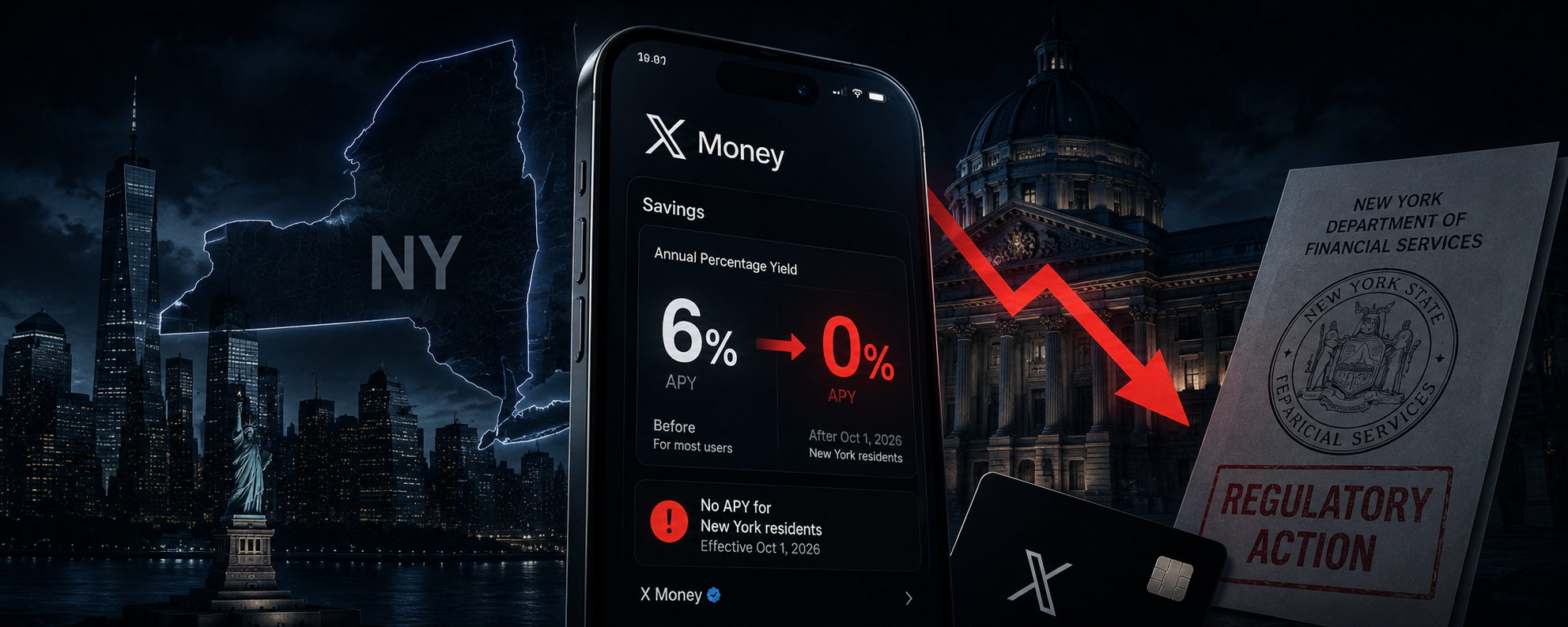
A 6 percent APY available to X Money customers elsewhere is being reduced to zero for New York residents, and Albany owes the people affected a much better explanation than regulatory silence.
New York has managed to create a particularly infuriating form of financial regulation, one in which a resident can use the product, deposit the money, receive the financial services, accept the regulatory protections imposed upon the company, and yet be specifically excluded from one of the product's most valuable benefits simply because his home address happens to fall inside New York State. X Money is advertising annual percentage yields as high as 6 percent to eligible customers, but X's own current disclosures now state plainly that New York residents do not receive APY, interest, or interest boosts on their Stored Value Accounts. More significantly, X has published a separate notice stating that New York residents who are presently receiving interest will see the APY and interest rate on their accounts reduced to 0.00 percent effective October 1, 2026.
That is the part of this story that should matter to every New Yorker regardless of whether they like Elon Musk, use X, subscribe to X Premium, or have any intention of opening an X Money account. The question is not whether Musk deserves special treatment. He does not. The question is why New Yorkers should receive worse financial terms than Americans living in other states when the underlying service is otherwise permitted to operate here.
X Money's published rate structure currently provides a standard 4 percent APY for eligible X Premium customers, with a boosted 6 percent rate when specified qualifying-deposit requirements are satisfied, while Premium+ customers can receive 6 percent APY. The rates are variable, and X makes no promise that 6 percent will continue indefinitely, but the distinction involving New York is not simply the normal movement of an adjustable interest rate. X's official rate disclosure singles the state out by name: New York residents do not receive APY, interest, or interest boosts. X's primary Money page likewise advertises up to 6 percent APY while expressly stating that interest is not currently available in New York.
That distinction becomes even harder to ignore because New York has not simply prohibited X Money from operating altogether. According to a regulatory summary of the New York Department of Financial Services' July 24, 2026 Weekly Banking Bulletin, DFS approved X Payments LLC effective July 23 to operate as a money transmitter under Article XIII-B of the New York Banking Law. In other words, after an extended licensing fight, New York ultimately allowed X Payments through the regulatory door. The present situation is therefore not as simple as saying X Money is an unlicensed financial company trying to evade New York oversight. The company reportedly obtained the license, yet New Yorkers are now being subjected to a materially different interest regime.
There is also an important technical distinction that deserves to be made because the public discussion has already started collapsing this story into the simplified claim that New York has "banned X from paying 6 percent interest on bank accounts." X Payments LLC itself is not a bank. The Stored Value Account agreement identifies Cross River Bank, a New Jersey state-chartered FDIC member institution, as the provider of the account, while X Payments acts as a service provider and interface. The agreement says funds associated with the account are held by Cross River Bank and may also participate in a deposit sweep program involving other FDIC-insured institutions. X Payments specifically states that it is not an FDIC-insured bank and does not itself take deposits.
That technical structure matters legally, but it should not obscure the consumer issue. A New Yorker looking at X Money sees substantially the same product interface, the same payment infrastructure, the same ability to move money, the same underlying banking partner, and many of the same account functions as a customer living across the border in Pennsylvania, yet the Pennsylvania customer may earn interest while the New York customer earns zero. Albany may have a technical regulatory theory for drawing that distinction. If it does, the Department of Financial Services should put that reasoning in front of the public in clear language.
As of this writing, I have not located a publicly released DFS order or detailed legal memorandum explaining the precise statutory reasoning behind the interest restriction. Current reporting states that DFS informed X Payments that interest could not be paid on these Stored Value Accounts in New York, and X's own product documentation unquestionably confirms the resulting restriction, but those are two different evidentiary questions. The existence of the zero-interest policy is documented directly by X. The exact legal rationale allegedly communicated by DFS deserves its own primary-source disclosure. That distinction matters because government agencies should not be permitted to exercise consequential regulatory authority through a black box and then expect citizens merely to accept the result.
There is also political history behind this. In May 2025, New York State Senator Brad Hoylman-Sigal and Assemblymember Micah Lasher publicly urged DFS not to grant X Payments a New York money-transmitter license. Their letter raised concerns about consumer protection, corporate conduct, cybersecurity, Musk's activities and what they viewed as questions about X's fitness to operate a financial service. DFS responded that every applicant would be subjected to the same standards, including safety and soundness requirements, anti-money-laundering controls, cybersecurity rules, consumer protections, investment requirements and background checks, while stressing that the agency would apply those standards consistently.
That history makes transparency now even more important. If X Payments satisfied New York's licensing requirements and received authorization to operate as a money transmitter, the state should explain exactly why a financial benefit available to customers elsewhere cannot be offered to its residents. If there is a specific statute preventing interest from being paid through this particular Stored Value Account structure, identify it. If the limitation is a condition attached to X's licensing arrangement, disclose the governing authority. If DFS believes the arrangement constitutes a banking activity that requires some separate authorization, explain that. If this is temporary while X and regulators restructure the product, say so. What should not be acceptable is simply informing millions of residents that they get zero while customers elsewhere get as much as 6 percent and expecting the matter to end there.
X has attempted to blunt the effect by creating a New York-specific direct-deposit promotion. According to its official terms, eligible New York residents can receive a $300 bonus if the account remains open for the required 90-day period and receives at least $3,000 in qualifying deposits during that period. X explicitly states that the bonus is provided by X Payments LLC, is not APY or interest, and is currently available only to New York residents. For customers already receiving interest, the 90-day eligibility period begins when their APY falls to zero on October 1.
That is certainly better than receiving nothing, but a temporary promotional payment is not the same thing as permitting New Yorkers to participate in an ongoing interest-bearing product. A one-time bonus eventually disappears. Compound interest does not. Someone maintaining several thousand dollars in an account over multiple years can accumulate returns continuously, particularly if the underlying rate remains competitive. The state's regulatory decision therefore potentially changes not merely a marketing perk but the economics of where a New Yorker chooses to keep cash. And this is where the story becomes larger than X Money.
New York routinely presents itself as one of the world's premier financial jurisdictions, and in many respects it is. The state has legitimate reasons to police financial institutions aggressively. Fraud exists. Fintech companies can fail. Poorly structured pass-through deposit arrangements can create serious problems. Consumers should understand exactly where their money is held, which entity controls the ledger, what FDIC insurance actually protects, and what happens if the technology company sitting between the customer and the bank fails. X Money itself contains important caveats concerning pass-through FDIC protection and its sweep arrangement, and consumers should read those disclosures rather than assuming the X logo magically turns a fintech product into a conventional checking or savings account. But consumer protection and consumer deprivation are not the same thing.
Protecting a consumer means ensuring that he understands the financial product, that his money is properly safeguarded, that representations concerning interest and insurance are accurate, that the company has adequate reserves and compliance controls, and that there is a functioning mechanism for recovering money when something goes wrong. It should not automatically mean telling the consumer that an economic opportunity available to residents of other states is simply unavailable to him.
I live in New York. If I qualify for an account, understand its terms, accept its risks, deposit my own money and voluntarily choose X Money over another financial product because I believe the return is attractive, I want to know why the State of New York believes it should stand between me and that decision. That question deserves something more substantial than "because DFS said so."
There is a tendency in modern regulation to treat adults as though every economic decision must first be filtered through an administrative agency. Government begins with the legitimate power to punish fraud, enforce contracts, police insolvency and establish disclosure requirements, then gradually moves toward deciding which products people should be permitted to use and which benefits those products may provide. Somewhere along that progression, consumer protection can become government paternalism.
That is precisely why the underlying DFS reasoning needs to be released and scrutinized before people start making sweeping legal or constitutional claims about the decision. Not every regulatory restriction is unconstitutional merely because it is infuriating, economically harmful or bureaucratically excessive. A serious challenge would require identifying the statutory authority DFS relied upon, the legal classification of the Stored Value Account, the terms attached to X Payments' New York authorization, the respective roles of X Payments and Cross River Bank, and whether similarly structured financial products are being treated consistently. Those facts matter. But demanding those facts is itself an accountability issue.
New Yorkers should ask their legislators and the Department of Financial Services a straightforward question: What law prevents me from earning the same return on the same X Money product that an otherwise similarly situated American can earn simply by living in another state?
If the state has a compelling answer, publish it. If the law requires this result, identify the law and allow New Yorkers to decide whether that law still makes sense. If the restriction comes from an administrative interpretation, disclose the interpretation and defend it publicly.
And if New Yorkers are being denied a competitive financial product because regulators simply believe they know better than the residents whose money is involved, then that deserves a much larger political argument.
X Money may eventually lower its 6 percent rate everywhere. Another company may eventually offer something better. Elon Musk may succeed or fail in turning X into the financial platform he has envisioned. None of those possibilities changes the principle involved today. New Yorkers should not quietly accept being placed into a separate financial class while the rest of the country receives better terms. The $300 bonus is nice. I would rather have the choice.
And when government takes that choice away, government should at minimum be required to explain, precisely and publicly, who gave it the authority, what law it relied upon, and why New Yorkers are the ones being told their money must earn zero.