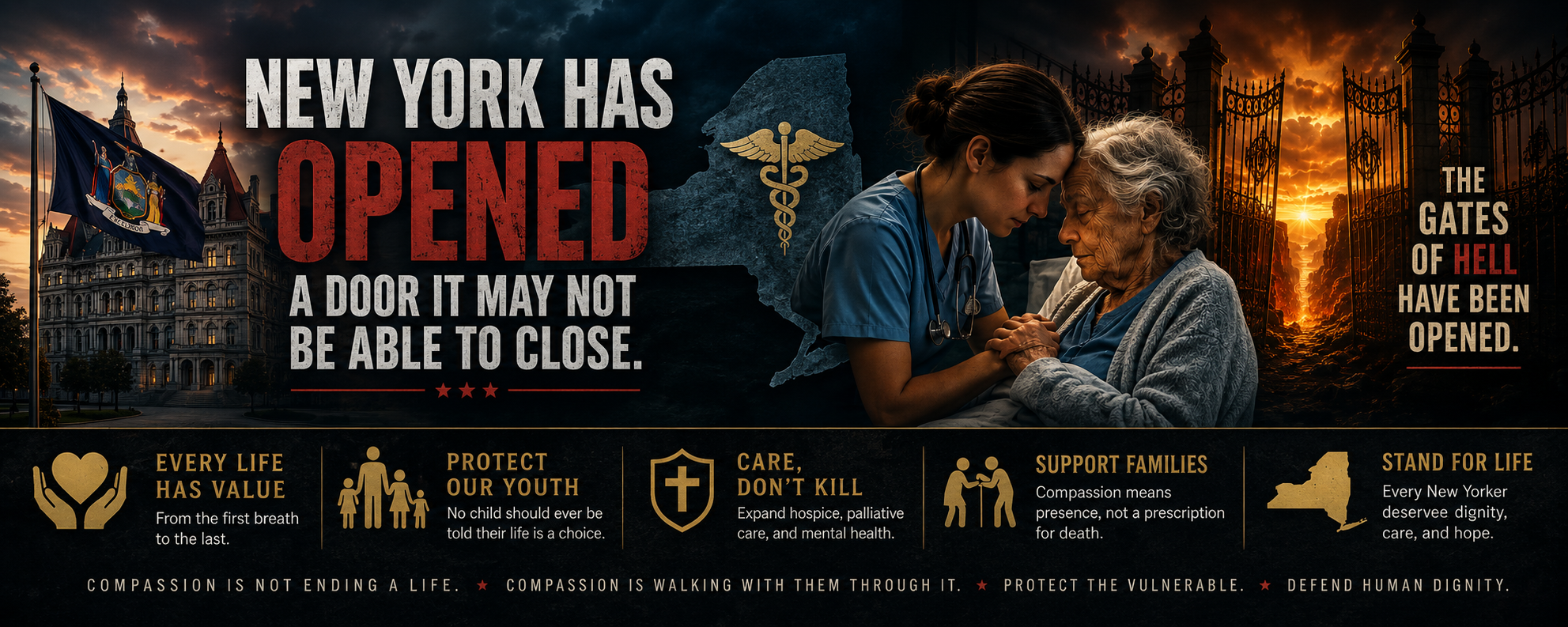
New York Has Opened a Door It May Not Be Able to Close
New York's Medical Aid in Dying law represents something far larger than another disagreement over healthcare policy. It represents a fundamental change in the relationship between medicine, government, suffering, and human life. For generations, when a person reached the darkest moments of illness, our responsibility was clear: relieve their suffering, surround them with care, protect their dignity, and remind them that their life retained value even when their body was failing. With this law, New York has crossed a line. The state has accepted the principle that under certain circumstances death itself can become an officially sanctioned response to human suffering. I cannot accept that principle, and no person, Especially people who call themselves Dr. ever should.
Supporters call it medical aid in dying. Elsewhere, similar systems are commonly discussed under terms such as MAID—Medical Assistance in Dying. The terminology is deliberately clinical, but clinical terminology does not resolve the underlying moral question. We are still talking about a system in which medical professionals provide the means by which a person's life is intentionally ended. Whatever terminology we choose, that deserves extraordinary scrutiny.
There are heartbreaking cases at the center of this debate. Anyone who has watched someone suffer from terminal illness understands why the argument for assisted death can be emotionally powerful. People fear unbearable pain. They fear losing control of their bodies. They fear becoming dependent on their families. They fear spending their final months attached to machines or confined to hospitals. Those fears are real.
But our answer to those fears should be better medicine, better hospice care, better palliative care, better pain management, stronger families, stronger communities, and a healthcare system capable of standing beside people when life becomes extraordinarily difficult. Compassion should mean that we refuse to abandon someone in suffering—not that we make death part of the treatment plan.
The question also extends far beyond the adults immediately covered by today's law. One of my greatest concerns is what happens to the boundaries tomorrow.
New York may establish eligibility requirements, waiting periods, physician reviews, documentation requirements, and other safeguards. Those protections matter. But legislation does not exist in a vacuum, and laws do not necessarily remain frozen in the form in which they were originally enacted. Once society accepts the underlying principle that intentional death can constitute legitimate medical care, future political battles inevitably concern who qualifies, under what circumstances, and whether existing restrictions are too narrow. That is where the experience of other jurisdictions deserves serious examination.
Canada's MAID system, for example, began with substantially narrower eligibility than exists today. Subsequent legislation expanded eligibility beyond circumstances in which natural death was reasonably foreseeable, while the question of eligibility where mental illness is the sole underlying medical condition has generated years of political and medical controversy. Whatever position someone ultimately takes on Canada's system, its evolution demonstrates why concerns about future expansion cannot simply be dismissed as irrational speculation.
And one boundary deserves particularly fierce protection: children and adolescents. Young people cannot become another frontier in this debate. Adolescence can involve extraordinary emotional volatility. A teenager experiencing despair may genuinely believe that circumstances will never improve. Yet circumstances change. People mature. Treatment changes. Families reconcile. Opportunities appear. Lives that seemed hopeless at sixteen can look entirely different at twenty-six. Our responsibility toward a young person experiencing despair must therefore remain unequivocal: your life is worth protecting. There can never be ambiguity about that message.
If assisted death becomes normalized as healthcare for adults, New Yorkers must remain vigilant against any future attempt to extend that philosophy to minors or to weaken protections surrounding young people experiencing psychological or emotional crises. Children deserve stronger safeguards than adults, not weaker ones. Their vulnerability demands an exceptionally high barrier against any system that could allow temporary despair, external pressure, family circumstances, financial considerations, institutional incentives, or an evolving diagnosis to become entangled with an irreversible decision.
The same vigilance is necessary for elderly people, disabled people, economically disadvantaged New Yorkers, and anyone who believes themselves to be a burden. Consider the psychological difference between living in a society where medically assisted death is unavailable and living in one where it is presented as an available option. A seriously ill person may begin asking questions that should disturb every one of us:
How much is my treatment costing my family? How much longer can they afford to care for me? Am I destroying my children's lives? Would everyone be better off if I were gone?
A choice does not occur in isolation simply because the law calls it voluntary. Human beings make decisions inside families, hospitals, insurance systems, economic realities, and cultures. That makes protecting genuine voluntariness extraordinarily important. We should also be willing to confront the contradiction in the message government sends about suicide.
We spend enormous resources telling people contemplating suicide that their darkest moment does not determine the value of the rest of their life. We encourage them to seek help. We tell families to recognize warning signs. We train professionals to intervene. We rightly insist that despair deserves treatment and human presence.
That commitment to preserving life should remain foundational even as we confront the uniquely difficult realities of terminal disease. There is also something deeper happening here than legislation.
The gates of hell have been opened.
I do not use those words casually. I use them because I believe New York has crossed a moral threshold whose consequences may reach much further than today's statute. Once government accepts the proposition that deliberately ending a human life can be incorporated into medicine as an act of compassion, the argument changes forever. The next debate is no longer about whether the principle should exist. It becomes a debate about where its boundaries should be drawn. That distinction matters enormously.
The measure of a compassionate society cannot simply be how many choices it provides. Sometimes civilization is defined by the boundaries it refuses to cross. We prohibit certain actions precisely because human beings can become vulnerable, desperate, frightened, dependent, or susceptible to pressure.
Medicine occupies a uniquely important place within that social contract. When I enter a hospital, I want to know that everyone in that building is fundamentally oriented toward preserving my life, relieving my suffering, and protecting my dignity. I want the frightened elderly patient to know the same thing. I want the disabled New Yorker to know it. I want the impoverished patient who cannot afford months of specialized care to know it.
And above all, I want every young person to know it. Your worth cannot be calculated by the cost of keeping you alive. Your dignity cannot be measured by your productivity. Your value does not disappear when you become dependent upon someone else. A terminal diagnosis does not make someone less human. Disability does not make someone less human. Age does not make someone less human. Suffering does not make someone less human. Our answer should be to build a healthcare system capable of proving those principles through its actions.
Invest in hospice. Expand palliative medicine. Improve pain management. Support family caregivers. Expand home care. Fight loneliness among the elderly. Improve access to mental healthcare. Make sure people facing catastrophic diagnoses have advocates standing beside them. Give physicians every possible resource to alleviate suffering without intentionally ending the patient's life. That is the kind of progress New York should pursue.
There will be people who sincerely disagree with me. Some have watched parents, spouses, or friends endure terrible deaths and have concluded that nobody should be forced through the same experience. Their experiences deserve respect. This issue is too consequential to reduce everyone on the opposite side to villains. But compassion cannot eliminate the obligation to examine where a principle leads.
Today the argument concerns terminally ill adults meeting specific statutory requirements. Tomorrow's political arguments may concern those requirements themselves. New Yorkers should therefore watch every proposed expansion, every regulatory change, every interpretation of eligibility, and especially every discussion involving psychiatric illness, disability, diminished capacity, or minors.
Because some doors are much easier to open than to close. New York has opened one. I believe it was a profound mistake. The proper response to suffering is not to convince people that death can become healthcare. It is to build families, communities, hospitals, hospices, and institutions strong enough to walk beside someone through suffering without surrendering their inherent worth.
Protect the elderly. Protect the disabled. Protect the sick. Protect the poor. Protect our children. And whatever political battles come after this one, never allow convenience, economics, despair, or shifting definitions of compassion to determine which human lives remain worth protecting. Every New Yorker's life has value. Our laws should say so.
A Note on Suicide Prevention
If you or someone you know is struggling with thoughts of suicide, self-harm, or an immediate emotional crisis, please seek help. You do not have to face a moment of crisis alone.
In the United States, call or text the 988 Suicide & Crisis Lifeline to connect with trained crisis counselors. If there is an immediate danger to life, contact emergency services or go to the nearest emergency department.
A moment of despair does not have to become a permanent decision. Reach out to someone you trust, a family member, friend, counselor, physician, faith leader, or other person who can stay with you and help you find appropriate support.
Your life has value. Help is available.