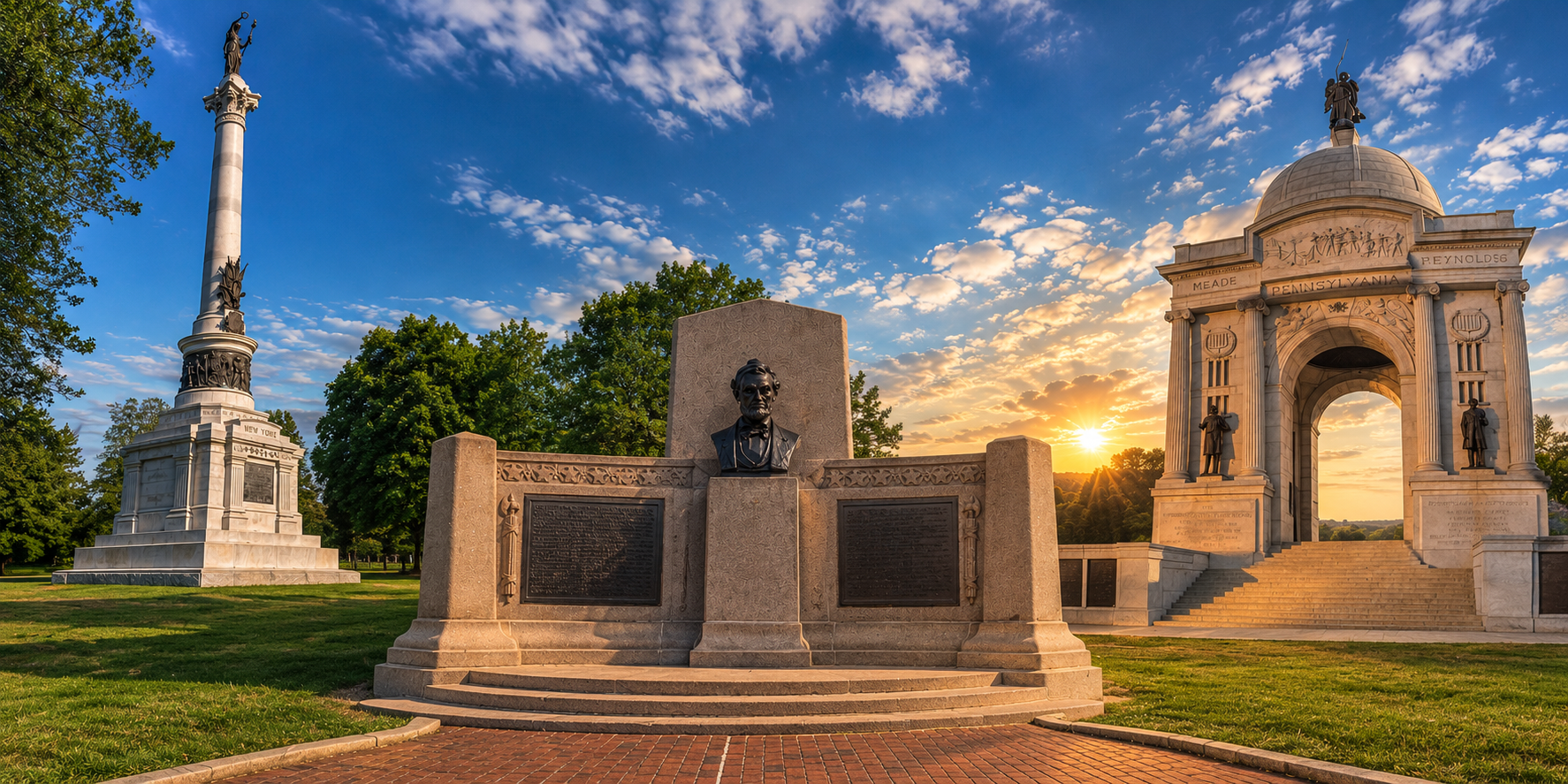
Stand among the monuments at Gettysburg and it becomes difficult to understand the Civil War as merely a conflict between two distant sections of the country. The names carved into the stone tell a different story. New York is everywhere: on the regimental monuments, in the casualty lists, in the names of officers and soldiers, and in the enormous contribution the state made to the Union war effort. The photographs accompanying this article capture several of those monuments, including the great New York monument at Gettysburg, reminders that the Empire State did not simply observe the Civil War from afar. New York was one of the principal forces that made Union victory possible.
When the Civil War began in April 1861, New York was the largest and most economically powerful state in the Union. Its population, ports, railroads, canals, factories, banks, farms, and commercial networks gave the federal government access to resources that were indispensable in a modern industrial war. New York City was the nation's commercial center, while communities throughout the Hudson Valley, the Mohawk Valley, Western New York, the Southern Tier, and the North Country were connected to an increasingly integrated economy. The Erie Canal tied the interior to the Atlantic, railroads moved men and material, and factories produced uniforms, weapons, equipment, food, and other supplies. The state's enormous resources allowed New York to absorb the economic shock of mobilization while continuing to function as a center of commerce and manufacturing. The New York State Military Museum describes the state's wartime resources as extraordinary and notes that its prosperity continued despite the immense drain of men, money, and material caused by the war. But the most important contribution New York made was measured in people.
New York sent more men into federal service than any other state. A postwar federal accounting credited New York with 467,047 troops, a figure that included soldiers, sailors and Marines, regular Army personnel, and men who paid commutation. When additional categories are considered, the state's contribution becomes even larger. More than sixteen percent of all men credited to the Union war effort came from New York under the federal accounting cited by the state's military history. Those numbers can become abstract. The monuments at Gettysburg make them human again.
At Gettysburg, New York organizations were present in extraordinary numbers. Eighty-seven New York regiments and batteries participated in the battle, representing roughly one-third of the Union force's regimental and battery organizations engaged there. New York officers commanded six of the Union Army's nineteen infantry divisions and twenty-one of its seventy brigades. Of the 23,049 Union casualties at Gettysburg, New York suffered 6,784.
That is why the New York monument at Gettysburg deserves more than a passing glance. It is not simply a piece of nineteenth-century memorial architecture. It represents an entire state that sent sons, husbands, fathers, brothers, workers, farmers, immigrants, professionals, and students into a war whose outcome would determine whether the United States remained a single nation.
The Civil War also revealed that New York itself was far from politically uniform. The state was overwhelmingly part of the Union cause, but its population contained fierce political divisions. Democrats, Republicans, abolitionists, conservatives, immigrants, businessmen, laborers, and radical reformers frequently disagreed about the war, emancipation, presidential power, conscription, and the future of the country. New York City in particular contained powerful Democratic and antiwar currents. The state's support for the Union therefore should not be confused with political unanimity. The war tested New York internally as much as it tested the nation.
The most dramatic example came in July 1863, when New York City erupted in the Draft Riots. Anger over federal conscription, economic competition, racial tensions, class resentment, and opposition to the war combined into several days of extraordinary violence. Black New Yorkers were attacked, businesses and buildings were destroyed, and the city descended into chaos before federal troops restored order. The riots remain one of the darkest episodes in New York's Civil War history because they demonstrate that even the Union's most powerful state contained people willing to resist the national war effort violently. Yet New York's story cannot be reduced to the Draft Riots any more than it can be reduced to the state's enormous military contribution.
New Yorkers participated in the Underground Railroad and the abolitionist movement long before the war. Frederick Douglass made Rochester one of the most important centers of abolitionist thought in the country. Harriet Tubman operated through networks connected to New York, and Black New Yorkers themselves fought for their communities, supported the Union cause, and eventually served in the United States Colored Troops. New York's relationship with slavery was complicated: slavery had existed in colonial New York, and the state did not completely abolish it until 1827, decades before the Civil War. By 1861, however, New York had become an important center of antislavery activism even as racial prejudice remained deeply embedded in society.
This contradiction is essential to understanding the period. The Civil War was simultaneously a war for Union, a war that destroyed slavery, and a political crisis that exposed the enormous distance between American ideals and American reality. New York embodied all three dimensions.
The state's contribution also extended far beyond the battlefield. New York's financial institutions helped sustain the Union economy. Its ports connected the United States to international commerce. Its factories supplied the war effort. Its agricultural regions fed soldiers and civilians. Its transportation infrastructure moved armies toward the front. Its newspapers shaped public opinion. Its churches, civic organizations, charitable societies, and families supported soldiers and hospitals. The war reached virtually every community in the state. And the soldiers did not come only from New York City.
They came from Rome, Utica, Syracuse, Albany, Rochester, Buffalo, Elmira, Binghamton, Troy, Kingston, Watertown, Oswego, the Adirondacks, the Hudson Valley, and hundreds of smaller communities. The New York State Archives preserves extensive military records documenting the men who entered federal service, including enlistment information, residence, rank, regiment, occupation, promotions, discharge, and, in many cases, details of their deaths and battlefield service. The state legislature itself recognized the importance of preserving these individual histories, directing the collection of an authentic record of New Yorkers who volunteered for federal service beginning in April 1861. That record matters because the Civil War was not fought by statistics. It was fought by individuals.
A regiment could be raised in a matter of weeks, trained imperfectly, transported hundreds of miles south, and thrown into combat against men doing precisely the same thing for the Confederacy. Some New York units would become famous. Others would disappear into the enormous casualty lists of the war. Some men would return home with physical wounds. Others would return carrying memories that could never be explained to people who had remained behind. Thousands would never return.
The monuments at Gettysburg were erected decades after those battles, when the survivors were old men and the country had already begun the difficult process of turning a living catastrophe into history. That distance can make the stone appear permanent and the war appear remote. It was neither to the people who lived through it.
The New York monument stands as a particularly powerful reminder of that transformation. Its very existence reflects the nineteenth-century American desire to preserve memory in stone. The names and symbols carved into these monuments were intended to tell future generations that the men represented there had not been forgotten. They also reveal something about how Americans of the postwar generation understood the conflict: as a defining national ordeal whose meaning could not be separated from sacrifice.
The Pennsylvania monument visible in the accompanying photographs tells the same story from another perspective. Pennsylvania and New York were the two great northern states surrounding the Gettysburg battlefield, and their contributions were enormous. The Confederate invasion of Pennsylvania in 1863 brought the war directly into the North, but the resulting battle became a Union victory in large part because soldiers from states such as New York, Pennsylvania, Massachusetts, Ohio, Michigan, and many others held their positions against Lee's army.
Gettysburg therefore belongs to Pennsylvania geographically, but it belongs to the entire Union historically. And New York's presence there is impossible to miss.
The Civil War also changed New York permanently. The state emerged from the conflict with an even greater sense of its importance to the national economy and political system. The war accelerated industrialization, expanded transportation networks, increased the importance of centralized government, and transformed the relationship between the federal government and individual states. New York's economic strength helped sustain the Union, while the Union's victory helped create the conditions for the extraordinary industrial expansion that would follow during the remainder of the nineteenth century.
The state's wartime experience also created a vast veterans' culture. Soldiers returned home and organized themselves into veterans' associations. Communities erected monuments. Cemeteries became places of public memory. Regimental histories were written. Names were recorded. Battlefields became sacred landscapes. The monuments at Gettysburg are part of that larger national project of remembrance. But there is another lesson in the stones.
New York's contribution demonstrates that the preservation of the Union was not accomplished by Washington alone. It was accomplished by states, communities, families, factories, farms, railroads, financiers, workers, immigrants, volunteers, and soldiers acting within a national framework. The federal government could call an army into existence, but it required the resources of the states to actually put that army into the field. New York supplied those resources on a scale unmatched by any other state.
The Empire State therefore occupies a unique place in the history of the Civil War. It was a financial center, an industrial powerhouse, a transportation hub, an immigrant gateway, an abolitionist stronghold, a center of political opposition, and the source of more Union manpower than any other state. It was capable of extraordinary patriotism and extraordinary internal conflict at the same time. That complexity is precisely what makes its history worth remembering.
When we look at the New York monument at Gettysburg today, we should not see only marble and bronze. We should see the enormous chain of decisions that connected a farm in upstate New York to a battlefield in Pennsylvania. A young man left his home. A community raised money for his equipment. A train carried him south. A regiment marched toward Gettysburg. An officer gave an order. Artillery opened fire. Men from New York climbed a hill, crossed a field, defended a position, or charged into a line of Confederate soldiers. Some survived. Some did not. Decades later, their state placed their memory in stone. That is the deeper meaning of these monuments.
The Civil War is often presented as a story of presidents, generals, famous battles, and political speeches. Those things matter. But beneath them was a much larger story: ordinary Americans being forced to decide what the Union meant to them and what they were willing to sacrifice to preserve it.
New York answered that question with hundreds of thousands of men, enormous quantities of money and material, and thousands of lives. The Empire State did not merely watch the Civil War.
New York helped fight it, finance it, supply it, survive it, and ultimately win it. And at Gettysburg, surrounded by the monuments of the men who came from across the country, the stones still make that history visible.