On August 30, 2026, another chapter in the history of American space astronomy began at Launch Complex 39A at NASA’s Kennedy Space Center. At 7:26 a.m. Eastern Daylight Time, a SpaceX Falcon Heavy lifted away from the Florida coast carrying NASA’s Nancy Grace Roman Space Telescope, an observatory built not simply to look deeper into the universe, but to look across far more of it at once. Thirty-two minutes later, at approximately 7:58 a.m., Roman separated from the Falcon Heavy’s upper stage and began flying independently. Communications had already been established with the spacecraft, and Roman started its roughly million-mile journey toward an orbit around the second Sun-Earth Lagrange point, L2, where it will undergo commissioning before beginning its scientific mission.
That successful departure from Earth marked the transition of Roman from an engineering project into an operating spacecraft. For years, the observatory existed as mirrors, detectors, structural assemblies, software, thermal systems, electronics, clean-room hardware and an enormous amount of scientific planning. Now it is in space, carrying a 2.4-meter primary mirror toward a location roughly one million miles from Earth and preparing to address several of the most difficult questions in modern astrophysics. Roman will investigate the expansion of the universe, trace the distribution of dark matter, search for planets across the Milky Way, study the development of galaxies and demonstrate technologies that could eventually help astronomers directly image worlds resembling our own. NASA describes the mission as a wide-field infrared observatory capable of examining enormous portions of the sky with a combination of sensitivity, resolution and survey speed that has never before been available from a space telescope.
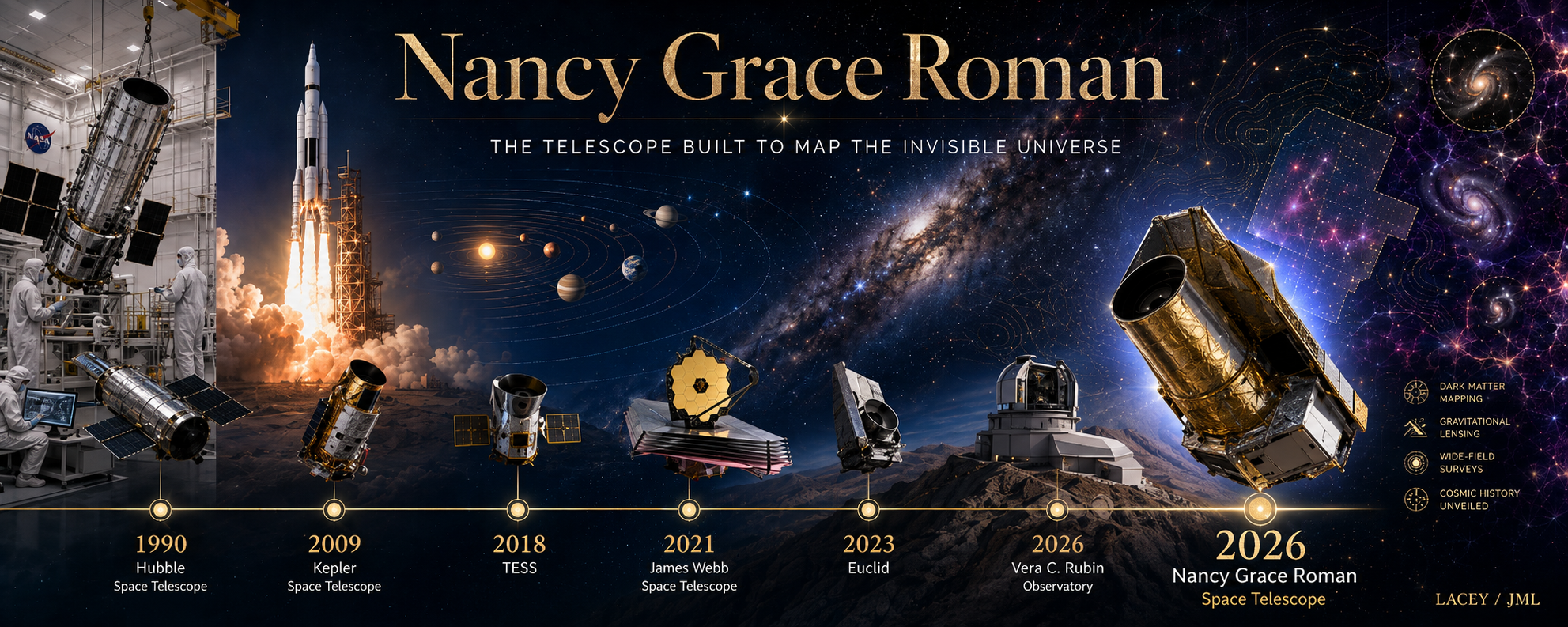
The significance of Roman is easiest to understand when it is placed alongside the telescopes that came before it. Hubble changed astronomy by giving scientists an extraordinarily sharp view from above Earth’s atmosphere. Kepler demonstrated that planets are not rare exceptions but a basic feature of our galaxy. TESS expanded the search for planets around comparatively nearby stars. James Webb opened a much deeper infrared window into cosmic history. The European Space Agency’s Euclid mission began systematically mapping the dark universe, while the Vera C. Rubin Observatory has now started a ten-year survey designed to repeatedly photograph much of the southern sky. Roman enters this expanding network of observatories with a capability that is unusually well suited to the next stage of astronomy. Rather than concentrating solely on individual targets, Roman has been designed to apply the precision of a flagship space telescope to immense populations of galaxies, stars and planetary systems.
That difference matters because many of the remaining questions in astrophysics cannot be answered by examining only a handful of remarkable objects. Scientists increasingly need statistics on an enormous scale. They need hundreds of millions of galaxies rather than hundreds, millions of stars rather than thousands and repeated observations of large regions of the sky rather than isolated snapshots. Roman was designed for precisely that form of astronomy.
A Hubble-Sized Mirror With a Much Wider View
Roman’s primary mirror measures 2.4 meters, or 7.9 feet, across, exactly the same diameter as the primary mirror aboard the Hubble Space Telescope. The similarity is striking, but it does not mean Roman is simply a newer version of Hubble. The two observatories were designed around fundamentally different observing strategies.
Hubble, launched in 1990, became one of the most important scientific instruments ever constructed because it could examine relatively small regions of the sky at exceptionally high resolution from above the distorting effects of Earth’s atmosphere. Its instruments span ultraviolet, visible and near-infrared wavelengths, giving Hubble capabilities that Roman does not attempt to duplicate. Hubble has spent more than three decades producing detailed observations of planets, stars, nebulae, galaxies, black holes and the distant universe. It excels when astronomers know where they want to look and need a precise examination of that target.
Roman is built to take much of that kind of image quality and spread it across a dramatically larger area. Its 300-megapixel Wide Field Instrument uses an array of 18 detectors, producing a field of view roughly 100 times larger than comparable Hubble observations while retaining similar sensitivity and resolution. NASA estimates that Roman will be capable of surveying the sky as much as 1,000 times faster than Hubble for comparable wide-field work. A single Roman exposure can therefore contain approximately the same amount of detail that would require roughly 100 Hubble images to cover the same region.
That difference changes the scale of the questions astronomers can ask. Hubble might observe an individual galaxy in extraordinary detail. Roman can study enormous populations of galaxies with sufficient resolution to measure their shapes, distributions, distances and changes over cosmic time. Hubble can identify and characterize individual gravitational lenses. Roman can search for those effects across huge areas of sky and turn them into statistical maps. It is not a question of one telescope replacing another. Roman and Hubble perform different functions, and their scientific value increases when their observations are combined.
The comparison is similar to using two exceptional cameras with different lenses. Hubble is capable of concentrating tremendous observational power on a relatively restricted field. Roman is designed to preserve much of that sharpness while dramatically widening the frame. It is the difference between examining a single section of a landscape and creating a detailed survey of the entire horizon.
James Webb Goes Deeper, Roman Goes Wider
The James Webb Space Telescope provides an even more useful contrast. Webb, launched in December 2021, carries a 6.5-meter segmented primary mirror, substantially larger than the 2.4-meter mirrors aboard Hubble and Roman. Its greater light-collecting area, cryogenic design and powerful infrared instruments allow it to detect extremely faint and highly redshifted objects. Webb can examine galaxies from the early universe, see through clouds of dust where stars and planets are forming and use spectroscopy to investigate the chemical composition of planetary atmospheres and distant astronomical objects.
Roman is not intended to outperform Webb at Webb’s particular job. Webb can look deeper into the infrared universe and study individual faint objects with extraordinary sensitivity. Roman trades some of that depth for a vastly greater field of view and much faster survey capability. NASA characterizes the relationship in terms of complementary strengths, with Webb providing highly detailed examinations and Roman supplying the large-scale context in which those objects exist. Roman can discover unusual targets among enormous populations, after which Webb can concentrate its more powerful infrared instruments on objects that warrant closer study.
That relationship may prove extremely productive. Roman could identify rare galaxies, unusual supernovae, gravitationally lensed systems, distant star-forming regions or previously unknown classes of astronomical objects simply because it will examine so much sky. Webb can then obtain detailed spectra or deeper infrared observations of selected targets. Hubble may contribute observations at wavelengths Roman and Webb cannot cover as effectively. Instead of viewing modern observatories as competitors, it is more accurate to think of them as components of an increasingly sophisticated astronomical system.
Roman will provide the reconnaissance. Webb can perform the detailed inspection.
Mapping a Universe We Cannot See
Roman’s wide-field capability is particularly important because one of its central scientific missions involves substances that no conventional telescope can photograph directly. Approximately 95 percent of the universe appears to consist of dark matter and dark energy, while ordinary matter, the atoms that make up planets, stars, gas clouds, spacecraft and human beings, accounts for only a small fraction of the cosmic total. Scientists have accumulated powerful evidence for both dark matter and dark energy, yet the fundamental nature of either remains unknown.
Dark matter reveals itself primarily through gravity. Galaxies and galaxy clusters move and behave as though substantially more mass exists than astronomers can account for by adding together the visible stars, gas and dust. Dark matter appears to provide much of that missing gravitational structure, forming an invisible framework around which ordinary matter and galaxies have assembled.
Roman will help map that framework through gravitational lensing. According to general relativity, mass curves spacetime, and light traveling through curved spacetime follows a correspondingly altered path. Massive objects can therefore act as gravitational lenses, bending and distorting light from galaxies behind them. In the most dramatic cases, known as strong gravitational lensing, distant galaxies can appear stretched into enormous arcs, rings or multiple images. Weak gravitational lensing is considerably subtler. A foreground concentration of matter may alter the shape of a background galaxy only slightly, to the point where the effect cannot be reliably identified from a single object.
The solution is scale. When astronomers precisely measure the apparent shapes of enormous numbers of galaxies, slight distortions begin to form statistically detectable patterns. Those patterns reveal the gravitational influence of matter between the galaxies and the telescope, including matter that emits no detectable light. Roman’s ability to examine vast regions with stable, high-resolution imaging will allow scientists to reconstruct portions of this otherwise invisible cosmic structure. NASA expects Roman’s wide surveys to provide some of the most extensive maps yet of how dark matter is distributed.
Dark energy poses an even more fundamental problem. Observations beginning in the 1990s showed that the expansion of the universe is accelerating, despite the gravitational attraction of matter that might otherwise have been expected to slow that expansion. The name dark energy describes whatever is responsible for that behavior, but scientists do not yet know whether it is a fundamental property of space, a previously unknown field, evidence of changing physics or an indication that our understanding of gravity is incomplete.
Roman will approach the problem through multiple cosmological measurements rather than relying on a single type of observation. Its surveys will examine galaxy clustering, weak gravitational lensing and enormous populations of distant supernovae, allowing researchers to compare how cosmic structure grew with how rapidly space expanded at different periods in the history of the universe. Roman’s High-Latitude Wide-Area Survey alone is planned to cover more than 5,000 square degrees, approximately 12 percent of the entire sky, and reveal hundreds of millions of galaxies.
The scientific value lies not merely in increasing the number of known galaxies, but in determining whether different methods for measuring the universe continue to agree as precision improves. If they do, the standard cosmological model becomes stronger. If they do not, the disagreement may be evidence of new physics.
Euclid and Roman Will Attack the Same Mystery Differently
Roman will not conduct this investigation alone. The European Space Agency’s Euclid observatory, launched in July 2023, is already carrying out a major survey of the dark universe from the L2 region. Euclid began its nominal science survey in February 2024 and is designed to examine billions of galaxies across billions of years of cosmic history, using both weak gravitational lensing and galaxy clustering to investigate dark matter, dark energy and the large-scale geometry of the universe.
Euclid is designed to survey approximately 15,000 square degrees, nearly one-third of the sky, giving it extraordinary breadth. Roman’s major cosmological survey will cover less total area, but Roman’s larger mirror and high-resolution infrared capabilities will allow it to examine its regions with greater depth and detail. The two missions therefore approach many of the same scientific problems from different directions. Euclid provides a vast map. Roman provides a more detailed view of selected portions of that cosmic landscape.
The overlap is scientifically valuable because cosmology increasingly depends on controlling extremely small measurement errors. Weak gravitational lensing, for example, requires astronomers to distinguish tiny distortions caused by gravity from distortions introduced by instruments, image processing or imperfect estimates of galaxy distances. Comparing independent observations from Euclid, Roman, Rubin and other observatories gives scientists additional ways to identify systematic errors and determine whether an apparent discovery represents new physics or a problem in the measurement itself.
The result is likely to be one of the most comprehensive investigations of cosmic structure ever attempted.
Rubin Adds Time to the Map
The Vera C. Rubin Observatory brings another dimension to the same scientific era. Unlike Roman, Webb, Hubble and Euclid, Rubin is not a spacecraft. It sits on Cerro Pachón in Chile, where its enormous camera and wide-field telescope began the ten-year Legacy Survey of Space and Time in late June 2026. Rubin’s Wide-Fast-Deep program is designed to repeatedly cover approximately 18,000 square degrees of the southern sky, obtaining new exposures of surveyed regions on a cadence of roughly every few days.
That repeated coverage effectively adds time to astronomy’s maps. Traditional astronomical images can make the universe appear static, but the real sky is constantly changing. Supernovae explode. Asteroids move. Stars vary in brightness. Black holes accrete matter. Distant galaxies flare. Objects travel across the solar system, while transient events can appear and disappear before conventional telescopes ever turn toward them.
Rubin is designed to capture those changes over an enormous portion of the sky. Roman, observing from space and at infrared wavelengths, can add another layer of information. The combination of Rubin’s repeated optical observations with Roman’s stable, high-resolution infrared measurements will allow astronomers to study many objects across different wavelengths and distinguish phenomena that either observatory alone might characterize less completely.
Within a period of only a few years, astronomy has therefore gained Webb, Euclid, Rubin and now Roman, while Hubble continues operating after more than three decades. Each instrument occupies a different scientific niche, but together they provide an increasingly complete view of the universe.
From Kepler and TESS to Roman’s Planetary Census
Roman’s scientific mission extends well beyond cosmology. It will also become one of the most important planet-hunting observatories ever launched.
NASA’s Kepler Space Telescope, launched in 2009, fundamentally changed humanity’s understanding of planetary systems. Kepler monitored the brightness of large numbers of stars and searched for the slight, periodic dimming produced when planets crossed in front of their host stars. During Kepler and the later K2 mission, the spacecraft discovered thousands of exoplanets and demonstrated that planets are extraordinarily common throughout the Milky Way. The evidence became so extensive that NASA now summarizes Kepler’s legacy with a remarkable conclusion: our galaxy contains more planets than stars.
TESS, the Transiting Exoplanet Survey Satellite launched in 2018, expanded that approach across most of the sky. Whereas Kepler concentrated on relatively restricted star fields, TESS surveys far larger regions with particular emphasis on relatively bright and nearby stars. Many TESS discoveries are therefore especially useful for follow-up observations with other instruments.
Roman will perform a different kind of planetary census. Its Galactic Bulge Time-Domain Survey will repeatedly monitor hundreds of millions of stars toward the crowded center of the Milky Way. This region dramatically increases the probability that unrelated stars will momentarily align from our perspective, producing a phenomenon known as gravitational microlensing.
When a foreground star passes nearly in front of a more distant star, the gravity of the foreground star bends and magnifies the background star’s light. If a planet accompanies the foreground star, its gravity can produce an additional signature in the microlensing event. Unlike transit surveys, which are particularly effective at detecting planets orbiting close to their stars, microlensing can identify planets at substantially greater orbital distances. It can also detect planets with relatively low masses and potentially rogue planets moving through the galaxy without orbiting any star at all. NASA expects Roman to discover more than a thousand planets through microlensing.
The same observations may prove even more productive than the primary microlensing program. Because Roman will repeatedly measure the brightness of hundreds of millions of stars, scientists expect the dataset to reveal roughly 100,000 additional planets through transits. Some of those systems may lie as far as approximately 26,000 light-years from Earth, extending planetary surveys into regions of the Milky Way very different from the comparatively nearby stellar populations emphasized by TESS.
Kepler established that planetary systems are common. TESS has concentrated attention on nearby systems suitable for detailed follow-up. Roman will extend that census across a much larger portion of the galaxy and into types of planetary orbits that transit surveys do not detect efficiently. Together, those missions can begin answering a question more sophisticated than whether planets exist elsewhere: what does the average planetary system in the Milky Way actually look like?
Roman May Also Show Us How to Photograph Other Worlds
Roman carries a second exoplanet instrument whose long-term importance may exceed the immediate scientific results it produces. The Coronagraph Instrument, developed as a technology demonstration, is designed to suppress the overwhelming light of a star so that much fainter planets and circumstellar material can be observed nearby.
Directly imaging a planet beside its star is extraordinarily difficult because the star can be millions or billions of times brighter than the planet. Roman’s coronagraph combines specialized masks, deformable mirrors, high-precision cameras and active wavefront control to suppress starlight with unprecedented precision. NASA designed the system to demonstrate the ability to detect objects approximately 100 million times fainter than their host stars, representing an improvement of roughly 100 to 1,000 times over previous space-based coronagraph capabilities.
Roman is not expected to produce the first photograph of an Earth identical to our own. The larger significance is that it will test technologies required for future observatories capable of attempting exactly that task. NASA’s developing Habitable Worlds Observatory concept is intended eventually to directly image potentially Earth-like planets around Sun-like stars and examine their atmospheres for chemical evidence that could help scientists assess climate, geology, habitability and perhaps even biological activity.
Roman therefore occupies an important position between two generations of planetary astronomy. It will conduct a massive statistical search for planets using gravitational microlensing and transits while simultaneously testing technology that could help future telescopes move beyond indirect detection and begin studying individual Earth-sized worlds as physical places.
A Telescope Appropriately Named
The observatory’s name connects this new generation of astronomy directly to the origins of NASA’s great space telescopes.
Dr. Nancy Grace Roman joined NASA in 1959, only months after the agency itself had been established, and became its first chief of astronomy as well as its first female executive. She helped establish NASA’s program of space-based astronomical observatories at a time when the idea of putting large precision telescopes above Earth’s atmosphere remained technologically difficult, politically uncertain and extraordinarily expensive. She coordinated scientists and engineers, administered research programs, worked with policymakers and played an instrumental role in transforming the concept of a large orbiting telescope into the project that eventually became Hubble. Her contribution became so significant that colleagues referred to her as the “Mother of Hubble.”
There is an appropriate symmetry in the mission that now carries her name. Nancy Grace Roman helped create the institutional and scientific foundation for Hubble. Hubble subsequently helped transform cosmology, including observations associated with the discovery and confirmation that the expansion of the universe is accelerating. NASA notes that when Roman was later asked which Hubble discovery she found most interesting, she identified dark energy. The observatory bearing her name is now traveling into deep space with dark energy among its central scientific targets.
Roman’s legacy was never simply one telescope. She helped establish the premise that major space observatories should be built as broadly useful scientific infrastructure, serving entire generations of researchers. The Nancy Grace Roman Space Telescope follows that same philosophy. Its data are intended to support investigations extending far beyond the mission’s principal cosmology and exoplanet surveys, allowing researchers to explore questions that may not yet have been conceived.
The Telescope Built for Scale
That may ultimately become Roman’s most important characteristic. Astronomy has repeatedly demonstrated that when scientists increase the scale of observation, entirely new phenomena emerge. Hubble’s deep fields revealed thousands of galaxies in patches of sky that had appeared nearly empty. Kepler showed that planetary systems were common once enough stars were monitored continuously. Rubin is beginning to reveal what happens when much of the visible sky is photographed repeatedly. Roman will apply similar logic to high-resolution space astronomy.
Rare objects become populations when enough sky is examined. Weak gravitational signals become measurable when enough galaxies are observed. Short-lived events become discoverable when large regions are revisited. Planetary demographics become meaningful when observations extend across different parts of the galaxy and different orbital configurations. Unexpected objects that might never justify a targeted telescope proposal can be discovered simply because Roman happened to include them in an enormous survey.
The observatory is therefore not merely a camera pointed toward predetermined destinations. It is a machine for creating datasets from which discoveries can continue emerging long after the original photons were collected.
Roman’s launch on August 30 marked the beginning of that process, not its completion. The spacecraft must travel approximately one million miles to the L2 region and complete an approximately three-month commissioning period involving deployments, instrument activation, calibration and testing before normal science observations can begin. The engineering challenge has shifted from constructing and launching the observatory to demonstrating that every major system can perform with the stability and precision demanded by the science.
If Roman performs as designed, however, the result will be an observatory unlike anything astronomers have previously possessed. Hubble demonstrated the transformative value of placing an exceptionally sharp telescope above Earth’s atmosphere. Kepler demonstrated the scientific power of observing enormous stellar populations continuously. Webb pushed infrared astronomy deeper into cosmic history than previous observatories could reach. Euclid is building an enormous map of the dark universe, and Rubin has begun recording the southern sky as a changing, evolving system rather than a static collection of objects.
Roman now joins that lineage with a 2.4-meter mirror, Hubble-class resolving power and a field of view built for astronomical surveys on an unprecedented scale. It will use visible galaxies to trace invisible matter, cosmic structure to test dark energy, crowded star fields to reveal distant planetary systems and advanced optics to demonstrate how future telescopes may one day photograph worlds around neighboring stars.
The telescope has already completed the first and most visibly dramatic part of that journey. It has left the clean room, left Kennedy Space Center, survived launch, separated from its rocket and begun flying independently into deep space. What remains is the reason it was built in the first place: to turn an enormous field of view toward a universe in which most of the mass and energy cannot be seen directly, and to use the things that shine to reconstruct the hidden structure behind them.
The Nancy Grace Roman Space Telescope was not built merely to produce another collection of extraordinary images. It was built to measure the universe at a scale large enough to expose patterns that individual observations cannot reveal. In doing so, Roman may help answer some of the oldest questions in astronomy while confronting some of the newest questions in physics.
The telescope built to map the invisible universe is no longer waiting on Earth. It is already on its way.