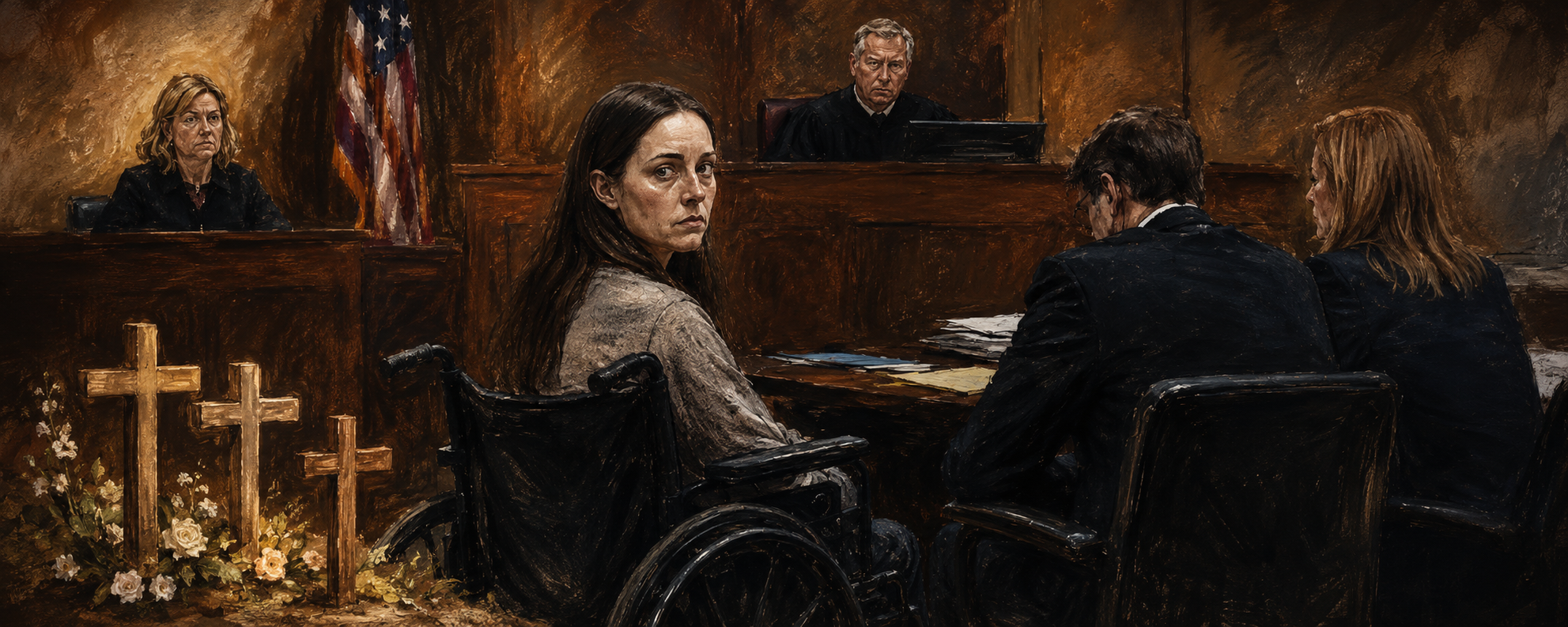
The Lindsay Clancy case has become one of those rare criminal proceedings in which the public conversation surrounding the defendant threatens to overwhelm the conduct that brought the case into existence in the first place. There is no serious dispute that Clancy was suffering from significant psychiatric problems before January 24, 2023, and there are legitimate questions about the quality of the treatment she received, the medications she was prescribed, the manner in which her symptoms were evaluated, and whether the medical system adequately recognized the severity of what was happening to her. Those questions should be investigated, and they should be investigated aggressively, because postpartum depression, postpartum psychosis, and other severe psychiatric conditions associated with childbirth are real, dangerous, and too often poorly understood. Women suffering from those conditions deserve competent physicians, accessible psychiatric care, meaningful follow-up, and a medical system capable of recognizing when an ordinary mental-health problem has crossed into an emergency. None of that, however, requires the public to abandon the equally important principle that people who retain the legal capacity to understand and control their actions should be held responsible when those actions destroy the lives of others. I believe Lindsay Clancy should be convicted, and I do not believe that position is inconsistent with supporting better mental-health care.
The central problem with much of the public advocacy surrounding this case is that compassion and accountability have increasingly been treated as though they are competing moral positions. They are not. It is possible to believe that Clancy was seriously mentally ill, that she was failed in important ways by the systems responsible for treating her, that postpartum psychiatric illness deserves greater public attention, and that substantial reforms may be necessary, while also believing that killing three children requires criminal accountability if the evidence establishes that the person who committed those killings retained the ability to understand what she was doing and appreciate its wrongfulness. Those ideas can exist simultaneously, and in a functioning justice system they must exist simultaneously, because mental illness is neither a moral defect nor a blanket exemption from responsibility.
Cora Clancy was five years old. Dawson Clancy was three. Callan Clancy was eight months old. They were killed inside their home on January 24, 2023, and the legal dispute now before the jury is not primarily about who killed them. The issue is whether Lindsay Clancy was criminally responsible for what she did. That is an important legal distinction because Massachusetts law does not treat the mere existence of a psychiatric diagnosis as the equivalent of legal insanity. The question is whether, because of mental disease or defect, a defendant lacked the substantial capacity to appreciate the criminality or wrongfulness of her conduct or lacked the substantial capacity to conform her conduct to the requirements of the law. Once criminal responsibility becomes a legitimate issue in the case, the Commonwealth bears the burden of proving beyond a reasonable doubt that the defendant remained criminally responsible. That is a demanding burden, and it should be, because a civilized legal system must recognize that there are situations in which mental disease can become so profound that ordinary concepts of culpability no longer apply.
What that standard does not mean, however, is that depression, psychosis, medication, hospitalization, intrusive thoughts, emotional deterioration, or a history of seeking psychiatric treatment automatically resolve the question of responsibility. Mental illness can explain conduct without necessarily eliminating agency. A person can be severely depressed and still understand right from wrong. A person can experience psychotic symptoms and still retain substantial control over particular actions. A person can be mentally ill and still plan, conceal, communicate, make decisions, create opportunities, and understand consequences. The existence of illness is therefore only one part of the inquiry. The more difficult question is what that illness actually did to the defendant's capacity at the specific time the crime occurred.
The defense has presented substantial evidence on that point. Expert testimony has described Clancy as suffering from severe psychiatric illness and, according to the defense theory, postpartum psychosis accompanied by delusional thinking and a command hallucination. Her treatment history, her attempts to obtain help, and the deterioration observed by people around her have all been used to support the argument that what occurred was the product of a mind so impaired that ordinary criminal responsibility should not attach. That evidence deserves to be taken seriously. It should not be mocked or dismissed simply because the facts of the crime are horrific. If the insanity defense is to mean anything, juries must be willing to apply it in the rare cases where the evidence genuinely establishes that a person's ability to understand or control her conduct was destroyed by disease.
The prosecution, however, has presented a materially different account of Clancy's mental state, and that account cannot simply be pushed aside because it complicates a sympathetic narrative. Prosecutors have argued that Clancy was severely depressed but remained capable of understanding what she was doing, distinguishing right from wrong, communicating coherently, making decisions, and controlling her behavior. The prosecution has focused on the circumstances preceding the killings, including the manner in which Patrick Clancy was sent out of the house, the communications that occurred while he was away, the phone activity surrounding those errands, and the broader sequence of events that the Commonwealth argues created a period in which Clancy knew she would be alone with the children. None of those facts alone proves criminal responsibility, and planning itself does not prove sanity, because mentally ill people can plan and psychotic people can perform complicated tasks. Taken together, however, those facts are relevant because they can reveal awareness, deliberation, timing, purposeful behavior, and the ability to manipulate circumstances in pursuit of a particular outcome.
That evidence is precisely why I reject the idea that the public should simply accept Clancy as another victim of a failed mental-health system and move immediately toward absolution. There is a profound difference between saying that someone was mentally ill and saying that mental illness legally excused what that person did. The first proposition may be medically obvious. The second must be proven through the legal standard governing criminal responsibility. When three children are dead, that distinction cannot be treated as a technicality.
This is also why I believe the people publicly standing with Lindsay Clancy are wrong. I understand the impulse behind some of that support. Many of the people gathering outside the courthouse are attempting to draw attention to postpartum mental-health conditions, and that cause is legitimate. Mothers suffering from severe postpartum depression and psychosis need better care. Families need better information. Physicians need better diagnostic tools. Hospitals need better procedures for evaluating dangerous symptoms. Insurance systems should not make psychiatric treatment harder to obtain at the exact moment when someone is deteriorating. If this case exposes weaknesses in those systems, then those weaknesses should be addressed. What I cannot accept is the transformation of Lindsay Clancy herself into the symbol around which that advocacy is organized.
There is something deeply wrong about watching a case involving three murdered children become publicly centered upon solidarity with the person who killed them. The conversation increasingly revolves around Clancy's suffering, Clancy's diagnosis, Clancy's treatment, Clancy's medications, Clancy's mental state, Clancy's future, and Clancy's supporters, while the children whose lives ended inside that house risk becoming supporting characters in their own deaths. That imbalance should disturb anyone who believes victims matter.
Cora, Dawson, and Callan cannot stand outside the courthouse. They cannot wear ribbons or hold signs. They cannot give interviews, explain what happened to them, or tell the public how frightened they were. They cannot ask why the adult responsible for protecting them became the person who ended their lives. They cannot participate in the national debate now being built around their deaths. The defendant is alive and therefore capable of becoming the center of a movement. The victims are dead and therefore depend entirely upon everyone else to remember that their lives possessed value independent of the condition of the person who killed them.
That is why I believe the public response has become morally distorted. Advocacy for postpartum mental-health care does not require solidarity with Lindsay Clancy. It requires solidarity with women who need treatment before tragedy occurs. It requires investment in psychiatric services, improved screening, better continuity of care, more aggressive intervention when dangerous symptoms emerge, and better education for spouses and families trying to understand whether a loved one is experiencing a routine postpartum struggle or a potentially catastrophic psychiatric emergency. Those reforms could save lives. They could prevent another family from arriving at the place the Clancy family reached. None of that requires us to pretend accountability is cruelty.
The false choice being presented in this case is that one must either stand with Lindsay Clancy or deny the reality of postpartum mental illness. That is an intellectually weak position and a dangerous one. Millions of people live with serious mental-health conditions without killing anyone. Women experiencing postpartum depression or psychosis should not be stigmatized as inherently violent, and their illnesses should not be reduced to a convenient explanation for every criminal act committed by a person carrying a psychiatric diagnosis. Serious mental-health advocacy should demand that every case be evaluated honestly, individually, and according to evidence.
If a defendant's mental disease truly destroyed the capacity required for criminal responsibility, the law should recognize that. If it did not, the law should recognize that too. There is no contradiction in demanding both.
We should be capable of saying that Lindsay Clancy may have been desperately ill and still asking whether she knew killing her children was wrong. We should be capable of criticizing the care she received while examining whether she deliberately created circumstances that allowed the killings to occur. We should be capable of feeling compassion for a sick human being without allowing that compassion to erase the agency she may have retained. We should be capable of investigating failures within psychiatric medicine while also remembering that Cora, Dawson, and Callan possessed rights of their own, including the most basic right of all, the right to remain alive.
The discussion becomes especially important because children are uniquely vulnerable. They do not choose their homes, their parents, or their circumstances. They cannot remove themselves from dangerous situations. They cannot meaningfully protect themselves from an adult who intends to harm them. They depend almost completely upon the people around them for safety, and that dependence creates a profound moral obligation for society to take crimes against children seriously. When the person accused of killing them is also someone the public finds sympathetic, that obligation becomes even more important, not less.
Compassion should influence how we understand a case. It should influence how we treat mentally ill defendants. It should influence sentencing, treatment, confinement, and public policy where the law allows it. Compassion should not require intellectual dishonesty about what happened. Three children were killed. Their mother killed them. The remaining legal question is whether she was criminally responsible for doing so.
If the jury concludes beyond a reasonable doubt that Lindsay Clancy retained the substantial capacity to understand the wrongfulness of her conduct and to control her actions, then she should be convicted. Her mental illness should remain part of the story because it plainly matters, but it should not erase responsibility where responsibility legally exists. A diagnosis can explain why someone became dangerous without transforming the resulting deaths into an event for which no one can be held accountable.
At the same time, this case should force a serious examination of postpartum psychiatric care. Medical providers should study it. Legislators should study it. Hospitals should study it. Families should study it. The circumstances leading to January 24, 2023, should be examined not because doing so excuses the killings, but because understanding those circumstances may help prevent another family from experiencing the same catastrophe. Better mental-health care and criminal accountability are not enemies. They are two separate obligations owed by a society capable of recognizing both illness and responsibility.
That is where I separate myself from the people standing publicly with Lindsay Clancy. I will stand for better postpartum mental-health treatment. I will stand for women who know something is terribly wrong and cannot get anyone to take them seriously. I will stand for families trying desperately to obtain competent psychiatric care for someone they love. I will stand for reforms that identify dangerous deterioration earlier, improve access to specialists, and prevent psychiatric emergencies from becoming funerals.
But I will not accept the argument that supporting those things requires standing against accountability. If the evidence establishes that Lindsay Clancy remained criminally responsible, she should be convicted. That is not hostility toward mental illness. It is not a rejection of compassion. It is the recognition that compassion cannot become absolution simply because the facts are tragic, the defendant is sympathetic, or the circumstances are medically complicated. We should be capable of caring about Lindsay Clancy's mental health while remembering that this case did not begin with a diagnosis. It began with three dead children.
Their names were Cora, Dawson, and Callan, and whatever broader lessons eventually emerge from this case, their lives should never be reduced to a footnote in the movement built around the woman who ended them.