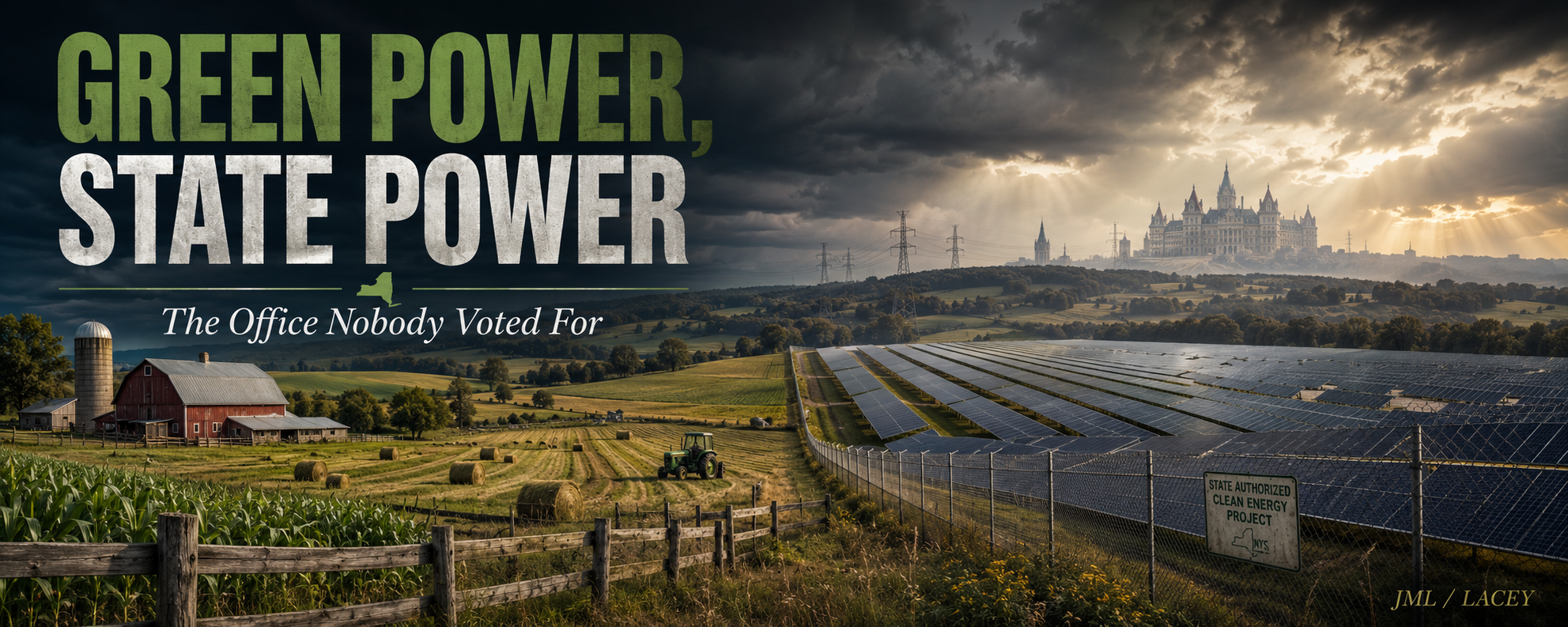
New York's Renewable-Energy Siting System and the Battle Over Upstate Land
Article I: The Office Nobody Voted For
How New York Centralized the Power to Decide Where the State's Renewable-Energy Future Will Be Built
I have followed the expansion of utility-scale solar across upstate New York closely, not as somebody looking at an abstract energy model from hundreds of miles away, but as a New Yorker watching the physical landscape change. In communities that have spent generations defined by farms, forests, open fields and small towns, enormous solar installations have begun appearing behind fences and along rural roads. Fields that once produced corn, hay, dairy feed or other crops are increasingly being considered not according to what can be grown from the soil, but according to how many megawatts can be produced above it. Supporters call this a necessary transformation of New York's energy system. Developers promise lease income, construction work, tax revenue and emissions-free electricity. Opponents see productive agricultural land and rural communities being asked to carry an increasingly large share of a statewide energy policy they did not design. Somewhere between those competing descriptions sits a government office most New Yorkers had probably never heard of until a wind or solar project arrived in their town.
That office is the New York State Office of Renewable Energy Siting and Electric Transmission, better known as ORES. Understanding ORES is necessary before understanding the Fort Edward Solar controversy, because Fort Edward is not merely a story about one developer, one collection of farms or one group of residents objecting to solar panels. It is an example of a much larger change in how New York decides where major energy infrastructure will be built, which laws govern those decisions and how much authority remains with the communities that must physically host the projects.
The title of this article requires an important distinction. New Yorkers did not elect the officials who make individual ORES permitting decisions, but ORES did not simply appear from nowhere or seize power for itself. Its authority was created by statutes enacted by New York's elected Legislature and signed into law by the governor. That distinction matters. The question is not whether ORES possesses legal authority. It does. The more important question is why New York decided that this particular category of development required a centralized state permitting system powerful enough, under defined circumstances, to override substantive local land-use requirements.
The answer begins with New York's climate policy. In 2019, the Legislature enacted the Climate Leadership and Community Protection Act, establishing an aggressive timetable for transforming the state's electrical system, including a statutory objective of a zero-emissions electric system by 2040. The following year, the Legislature enacted the Accelerated Renewable Energy Growth and Community Benefit Act. Among its provisions was Executive Law §94-c, which created the original Office of Renewable Energy Siting and gave it responsibility for conducting coordinated and timely reviews of major renewable-energy facilities. New York's appellate courts have described the purpose plainly: the state wanted renewable generation projects to be sited in a timely and cost-effective manner while still considering environmental, social and economic factors.
In 2024, Albany went further. The Renewable Action Through Project Interconnection and Deployment Act, appropriately abbreviated the RAPID Act, reorganized this system again. Executive Law §94-c was repealed and replaced with Article VIII of the Public Service Law. The office became the Office of Renewable Energy Siting and Electric Transmission, and its responsibilities were expanded to include major electric transmission infrastructure. The Third Department of New York's Appellate Division summarized the result in a May 2026 decision: the law consolidated environmental review, permitting and siting of major renewable-energy and transmission facilities and established ORES as the single forum responsible for their coordinated and timely review. That phrase, single forum, deserves considerably more public attention than it receives.
For generations, land-use disputes in New York have been closely associated with local government. Town boards, planning boards, zoning boards and county agencies traditionally play significant roles in determining what kinds of development are permitted and under what conditions. A person who wants to construct an ordinary commercial development may confront local zoning requirements, setbacks, site-plan review, special-use permits and other municipal restrictions. Large renewable-energy projects operate under a different system. Article VIII consolidates the principal state-level siting authority in ORES. Local governments still participate, their substantive laws are not automatically erased, and municipalities can challenge requested waivers, but the final siting decision no longer belongs to the town simply because the project is being built within that town. This is where the phrase “unreasonably burdensome” enters the argument.
Under the statutory framework, ORES generally considers applicable local laws when reviewing a major renewable-energy project. A developer seeking relief from a substantive local requirement must identify the law, request that ORES decline to apply it and provide facts and analysis supporting that request. ORES can then elect not to apply a local law if it determines that the requirement is unreasonably burdensome in light of New York's climate targets and the environmental benefits of the proposed renewable facility. The waiver is therefore neither supposed to be automatic nor unlimited. The applicant bears a burden, municipalities can oppose the request, and ORES is supposed to evaluate the circumstances of the individual project.
Nevertheless, the significance of that authority should not be minimized. A municipality may enact a law specifically intended to regulate the size, setbacks, location or other characteristics of renewable-energy development within its borders, yet state law reserves the possibility that ORES can determine that applying the local requirement would place an unreasonable burden on achieving statewide renewable-energy objectives. New York's courts have upheld this arrangement.
In Matter of Town of Copake v. New York State Office of Renewable Energy Siting, municipalities and other petitioners challenged portions of the §94-c regime, including ORES's authority to waive local requirements. The Appellate Division rejected the argument that this limited preemption authority violated New York's constitutional home-rule protections. The court emphasized that the Legislature itself had expressly granted ORES the authority and that the regulations required project-specific consideration. The court also noted that an applicant seeking a waiver carries the burden of demonstrating why the local law is unreasonably burdensome and that municipalities may challenge the waiver.
A year later, in Matter of Town of Cambria v. New York Office of Renewable Energy Siting, another appellate court confronted a municipality's objections involving local solar laws. The court again upheld the ORES process, including its treatment of requested waivers where the developer argued that certain local restrictions would reduce available acreage enough to make the project infeasible or require technology that was not available. The decision is important because it illustrates how the system operates in practice. Local law remains relevant, but local law is not necessarily controlling when it conflicts with what the state determines is necessary to accomplish its broader renewable-energy policy.
That does not mean local residents have no opportunity to speak. ORES proceedings include public-comment periods, public hearings and mechanisms through which municipalities, organizations and individuals can seek party status and raise issues for adjudication. But even here, the distinction between being allowed to speak and possessing decision-making authority matters. Under current regulations, a person or organization seeking full party status must do more than disagree with a proposed facility. They generally must identify substantive and significant issues and, when offering expert evidence, specify the witness, qualifications, expected evidence and grounds supporting the issue. The Third Department reaffirmed these standards as recently as May 14, 2026, in litigation concerning the Prattsburgh Wind project.
The state has therefore created a system in which communities can participate, but participation should not be confused with a local veto. The final authority resides with the state. Fort Edward demonstrates why this matters.
On May 26, 2026, ORES issued a final siting permit for Boralex's 100-megawatt Fort Edward Solar Project in Washington County. According to the Department of Public Service, the completed facility is expected to generate enough electricity to serve approximately 25,600 average homes and provide more than $14 million in community benefits over its operational life. The state says approximately 120 full-time-equivalent construction jobs will be created, along with as many as three permanent operational positions. The project will include photovoltaic arrays, access roads, inverters, underground collection infrastructure, fencing, landscaping and a collection substation connected to the existing electrical grid. Those are legitimate benefits, and any serious examination of this project has to acknowledge them.
The same state announcement, however, contains another set of numbers that deserves equal attention. During the ORES review, the project was redesigned several times. According to DPS, the project's footprint was reduced by 146 acres, impacts to occupied wildlife habitat were reduced by 136 acres, wetland impacts by 144 acres and impacts to active agricultural land by 269 acres. The final project footprint is approximately 530 acres. That is where the argument becomes more complicated than the slogans used by either side.
If agricultural impacts did not matter, there would have been no reason to highlight a 269-acre reduction in those impacts when announcing the permit. If wildlife impacts did not matter, there would have been no reason to redesign the project around them or require a Net Conservation Benefit Plan. If the original proposal presented no meaningful land-use conflicts, there would have been no reason for the project footprint to change substantially during regulatory review. The final approval therefore should not be misrepresented as the state finding that the project has no environmental or agricultural consequences. The state's position is instead that those effects have been examined, reduced, conditioned and mitigated sufficiently to allow the project to proceed. Whether New Yorkers agree with that conclusion is a separate question.
It is also a question being asked while the state's agricultural base is already shrinking. New York State Comptroller Thomas DiNapoli reported that New York lost approximately 364,000 acres of farmland between 2017 and 2022, a decline of roughly 5.3 percent, while losing nearly 2,800 farms. A later Comptroller report found that another 100,000 acres of farmland and 500 farms disappeared between 2024 and 2025. Those numbers cannot honestly be attributed entirely, or even primarily, to solar development. Farmers face high labor expenses, volatile commodity prices, development pressure, succession problems, housing expansion, weather risks and numerous other financial pressures. The Comptroller's earlier analysis found 1,728 acres within agricultural districts classified as solar electric generation facilities, only a fraction of the overall farmland decline recorded during that period.
That context is important because this series is not going to manipulate farmland-loss statistics to make solar responsible for every disappearing farm in New York. The numbers do not support that argument. They support a different question. If New York is already losing agricultural land at a concerning rate, how much additional productive land should the state intentionally commit to utility-scale energy generation, and who gets to make that determination?
New York itself recognizes that construction on agricultural land can create soil and drainage problems requiring mitigation. The Department of Agriculture and Markets maintains specific guidelines governing solar construction on agricultural lands, including requirements concerning construction practices, restoration, monitoring, remediation and eventual decommissioning. Those guidelines contemplate land inside solar facilities eventually returning to agricultural use after decommissioning and require attention to topsoil, compaction, drainage systems and restoration.
That is not evidence that every solar installation permanently destroys farmland. It is evidence that the state recognizes agricultural disturbance as a real engineering and land-management problem.
For residents of upstate New York, this distinction matters because we are not discussing electricity generated in an invisible laboratory. Energy policy occupies land. It requires acreage, transmission, roads, substations and physical infrastructure. The question of where those facilities belong cannot be separated from the people who already live there, the farms already operating there and the economic value of the soil beneath them.
At the same time, landowners have rights of their own. The Fort Edward record includes participating landowners who argued that solar lease revenue could provide financial stability, allow land to remain intact and help families continue other agricultural operations. Some have argued that a solar lease may preserve a property from residential subdivision or other development that would alter the land more permanently. The state cited those arguments when approving Fort Edward. That deserves consideration too. A serious discussion of property rights cannot mean defending a farmer's ownership only when the farmer makes the choice we prefer. If a private landowner voluntarily leases property to a solar developer, that decision also belongs in the equation.
The deeper controversy is therefore not reducible to whether solar energy is good or bad. It concerns the balance between private property, agricultural preservation, municipal government, environmental protection and statewide energy policy. New York has decided that achieving its climate targets requires a permitting structure capable of moving large projects forward even when significant local resistance exists. The Legislature made that policy choice, the courts have thus far upheld the essential architecture of the system, and ORES now administers it.
By May 2026, ORES reported that it had approved 36 large-scale wind and solar projects representing more than 5.1 gigawatts of renewable generation. The office is therefore no longer an experiment buried in Albany bureaucracy. It is one of the institutions actively determining what enormous portions of New York's future physical landscape will look like. That deserves scrutiny.
It deserves scrutiny from people who support renewable energy, because an expedited permitting system should still demonstrate that environmental protection is more than language in a statute. It deserves scrutiny from farmers, because soil capable of producing food is a resource that cannot simply be evaluated by the megawatt. It deserves scrutiny from local officials, because home rule means considerably less if statewide policy can ultimately overcome local restrictions. It deserves scrutiny from landowners who support solar development, because their property rights deserve acknowledgment rather than caricature. And it deserves scrutiny from every New Yorker who has been told that the state's enormous energy transition can occur without difficult tradeoffs. Fort Edward will be our first case study.
In the articles that follow, I am going to examine what sits beneath the broad claims made by both supporters and opponents of the project. I will look at the agricultural acreage, the threatened and endangered grassland birds, the project's changing footprint, the public-participation process, the battle over party status, the environmental mitigation requirements, the agreements reached between developers and conservation groups, and the fundamental question of what happens when Albany's climate objectives collide with local concerns over land, agriculture and conservation.
Before any of that can be understood, however, we have to understand who actually holds the permit. The answer is not the town. It is ORES. And that fact is not an accident or a bureaucratic technicality. It is exactly how New York designed the system. And that is precisely the problem.