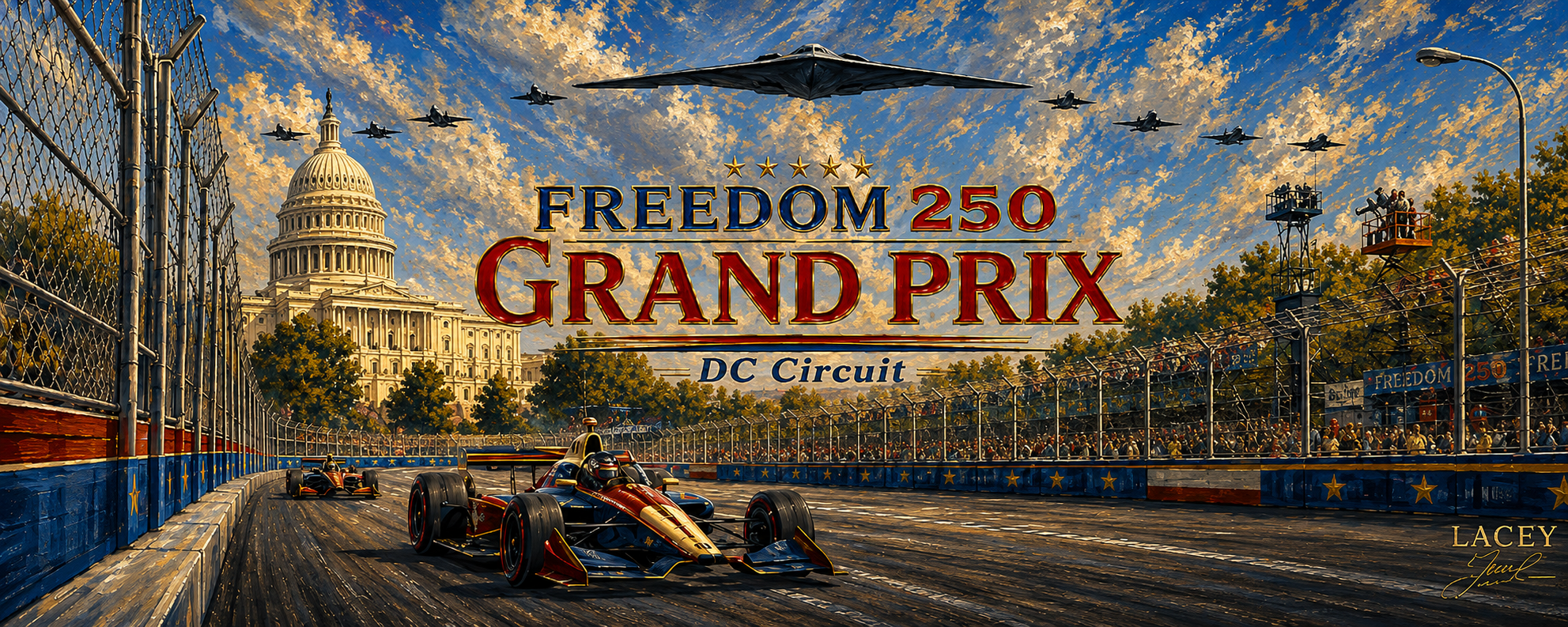
The Freedom 250, travel exhaustion, and the strange realization that I have not actually traveled nearly as much as people think
I almost went to the Freedom 250 Grand Prix in Washington, D.C., and under almost any other circumstances I probably would have. The idea of an IndyCar race tearing through the streets of the nation’s capital during America’s 250th anniversary was almost perfectly designed to appeal to me. It combined racing, history, travel, spectacle, patriotism, and the opportunity to physically place myself in the middle of something that was unlikely to happen in quite the same way again. Washington, D.C., is normally associated with monuments, museums, federal buildings, motorcades, political institutions, and the enormous weight of American history, not open-wheel race cars moving at speed through streets that millions of people ordinarily experience as tourists, commuters, and pedestrians. The Freedom 250 took that familiar landscape and temporarily transformed it into something entirely different, and as someone who has increasingly tried to stop experiencing interesting things through a screen and instead make the effort to actually go see them for myself, it should have been an easy decision. I thought seriously about going, looked at the logistics, considered the trip, and knew perfectly well that years from now this would be one of those events people would remember precisely because of how unusual it was. Nevertheless, when the weekend finally arrived, I stayed home.
The reason was almost ridiculous enough that I had to laugh at myself when I admitted it: I was tired of traveling. That sounds considerably more dramatic than the reality, because the truth is that I have not actually traveled very much, at least not in the way people probably imagine when they look at everything I have been doing lately. I am not somebody who spends half the year in airports, jumps between continents, lives out of hotel rooms, or has developed some elaborate system for fitting everything necessary for life into a carry-on bag. There are people who travel more in a single month than I have during entire stretches of my life. I have not suddenly become a professional traveler, and I am certainly not some seasoned road warrior who considers a six-hour drive an insignificant inconvenience. Yet from the outside, my life has increasingly started to look like one in which I am constantly going somewhere, doing something, attending something, or finding another reason to put miles between myself and home. That perception is not entirely wrong, but it is also not quite accurate, and the difference between those two things is what made missing the Freedom 250 interesting enough to me that I began thinking about it as something worth writing about.
What has changed is not necessarily the total amount of travel I have done, but the way I think about distance, opportunity, and the places around me. There was a time when places several hours away existed mostly as destinations that I might visit someday. They were points on a map, interesting in theory, but separated from ordinary life by a psychological distance that was considerably greater than the actual mileage. Increasingly, that has changed. Washington is no longer simply the capital several states away, it is somewhere I can reasonably decide to go. Virginia is not some distant location I might eventually visit, it is a place where I went and jumped out of an airplane. Historical sites, events, small towns, coffee shops, political gatherings, museums, roadside destinations, and reporting opportunities have gradually become less abstract because I have become more willing to get into a car and go see them. The radius of what I consider a reasonable trip has expanded dramatically, and with it has come a different relationship with movement itself. Instead of asking why I should go somewhere, I increasingly find myself asking why I should not.
That change has been important because much of my earlier life was considerably more stationary than people might assume from looking at what I do now. For years, life revolved largely around work, home, responsibilities, and whatever could reasonably fit between them. There were long hours, repetitive schedules, limited time, limited money, and the kind of routine that makes distance seem much more expensive than it actually is. When somebody spends most of his time working, recovering from work, preparing to return to work, and attempting to keep the rest of life functioning around that schedule, even a relatively short trip can begin to feel like something that requires a special occasion. The change came gradually, but at some point I stopped treating travel as something reserved for vacations or rare circumstances and started treating it as something I could incorporate into the life I was already living. That shift opened up experiences I would have missed before, but it also created a new problem: once you teach yourself to say yes to opportunities, it becomes surprisingly easy to forget that you are still allowed to say no.
The other reason travel tends to wear me down faster than the mileage alone would suggest is that I rarely travel simply for the purpose of traveling. There is almost always an objective attached to the trip. I want to see something, photograph something, interview somebody, investigate something, attend an event, explore a place, collect information for an article, experience something firsthand, or determine whether a place actually matches the reputation it has acquired from everyone else talking about it. Even recreational trips have a tendency to turn into projects because that is simply how I approach things. I do not particularly enjoy moving through the world passively. If I am somewhere, I want to understand it, document it, talk to people, remember the details, and eventually find some way to turn the experience into something larger than the day itself. That habit makes travel interesting, but it also means that what looks from the outside like a simple day trip can become a twelve- or fourteen-hour operation involving driving, parking, crowds, photographs, notes, conversations, route planning, food, fuel, equipment, schedules, batteries, weather, traffic, and the constant mental process of figuring out what needs to happen next.
Then, after all of that, the trip does not necessarily end when I get home. There are photographs to sort through, notes to organize, messages to answer, articles to begin, research to continue, people to follow up with, expenses to account for, and whatever ordinary responsibilities were waiting patiently while I was gone. Travel has increasingly become part of my work, my writing, my recreation, and the larger life I am trying to build, which means it does not fit neatly into the traditional category of taking time off. In many cases, I am not escaping from work at all, I am simply changing the location in which I am doing it. Eventually, however, the body does not particularly care whether the miles were driven for business, recreation, curiosity, or some combination of all three. Fatigue keeps its own accounting, and by the time the Freedom 250 arrived, mine had apparently accumulated enough of a balance that every part of me was telling me not to make another trip.
That created an unusual internal argument because everything else about the event told me I should go. This was history, racing, Washington, and a one-of-a-kind national spectacle all compressed into the same weekend. It was precisely the kind of event I have been trying to train myself not to miss simply because staying home would be easier. I knew I could probably make the trip work. I knew that if I went, I would almost certainly enjoy it. I knew I would come back with photographs, observations, a story, and the satisfaction of having been there when something unusual happened. None of that was really in question. What stopped me was the much simpler realization that I did not want to pack another bag, calculate another route, figure out another parking situation, deal with another crowd, walk another several miles through an event site, spend another long day on my feet, and then make the entire trip back knowing that everything else in my life would still be waiting when I returned.
So I stayed home, and strangely enough, staying home had become the harder choice.
That realization interested me because for several years I have been deliberately trying to push myself in the opposite direction. I have spent enough time understanding how easy it is to tell yourself that you will do something later. People delay trips, experiences, projects, conversations, risks, and opportunities because there is always another weekend, another year, another vacation, another opportunity, or some vaguely defined future version of life in which everything will finally be convenient. Sometimes that future arrives, but sometimes it does not. Opportunities disappear, circumstances change, people get older, money changes, health changes, responsibilities change, and events that looked repeatable suddenly become one-time experiences in retrospect. I have tried to internalize that lesson because I do not want to reach the end of my life surrounded by a collection of things I almost did.
That philosophy has pushed me into experiences I might once have talked myself out of, and I have no intention of abandoning it. At the same time, the Freedom 250 forced me to recognize the other side of that principle, which is that saying yes to life does not require saying yes to absolutely everything. There will always be another destination, another event, another historical site, another race, another town, another story, another person worth meeting, and another reason to convince myself that four hours of sleep is sufficient preparation for an absurdly long day. Once somebody begins deliberately pursuing experience, opportunity becomes almost endless, and that creates its own form of pressure. The danger is that a philosophy intended to make life larger can eventually become another obligation, one in which every missed opportunity feels like failure and every weekend spent at home feels like time wasted.
That is probably not a healthy way to experience anything.
Sometimes the correct decision is to miss something, even something you genuinely want to see. That does not make the event less important, and it does not mean the desire to go was somehow false. It simply means that human beings have limits, and learning where those limits are is part of building a sustainable life around the things we care about. I still wish I had gone to the Freedom 250. Watching the race and seeing images from Washington did absolutely nothing to make me feel better about my decision. Every time I saw the cars moving through the city, some part of me immediately thought that I should have been there. I probably would have had a fantastic time, and I almost certainly would have written a completely different article afterward.
But I also think a small amount of regret is healthy. I would rather occasionally regret staying home than return to the version of myself who constantly found reasons not to leave it.
The funniest part of the entire experience remains the phrase I used to explain the decision: travel exhaustion. It makes me sound considerably more worldly than I am. I have not spent the year bouncing between Europe, Asia, and South America. I have not crossed oceans every month, collected a stack of boarding passes, or developed strong opinions about airport lounges. Most of the adventures I have taken recently can still be reached with a car, enough gasoline, several cups of coffee, and questionable judgment about how much sleep is actually necessary. I have traveled more than I once did, certainly, but not nearly as much as somebody looking at my life from the outside might reasonably assume.
The important comparison, however, is probably not between me and somebody else. It is between the person I am now and the person I used to be. By that measurement, I have traveled a great deal. I have moved geographically, certainly, but more importantly I have changed psychologically. Places that once seemed distant now feel reachable. Experiences that once looked like something other people did increasingly feel available to me. I have become more willing to get into the car, buy the ticket, introduce myself, walk into an unfamiliar place, take the chance, and accept that not every experience needs to be perfectly planned before it begins. That change cannot really be measured in miles because the psychological distance between those two versions of myself is far greater than the distance between my house and Washington.
So I missed the Freedom 250, and I still wish I had been there. I expect there will be other events in the future where I face the same decision, and sometimes I will go even when staying home would be easier. Sometimes I will probably go when staying home would actually have been smarter. That is part of the tradeoff that comes with trying to build a life around experience rather than postponement. This time, however, I stayed home, accepted that I could not be everywhere, and allowed one road to continue without me. The irony is that it took becoming considerably more willing to travel for me to finally understand that occasionally choosing not to travel is not necessarily retreat. Sometimes it is simply the price of making sure that when the next road really matters, I still have enough left in me to take it.