There are some things you inherit without ever realizing you inherited them. They are not written into a will or handed down in a box. Sometimes they sit quietly in old photographs and family stories for decades until one day you find yourself doing something that causes you to look backward and wonder how much of the people who came before you is still traveling with you.
My first time on a horse was two years ago, but the decision to get into the saddle had actually begun months earlier. I had spent much of that winter thinking about horseback riding. There was no great plan behind it. It was simply something I had never done and increasingly wanted to experience for myself. By March, thinking about it was no longer enough. I found a place in New York, reached out, and set a date to ride with Mary Dixon of Ride NY's Adventure Trail. Then April arrived, and so did pneumonia.
Getting sick could easily have become the excuse to forget about the whole thing. Instead, about a month after having pneumonia, I went anyway. I showed up knowing almost nothing about riding a horse beyond what I had seen and what little I understood from other people. I had no childhood riding experience to fall back on, no years of lessons, and no practical reason to believe I would take to it particularly quickly. This was going to be my first time in the saddle.
Mary, on the other hand, had decades of experience. She was seventy-seven years old when I rode with her and had been riding since roughly her mid-forties. That meant I was stepping into a world in which she had accumulated approximately three decades of practical experience. I was beginning at zero. Within about thirty minutes, however, I was riding.
More surprising to me was where I ended up. Instead of cautiously following everyone else for the entire ride, I found myself at the front, leading the pack down the trail. I had gone from never having ridden a horse to sitting at the head of the group in roughly half an hour. That does not mean I became an experienced horseman in thirty minutes. I certainly did not. Riding competently under the supervision of someone with decades of experience is very different from possessing that experience yourself. What surprised me was how natural the basic act of riding felt once I was actually doing it. I loved it.
That first ride took us away from the barn and onto the trail, beneath trees and through the kind of country that immediately changes your perception of distance and movement. There was no engine beneath me, no dashboard in front of me and no pavement underneath us. There was simply the horse, the trail, the woods and the responsibility of paying attention to an animal that had its own instincts and awareness of everything happening around us.
For somebody accustomed to machinery, manufacturing and cars, the difference fascinated me. A machine responds according to its design. Apply the correct input and, assuming everything is functioning properly, you expect a predictable mechanical response. A horse is not a machine. It is a large and powerful living animal with training, instincts, experience and a personality of its own. Your hands matter. Your posture matters. Your confidence matters. The horse is constantly communicating with you while simultaneously receiving information from what you are doing.
I went into that first ride thinking I was trying something new. What I did not fully appreciate at the time was that I was also stepping into something that had existed in my family long before I was born.
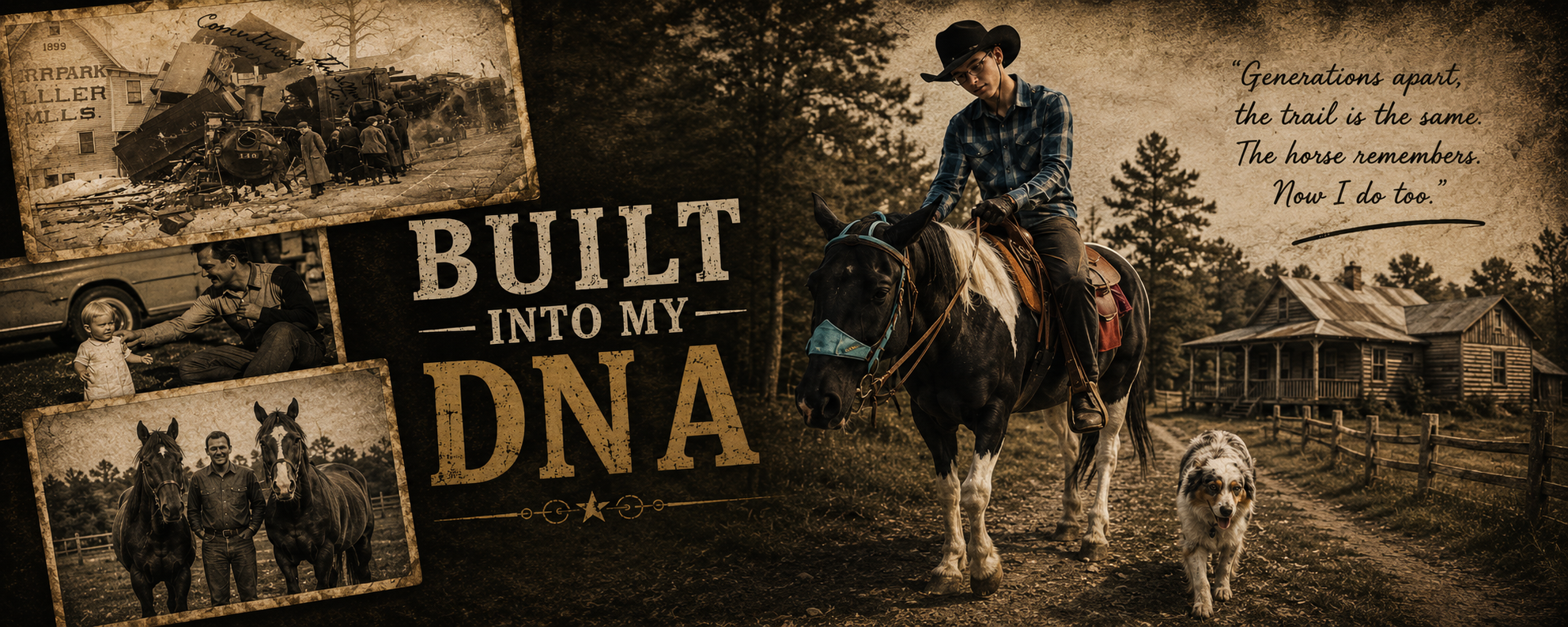
My grandfather was good with horses. I have old black-and-white photographs from that part of my family's history, photographs that belong to an America considerably different from the one I grew up in. Horses were still close enough to ordinary life that knowing how to handle one was not necessarily remarkable. Looking at those photographs before I rode, I saw family history. Looking at them afterward, I saw something different. For the first time, I possessed at least a small point of reference for something he had known far better than I did.
My mother also knew horses, although her experience came from a very different environment. She grew up on Long Island, and while she was in college she had access to what I would describe as the white-collar horse world. Horses in that environment could be recreation, sport, competition and part of an entirely different social culture. Her experience was not identical to my grandfather's, and mine would not be identical to hers. Yet across different places, different generations and different circumstances, horses kept appearing in the family story. The more I thought about that, the more the old photographs began to matter.
There are photographs of my father as a child and young man, long before he became the father I knew. There are photographs of my grandfather. There are images of horses, old automobiles, houses and railroads. My great-grandfather's history was tied to the railroad, and remarkably, he survived more than one documented train wreck. One photograph shows railroad men posed around a steam locomotive. Another shows the aftermath of a wreck, with the locomotive buried beneath wreckage while men stand around the destruction.
Those photographs document a world that is gone, but they also remind me that history does not feel like history when you are living through it. At the time, it is simply your life. Somebody goes to work. Somebody takes care of a horse. Somebody poses beside a locomotive. Somebody photographs a father with his child. Decades pass, the people grow older, children have children of their own, and suddenly an ordinary photograph becomes evidence of a world the next generation never knew.
My father would eventually have ten children with my mother. Their life together would span decades, but there was a time when none of that had happened yet. He was simply the little boy in those photographs. My grandfather was once a younger man whose future had not yet unfolded. My great-grandfather could not have known that generations later one of his descendants would be studying photographs of the locomotives and wrecks that had been part of his own working life.
Eventually you stop looking at family photographs simply as pictures of your parents and grandparents. You begin looking for yourself in them.
Sometimes it is physical resemblance. Sometimes it is a posture or expression. More often, at least for me, it is something less tangible. You wonder where certain interests came from. You wonder whether the impulse to go somewhere unfamiliar, learn something new, work with your hands, operate machinery, travel, or simply see what is on the other side of the next hill really began with you. Horseback riding gave me another reason to ask that question.
The first ride could easily have remained a one-time experience. I had wanted to try it, I had done it, and that could have been the end of the story. Instead, almost immediately, I knew I wanted to do it again. Two months later, I went back. The date of that second ride was July 3.
That date carried considerably more meaning for me than it would have to almost anyone else. July 3 marked the three-year anniversary of my Corvette accident. Three years earlier, that day had been defined by twisted metal, destruction and the violent end of something I had loved. Now, on the same date, I was getting back into a saddle because I had discovered something new that I loved.
I did not originally begin riding horses as some carefully constructed response to the accident. I had spent the winter thinking about riding, found Mary, contacted her in March and finally went after recovering from pneumonia. The sequence matters because I do not want to manufacture symbolism where it did not exist. But returning on July 3 gave the second ride a meaning of its own.
Anniversaries have a way of becoming markers whether we want them to or not. A date associated with something bad can remain permanently attached to the event, and every year the calendar eventually brings you back to it. You cannot change what happened on the original day. What you can change is what happens on that date afterward. Three years after my Corvette accident, I was not standing beside a wrecked car. I was on horseback. There was something satisfying about that.
The machine and the animal could hardly have been more different. The Corvette represented speed, mechanical power and one particular period of my life. The horse represented something slower, older and entirely new to me. One experience had ended violently. The other had only just begun.
Perhaps that is why the photographs from those rides have become more meaningful with time. The older family photographs are black and white. Mine are filled with summer green. My grandfather's world and my mother's world were different from mine, just as my life will be different from whatever comes after me. The technology surrounding us changes. The cars change. The locomotives change. Long Island changes. New York changes. Entire industries appear and disappear. The horse remains a horse.
There is something extraordinarily old about traveling on horseback. Today we largely think of riding as recreation, but for most of human history horses were transportation, labor, agriculture, communication and war. People crossed countries on horseback. Families depended on them for their livelihoods. Armies moved because of them. Settlements remained connected because riders carried information between them. For centuries, sitting where I was sitting was not an unusual adventure. It was part of civilization itself.
Modern life has separated most of us from that reality. We can cross in hours distances that once required days. We press an accelerator and summon hundreds of horsepower without thinking very much about where that word came from. Then you actually sit on one horse and begin moving through the woods, and the landscape changes. You notice the incline of the ground, the mud beneath the horse's feet, the branches hanging over the trail and the sunlight breaking through the canopy. Distance becomes physical again.
That first April ride started because I had spent a winter thinking about trying something I had never done before. I contacted a seventy-seven-year-old woman who had been riding for decades, showed up about a month after having pneumonia, climbed onto a horse with essentially no experience, and within half an hour found myself riding at the front of the group.
Two months later, on the anniversary of one of the worst days of my life, I came back because I wanted to do it again. Only afterward did I begin putting the larger story together.
My grandfather knew horses. My mother knew horses. The black-and-white photographs had been there long before I ever thought seriously about riding. I had grown up surrounded by pieces of that history without really considering that one day I might add my own photographs to it. Now I have.
I am still not going to pretend that a few trail rides make me a horseman. They do not. If anything, riding showed me how much knowledge there is to acquire and how much respect the animal deserves. But competence is not always the point of a first experience. Sometimes the important part is discovering that you want there to be a second. Mine came two months later.
The first ride showed me something I loved. The second transformed a date I already carried with me into something more complicated and, perhaps, something better. The old photographs then gave both experiences a history I had not completely understood when I first climbed into the saddle. My grandfather had his horses. My mother had hers. Decades later, I found mine.
Maybe that is coincidence. Maybe family history simply makes us notice connections that otherwise would have passed without comment. I cannot prove that some instinct for horses traveled through generations until it finally reached me, and I am not interested in pretending that I can.
But I know what happened when I finally got into the saddle. Within thirty minutes, I was riding at the front. Two months later, I was back. And two years afterward, I am still looking at those old black-and-white photographs differently. Maybe some things really do stay in the blood.