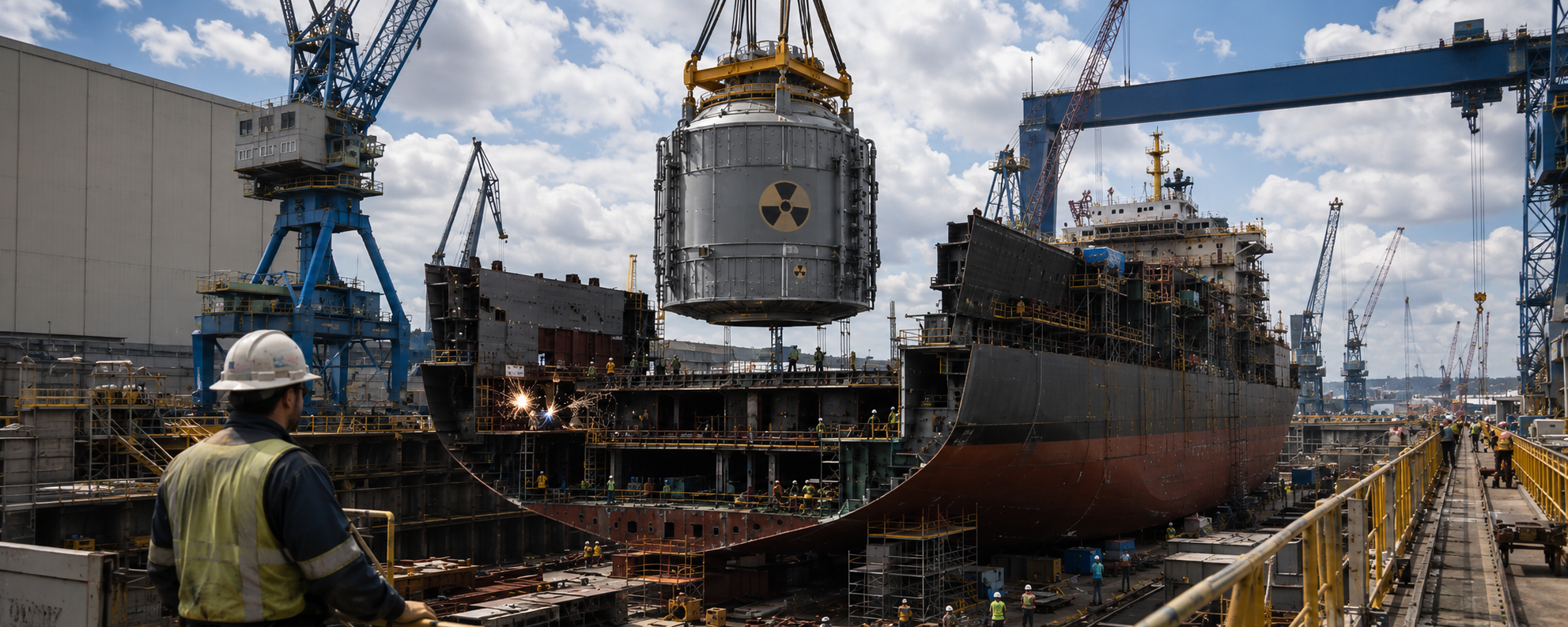
America does not need to rebuild the merchant marine of the twentieth century. It has an opportunity to build the merchant fleet of the twenty-first.
By James Lacey
For roughly fifteen years, I have believed that one of the most logical applications of nuclear power has been sitting in front of us in plain sight: the merchant ship. Long before nuclear-powered commercial shipping reentered serious federal discussion, before small modular reactors became a regular part of the national energy conversation, and before rebuilding the American maritime industrial base became a major policy objective, I was thinking about what nuclear propulsion could mean for commercial shipping. I am 28 years old now, and my interest in nuclear power reaches back to my early teenage years. In high school, I gave a presentation on nuclear energy in my government and economics class because even then I believed the public conversation surrounding nuclear power was far too narrow. We tended to discuss reactors almost exclusively as another means of generating electricity for the grid. I saw something considerably larger.
The basic proposition has always seemed remarkably straightforward. Nuclear fuel contains an extraordinary amount of usable energy in an extremely small quantity of material. An oceangoing merchant vessel, meanwhile, is one of the largest mobile industrial machines human beings routinely operate. It requires enormous amounts of energy, travels thousands of miles between fixed facilities, spends months at sea, and must carry everything necessary to sustain its operation along the way. Conventional ships dedicate substantial portions of their internal capacity to fuel and the machinery necessary to store, transfer and consume it. They must also continuously purchase that fuel, and their operating economics are heavily influenced by both its price and availability. Once those realities are placed beside the energy density and endurance possible with nuclear propulsion, the question becomes difficult to ignore: why have we not made a much more serious attempt to nuclearize commercial shipping?
The United States is now beginning to ask that question again. In 2026, the Maritime Administration began pursuing small modular reactor concepts for commercial maritime use, with the objective of examining whether nuclear power could support vessels capable of longer voyages, sustained higher speeds and reduced reliance on conventional marine fuels. That work is occurring at the same time that the United States is confronting the deteriorated condition of its commercial maritime industrial base and the overwhelming dominance China has established in global shipbuilding. These two problems should not be treated separately. Nuclear commercial propulsion may eventually offer the United States something considerably more important than an alternative engine for a cargo ship. It may offer a technological pathway for rebuilding American maritime power on fundamentally different terms.
A merchant vessel is, in many respects, an unusually attractive platform for nuclear propulsion. Commercial shipping is ultimately an exercise in maximizing useful transportation capacity while controlling operating costs. Every cubic foot and every ton devoted to propulsion systems, fuel storage and other non-revenue-producing necessities is capacity that cannot be used for cargo. Conventional oceangoing ships consume enormous quantities of fuel, and the economics become even more demanding as speed increases. The faster a large displacement hull moves through the water, the greater the power required to overcome resistance. That relationship is one of the reasons commercial vessels are generally operated according to an economic balance between transit time and fuel consumption rather than at the highest speed their machinery could theoretically sustain.
Nuclear propulsion does not eliminate hydrodynamic resistance, nor does it somehow make the energy required for higher speeds disappear. What it changes is the method by which that enormous quantity of energy is supplied. Instead of carrying and continuously burning thousands upon thousands of tons of petroleum-derived fuel, a nuclear-powered vessel could draw sustained energy from a reactor designed to operate for years between refueling periods. The implications extend far beyond the immediate fuel bill. If designers are no longer forced to allocate the same amount of space and displacement to conventional bunker fuel, portions of the vessel can potentially be reassigned to cargo, machinery, safety systems or other useful purposes. The vessel also becomes considerably less vulnerable to volatility in global petroleum prices and interruptions in fuel supply.
Speed may prove even more consequential. Merchant shipping is usually discussed in terms of how many containers or how much bulk cargo a particular vessel can carry, but that is only part of the economic equation. A ship's true transportation capacity is determined by how much cargo it can move over time. If two vessels carry similar loads but one can consistently complete a voyage substantially faster, the faster vessel can potentially make more trips during the same year. That translates into greater annual cargo throughput without necessarily requiring a proportional increase in the number of hulls.
There are broader supply-chain consequences as well. Modern manufacturing is built around increasingly sophisticated logistics systems, highly optimized warehouses, computerized inventory management and rapid distribution networks. Yet the ocean crossing itself remains governed by the economics of enormous vessels moving at comparatively modest speeds because fuel consumption becomes increasingly expensive as velocity rises. A nuclear-powered merchant ship capable of economically maintaining higher speeds could reduce the amount of time cargo spends between continents. Faster maritime transportation could improve inventory turnover, provide manufacturers with greater flexibility, shorten supply-chain response times and potentially create new competition with more expensive forms of freight transportation on certain routes.
This is where the concept becomes particularly relevant to America's competition with China. The United States has allowed its commercial shipbuilding capability to decline dramatically while China has built an industrial ecosystem capable of producing vessels at a scale America currently cannot approach. China possesses the shipyards, supply networks, industrial workforce, fabrication capacity and production volume necessary to dominate conventional commercial shipbuilding. Attempting to close that gap solely by producing the same types of vessels using the same basic technology presents an obvious problem. America would be attempting to catch an established competitor by entering a race in which that competitor already possesses an enormous structural advantage. There is another option. Change the race.
Instead of asking only how the United States can build conventional merchant ships as cheaply and rapidly as China, we should also be asking what technologies could create a fundamentally superior American commercial vessel. Nuclear propulsion is one of the few technologies with the potential to change the underlying operating characteristics of the ship itself. If it can be made economically, legally and commercially viable, the United States could develop a maritime industry built not merely around producing additional hulls, but around producing a new class of high-endurance, high-power commercial vessels supported by an entirely new domestic industrial ecosystem.
That ecosystem would have value far beyond the ships themselves. A serious nuclear merchant program would require naval architects, nuclear engineers, marine engineers, machinists, welders, electricians, instrumentation specialists, reactor technicians, shipyard workers, component manufacturers, fuel-cycle infrastructure, training facilities, maintenance centers and specialized ports. It would create demand for precisely the kind of advanced industrial skills that the United States has spent decades allowing to erode. Shipbuilding is not simply about assembling steel into a hull. It is about maintaining the network of human knowledge, suppliers, machine tools, factories and infrastructure necessary to repeatedly build sophisticated machines.
America has already demonstrated that nuclear propulsion can be used in a merchant vessel. The N.S. Savannah, conceived during the Eisenhower administration's Atoms for Peace program, entered service in the early 1960s and demonstrated that a nuclear-powered merchant ship could operate successfully. What it did not demonstrate was that the specific economic, regulatory and industrial environment of the twentieth century was prepared to support a large commercial nuclear fleet. Those are two very different conclusions.
The failure of the Savannah to produce hundreds of successors is sometimes treated as evidence against nuclear commercial shipping. I think that is the wrong lesson. Savannah was a demonstration of technological possibility, not the culmination of a mature industrial system designed around large-scale commercial deployment. Reactor technology has advanced substantially since then. Materials have improved. Automation has improved. Computational engineering has improved. Manufacturing technology has improved. Nuclear safety systems have improved. The worldwide shipping industry has changed enormously, and the strategic importance of American shipbuilding has changed with it.
The proper question is therefore not why a vessel designed more than sixty years ago failed to create an immediate nuclear merchant revolution. The more useful question is what a nuclear merchant vessel designed specifically around the technological, economic and geopolitical realities of the 2030s could accomplish.
There are, of course, significant obstacles, and anyone treating this as a simple matter of replacing a diesel engine with a reactor is ignoring the hardest portions of the problem. A commercially successful nuclear merchant fleet would require an international regulatory architecture capable of supporting it. Governments would need to determine how reactors are licensed, how crews are certified, how nuclear vessels are inspected, how liability is assigned and how insurance markets handle the associated risk. Port authorities would need procedures for accepting nuclear-powered commercial vessels. Security standards would have to protect nuclear material and reactor systems from sabotage, terrorism and theft. Maintenance and refueling facilities would need to exist along viable trade routes, and nations would need agreements governing what happens when a nuclear vessel suffers an accident or requires emergency repairs in a foreign harbor.
Those problems are serious, but they are not arguments for abandoning the technology. They are design requirements. Engineering has always involved identifying constraints and developing systems capable of functioning within them. The regulatory, financial, legal and logistical architecture surrounding a nuclear merchant fleet should be treated as part of the machine itself. The ship, reactor, port, shipyard, crew, insurance structure, fuel system, maintenance network and regulatory framework all have to operate together. A nuclear cargo vessel without that surrounding infrastructure is little more than a technological demonstration.
That is why I believe the United States should avoid repeating the mistake of treating the next nuclear merchant ship as an isolated prototype. The objective cannot simply be to construct one extraordinary vessel, prove that it works, display it around the world, issue a collection of reports and then allow the program to disappear. The objective must be industrialization.
One vessel should create the knowledge required to build the next ten. Those ten should establish the production methods necessary to build fifty. Shipyards should know another hull will follow the one currently under construction. Component suppliers should be able to invest knowing additional orders are coming. Workers should be able to enter training programs knowing that the industry they are preparing for will still exist when their training is complete. Nuclear merchant propulsion will become economically important only when it becomes repeatable.
That distinction is essential because America's industrial problem has never been a lack of ability to produce remarkable prototypes. The United States has repeatedly demonstrated that it can design and build extraordinary machines. The deeper problem has increasingly been maintaining the industrial capacity necessary to manufacture sophisticated systems continuously, economically and at scale. A successful nuclear merchant program could therefore become more than a shipping initiative. It could become one component of a broader American industrial revival.
My interest in this subject predates the current policy debate by most of my life. When I stood in front of a high-school government and economics class talking about nuclear power, I was not thinking about a particular administration or politician. I was thinking about what could be done with a technology whose potential seemed far greater than the limited role we had assigned to it. Fifteen years later, I still believe that.
Nuclear power should never have been viewed exclusively as a debate over what type of power plant supplies electricity to the grid. It is an industrial energy technology, and its potential applications extend far beyond stationary electrical generation. Merchant shipping may be one of the most natural examples. Enormous vessels travel predictable routes, require continuous high power, operate for decades, consume huge quantities of fuel and form the backbone of international commerce. If nuclear power can be made commercially viable anywhere outside the electrical grid, maritime transportation deserves to be near the top of the list. Now, for the first time in years, the United States appears willing to seriously examine that possibility.
There is a long distance between government announcements, engineering concepts and a working fleet crossing the Pacific. Designs will change. Regulations will have to be written. Costs will have to survive commercial scrutiny. Ports and foreign governments will have to be convinced. Shipyards will have to develop capabilities they do not presently possess. Some schedules will slip, some concepts will fail and some assumptions will undoubtedly prove wrong. That is not evidence that the idea is impossible. It is what happens when a serious industrial concept moves from theory into reality.
Fifteen years after I first began thinking about this possibility, I do not want to see America simply rebuild the merchant marine it once had. I want to see this country build the merchant marine that should come next, a fleet designed around the technologies, industrial realities and strategic challenges of the twenty-first century.
We should not be satisfied with trying to manufacture yesterday's ships faster than China. We should build a ship that changes what the competition means. A nuclear-powered American merchant fleet could be that ship.