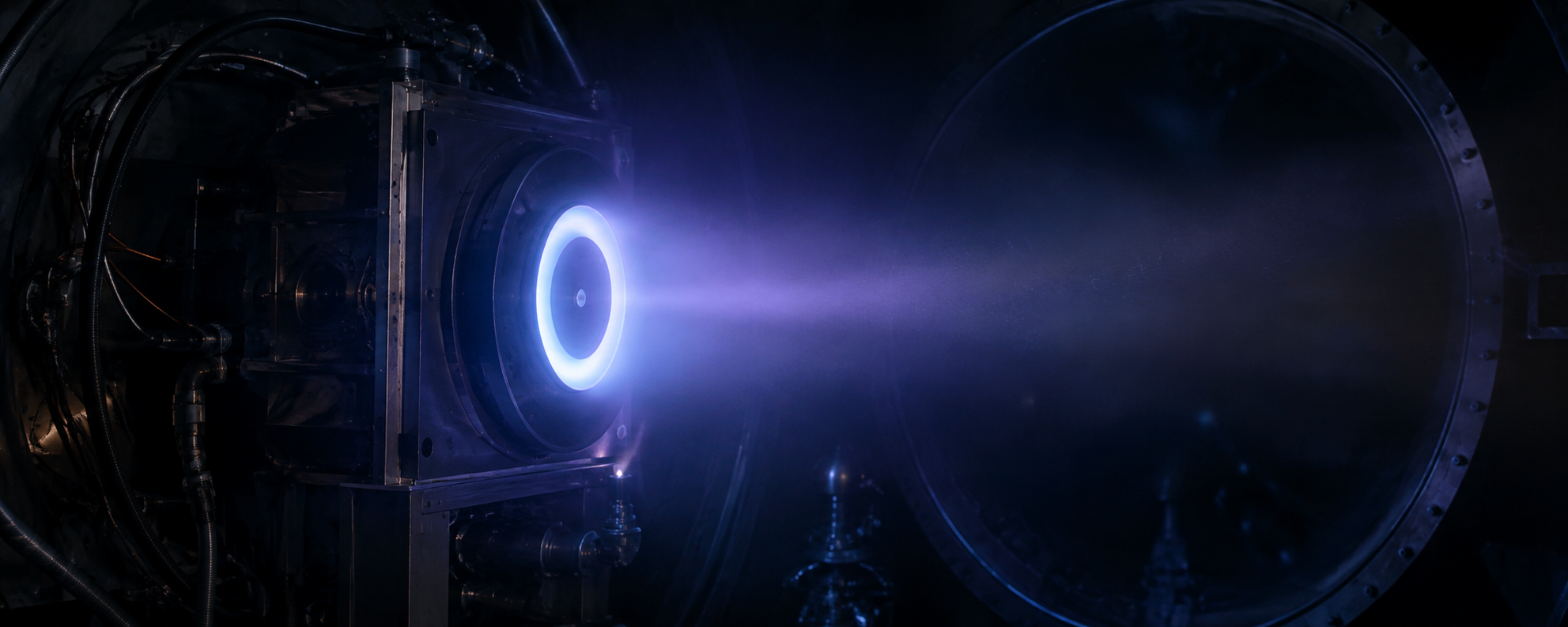
Blue Origin’s first internally developed Hall-effect thruster is more than another propulsion test. It is evidence that the company is building the machinery necessary to become an increasingly vertically integrated space transportation and infrastructure company, extending its propulsion capability from the enormous chemical engines that lift New Glenn into orbit to the electric engines that can move spacecraft once they are already there.
There are moments in aerospace development that look considerably smaller than they really are. A rocket standing hundreds of feet tall on a launch pad is obviously significant. A lunar lander descending toward the Moon is obviously significant. A new launch complex, a giant engine test stand or a reusable booster returning through the atmosphere presents itself naturally as a major engineering accomplishment. A relatively small circular device glowing blue inside a dark vacuum chamber does not have the same immediate scale. Yet the image Tory Bruno posted on September 1 may represent one of the more consequential pieces of Blue Origin’s rapidly expanding space architecture. Bruno, now President of National Security at Blue Origin, announced the first ignition of what he described as Blue Origin’s own internally developed Hall-effect thruster. Blue Origin subsequently confirmed that this was the company’s first firing of an internally developed Hall-effect thruster and said the test demonstrated sustained operation and the plasma conditions necessary for electric thrust. According to the company, the system progressed from concept to firing in a matter of weeks.
The distinction between “a Hall-effect thruster” and “our own, in-house Hall-effect thruster” is the important part of the announcement. Hall thrusters themselves are not new. Their lineage extends back decades, and today they are well-established spacecraft propulsion systems. NASA, commercial satellite manufacturers and international spacecraft operators have accumulated extensive experience with electric propulsion. What is new here is Blue Origin deliberately adding this technology to its own internal propulsion portfolio at precisely the moment when the company is moving beyond rockets and toward an integrated ecosystem of launch vehicles, orbital spacecraft, communications infrastructure, lunar systems and national-security platforms. Blue Origin already manufactures some of the largest chemical rocket engines in the United States. It produces the BE-4 that powers New Glenn and United Launch Alliance’s Vulcan, the hydrogen-fueled BE-3U used by New Glenn’s upper stage, the BE-7 developed for lunar landing applications and the BE-3PM associated with New Shepard. The company is now developing propulsion at the opposite end of the thrust spectrum, not an engine producing hundreds of thousands of pounds of thrust for a few minutes, but an electrically powered plasma engine designed to operate efficiently for extraordinarily long periods once a spacecraft is in space.
That difference deserves to be understood because a Hall-effect thruster is not a miniature rocket engine in the conventional sense. Chemical propulsion stores energy in propellants. Fuel and oxidizer react, the resulting hot gas expands through a nozzle, and enormous quantities of mass are accelerated rearward to produce enormous thrust. That is what a spacecraft requires when it must escape Earth’s surface. New Glenn’s seven BE-4 engines collectively produce millions of pounds of thrust because nothing less will lift an enormous launch vehicle through Earth’s gravity and atmosphere. Electric propulsion approaches the problem from almost the opposite direction. Instead of attempting to produce enormous thrust immediately, it uses electrical energy to accelerate a comparatively tiny amount of propellant to extremely high exhaust velocity. The resulting thrust can be very small, but the engine can continue producing it for hours, days, weeks or months. Over sufficient time, that continuous acceleration can produce enormous changes in spacecraft velocity while consuming dramatically less propellant than would be required by a comparable chemical system.
A Hall-effect thruster accomplishes this using plasma physics rather than combustion. Neutral propellant enters an annular discharge channel. Electrons supplied by a cathode interact with electric and magnetic fields inside the thruster. A radial magnetic field restricts the motion of electrons and causes them to circulate azimuthally around the channel, producing the Hall current from which the engine takes its name. Those energetic electrons collide with propellant atoms and ionize them, stripping away electrons and creating positively charged ions. An axial electric field then accelerates those ions out of the engine at extremely high velocity. Momentum carried away by that stream of ions pushes the spacecraft in the opposite direction. Electrons are subsequently added to the exhaust to keep the spacecraft and plume electrically neutral. NASA describes Hall thrusters as devices in which the magnetic field effectively traps electrons while the resulting plasma ions are electrostatically accelerated out of the discharge channel.
The electric-blue glow visible in Bruno’s photograph is therefore not decorative exhaust and it is not conventional rocket flame. It is luminous plasma. Similar brilliant blue plumes are familiar from xenon Hall-thruster testing at NASA, including systems associated with the Psyche spacecraft and more recent electric-propulsion development at the Jet Propulsion Laboratory. NASA notes that xenon Hall thrusters can accelerate their plasma to velocities on the order of tens of thousands of miles per hour. The amount of instantaneous thrust is tiny compared with a chemical rocket, but that comparison misses the purpose of the technology. A Hall thruster is not supposed to launch New Glenn. It is intended to make a spacecraft extraordinarily efficient once New Glenn has finished doing the violent part of the job.
This is why electric propulsion becomes increasingly important as Blue Origin’s ambitions shift from merely reaching orbit to operating throughout orbital space. Getting a payload into an initial orbit is only the first stage of many missions. A spacecraft may subsequently need to raise its orbit, change inclination, maintain station, reposition repeatedly, compensate for atmospheric drag, rendezvous with other spacecraft, transfer between orbital regimes or undertake journeys toward the Moon and beyond. Every one of those operations requires delta-v, essentially a change in velocity. Chemical propulsion can provide delta-v quickly, but spacecraft pay heavily for that speed because conventional propulsion requires significant propellant mass. Electric propulsion trades time for efficiency. For missions that do not require every maneuver to occur within seconds, that trade can be extraordinarily valuable.
Blue Origin already has an obvious platform for exploiting exactly that combination. Blue Ring, the company’s multi-mission orbital mobility spacecraft, is explicitly designed around hybrid chemical and solar-electric propulsion. Blue Origin describes the vehicle as capable of operating from Earth orbit through cislunar space and potentially farther outward, carrying and hosting payloads while providing communications, computing and other infrastructure services. The company currently advertises approximately 3,000 to 4,000 meters per second of total delta-v depending upon mission configuration. Rather than choose exclusively between high-thrust chemical propulsion and highly efficient low-thrust electric propulsion, Blue Ring combines the two. Chemical propulsion gives the spacecraft the ability to perform faster maneuvers when mission timing demands them, while solar-electric propulsion gives it an efficient means of accumulating large velocity changes over longer periods.
That architecture is extraordinarily interesting because it begins to treat propulsion the way aircraft designers treat different portions of a flight envelope. There is no universally perfect propulsion system. High thrust, high specific impulse, low mass, enormous efficiency, instantaneous response, long life and low cost cannot simply be maximized simultaneously. Engineering consists largely of trading those characteristics against one another. Blue Ring’s hybrid architecture acknowledges that reality. A chemical system can provide rapid maneuvering authority. Electric propulsion can provide endurance and propellant economy. Combine the two intelligently, and an orbital vehicle becomes substantially more flexible than one optimized around either extreme alone.
Blue Origin says Blue Ring can deliver or host thousands of kilograms of payload across multiple ports while operating in GEO, cislunar space and potentially interplanetary destinations. The company has also positioned the spacecraft heavily toward defense and space-domain-awareness missions, where maneuverability may be more than a convenience. The ability to reposition, inspect different orbital regions, host sensors, carry secondary spacecraft and maintain significant maneuver reserves could become increasingly important as military space architectures evolve beyond relatively static satellites occupying predictable orbits. Blue Origin has already announced sensor integrations intended for space-domain-awareness missions, and Blue Ring’s broader architecture includes onboard processing, communications and mission services in addition to transportation.
An internally produced Hall thruster consequently fits Blue Ring almost perfectly at the strategic level. Until Blue Origin publishes the new thruster’s technical specifications and flight assignment, it would be premature to claim a particular power level, thrust rating or operational configuration. The September 1 announcement did not publicly provide dimensions, input power, thrust, specific impulse, efficiency, propellant capacity, qualification life or a scheduled first flight. Those numbers matter enormously and should not be invented simply because the first test produced a beautiful plume. First ignition is the beginning of an engine-development program, not the end. Engineers still have to characterize performance across operating conditions, understand thermal behavior, verify the cathode and power-processing architecture, measure plume characteristics, conduct endurance testing, survive vibration and shock qualification, demonstrate restart capability, validate the propellant-feed system and eventually prove that production units can reproduce laboratory performance.
That distinction is particularly important with electric propulsion because lifetime is often as important as peak performance. A Hall thruster may be expected to operate for thousands of hours. Plasma interacting with the discharge channel and surrounding materials can gradually erode the engine, alter its geometry and eventually limit useful life. NASA has devoted considerable research to magnetically shielded Hall-thruster designs specifically because reducing plasma interaction with the discharge-channel walls can dramatically increase operating lifetime. A five-minute laboratory firing might prove that the physics works. It does not prove that the same engine can operate reliably for several thousand hours on orbit.
But that is exactly why this first ignition is worth noticing. Blue Origin has crossed the boundary between describing an electric propulsion capability and physically operating internally designed hardware. The company says the test sustained operation and established the plasma conditions necessary for thrust. That moves the technology from a drawing, simulation or development concept into experimental hardware producing measurable plasma behavior. There remains an enormous distance between this test and a flight-qualified propulsion subsystem, but every flight-qualified engine begins with exactly this kind of transition from engineering theory to hardware.
There is another reason this matters beyond Blue Ring. Blue Origin is simultaneously building TeraWave, an enormous multi-orbit communications network announced in January. TeraWave is planned around 5,408 optically interconnected satellites, including 5,280 spacecraft in low Earth orbit and another 128 in medium Earth orbit. Blue Origin says the system is designed primarily for enterprise, data-center and government users, with high-capacity links reaching as much as 144 gigabits per second through the LEO component and up to 6 terabits per second through optical links associated with the MEO architecture. Initial deployment is scheduled to begin in the fourth quarter of 2027.
A constellation of that scale transforms the economics of spacecraft manufacturing. If a company intends to build several spacecraft, purchasing major subsystems from established suppliers can make perfect sense. If it intends eventually to manufacture thousands of satellites, vertical integration begins to become far more attractive. Propulsion is not a peripheral component in a large constellation. Satellites need orbital insertion and phasing, collision avoidance, station keeping, formation management and eventually controlled disposal. The cumulative number of thrusters, power-processing units, valves, tanks and associated components required across thousands of spacecraft becomes enormous. Every dollar removed from the recurring cost of a satellite can be multiplied thousands of times. Every improvement in manufacturing throughput can affect the speed at which the entire constellation becomes operational.
This is one reason SpaceX’s development of its own electric propulsion became strategically important to Starlink. NASA’s current review of in-space propulsion notes that large constellations have materially changed propellant economics, including the use of xenon, krypton and argon in Hall-effect systems. Xenon has historically been attractive because its atomic mass and ionization characteristics make it a very good electric-propulsion working fluid, while cheaper alternatives can become attractive when a manufacturer is attempting to supply propulsion for thousands of spacecraft. In other words, propulsion architecture at constellation scale becomes as much an industrial question as a plasma-physics question.
This is where Blue Origin’s announcement becomes much more interesting to me than the photograph alone. The company is increasingly behaving not merely like a rocket manufacturer but like an aerospace industrial system. New Glenn provides heavy orbital transportation. Blue Ring is intended to provide mobility and services after launch. TeraWave creates persistent communications infrastructure. Blue Moon addresses transportation and operations on the lunar surface. Quartz is being developed as a global ground communications network, with Blue Origin announcing in August that its first stations in Bermuda, New Zealand and Australia had completed acceptance testing as part of a planned nine-site rollout. Bruno himself described Quartz as an integrated network intended for national-security, civil and commercial operators.
Seen individually, these can look like separate programs. Seen together, they look increasingly like layers of one architecture. Launch the spacecraft. Move the spacecraft. Communicate with the spacecraft. Provide services from the spacecraft. Build communications networks consisting of thousands of spacecraft. Land hardware on the Moon. Support government and military customers operating across the same environment. The more of those layers Blue Origin controls internally, the less dependent it becomes on outside suppliers for technologies that determine cost, schedule and ultimately mission capability.
That does not mean vertical integration is automatically superior. Aerospace history is full of companies that attempted to internalize too many technologies and discovered that specialist suppliers existed for good reasons. Every new internal capability requires engineers, test infrastructure, qualification programs, production equipment, supply chains, configuration control and years of continued technical support. Hall thrusters themselves are already available from experienced manufacturers. Developing one internally only makes strategic sense if Blue Origin believes the long-term volume, performance requirements, mission integration or cost structure justifies the investment.
The existence of Blue Ring and TeraWave makes that argument much easier to understand. Blue Origin is not preparing for one spacecraft. It is preparing for fleets.
There is also an important national-security dimension. Bruno did not arrive at Blue Origin as a conventional commercial-space executive. After nearly twelve years running United Launch Alliance, he joined Blue Origin to lead its National Security organization, and Blue Origin is simultaneously positioning New Glenn, Blue Ring, Quartz and other systems around increasingly demanding U.S. government missions. The future military space environment is likely to place greater value on maneuverability, proliferation, responsive deployment and distributed architectures. A satellite that has significant remaining maneuver capability is inherently more operationally flexible than one that must carefully conserve a small chemical propellant reserve for the duration of its life.
Electric propulsion cannot replace chemical propulsion in every military maneuver because low thrust imposes time penalties. If a spacecraft needs to move immediately, a slow orbital spiral may be unacceptable. This again makes Blue Ring’s hybrid architecture notable. It suggests a spacecraft designed around both endurance and responsiveness rather than forcing every mission through one propulsion regime.
For deep-space operations the same basic physics becomes even more compelling. Chemical propulsion is indispensable for high-thrust events, but the tyranny of the rocket equation makes carrying enormous quantities of propellant expensive. Electric propulsion can achieve much higher specific impulse because it accelerates propellant to far greater exhaust velocities. NASA’s 12.5-kilowatt-class Advanced Electric Propulsion System, for example, has demonstrated specific impulse above roughly 2,600 seconds, illustrating why Hall propulsion is attractive for missions in which efficiency matters more than instantaneous thrust. The exact performance of Blue Origin’s new engine is not yet public, and it should not be assumed to match any existing NASA system, but the underlying advantage is the same.
This is also why the photograph looks almost deceptively peaceful. A BE-4 hotfire is violence made visible: combustion, pressure, vibration and enormous mass flow. A Hall thruster produces a quiet luminous plasma that appears almost motionless by comparison. Yet the exhaust particles leaving an electric thruster can be moving at velocities many times greater than the hot gases leaving a conventional chemical rocket. Chemical propulsion wins by throwing much more mass out of the vehicle every second. Electric propulsion wins by throwing a much smaller amount of mass vastly faster and continuing to do it for an extremely long time.
The two technologies are not competitors so much as complementary tools. One gets the infrastructure into space. The other helps make that infrastructure useful after arrival.
That is why I think the phrase “in house” in Bruno’s announcement deserves nearly as much attention as “first ignition.” Blue Origin already knows how to build rocket engines. What it is demonstrating now is an intention to own a larger portion of the spacecraft beneath the payload fairing as well. Electric propulsion is a foundational technology for persistent orbital operations. If Blue Origin can mature this first internal Hall-thruster effort into a reliable, manufacturable family of propulsion systems, it gains another critical building block that can be designed alongside its spacecraft instead of adapted to them afterward.
There are still major questions. We do not yet know the thruster’s power class. We do not know its measured thrust. We do not know its specific impulse or total efficiency. We do not know its target operating life or whether the design will branch into several sizes. We do not know how rapidly Blue Origin intends to move from prototype testing into environmental qualification and production. We do not know whether the hardware shown by Bruno closely resembles the eventual flight article. Those details will determine whether this remains an interesting internal technology project or becomes a major production propulsion system.
What we do know is enough to make the test significant. Blue Origin designed a Hall-effect thruster internally, built it, ignited it and achieved sustained plasma operation. It is doing so while developing a spacecraft explicitly dependent upon solar-electric propulsion, while preparing a 5,408-satellite communications architecture and while broadening its operations into national security, orbital logistics and deep-space infrastructure. That context transforms a blue ring glowing in a vacuum chamber from an isolated laboratory experiment into another piece of a much larger industrial strategy.
For decades, the public image of Blue Origin was dominated by New Shepard and the long development of New Glenn. That version of the company is becoming increasingly outdated. The emerging Blue Origin is trying to build engines, launch vehicles, spacecraft, lunar landers, orbital transportation systems, satellite networks and communications infrastructure. If that strategy succeeds, the company will not merely sell a ride into space. It will own significant portions of the transportation and infrastructure chain on both sides of launch.
The enormous BE-4 gets New Glenn away from Earth. The comparatively tiny Hall thruster represents what happens next.
And that may be why this small blue light is worth paying attention to. It is not Blue Origin discovering electric propulsion. It is Blue Origin deciding that electric propulsion is important enough to become one more capability it intends to possess for itself.