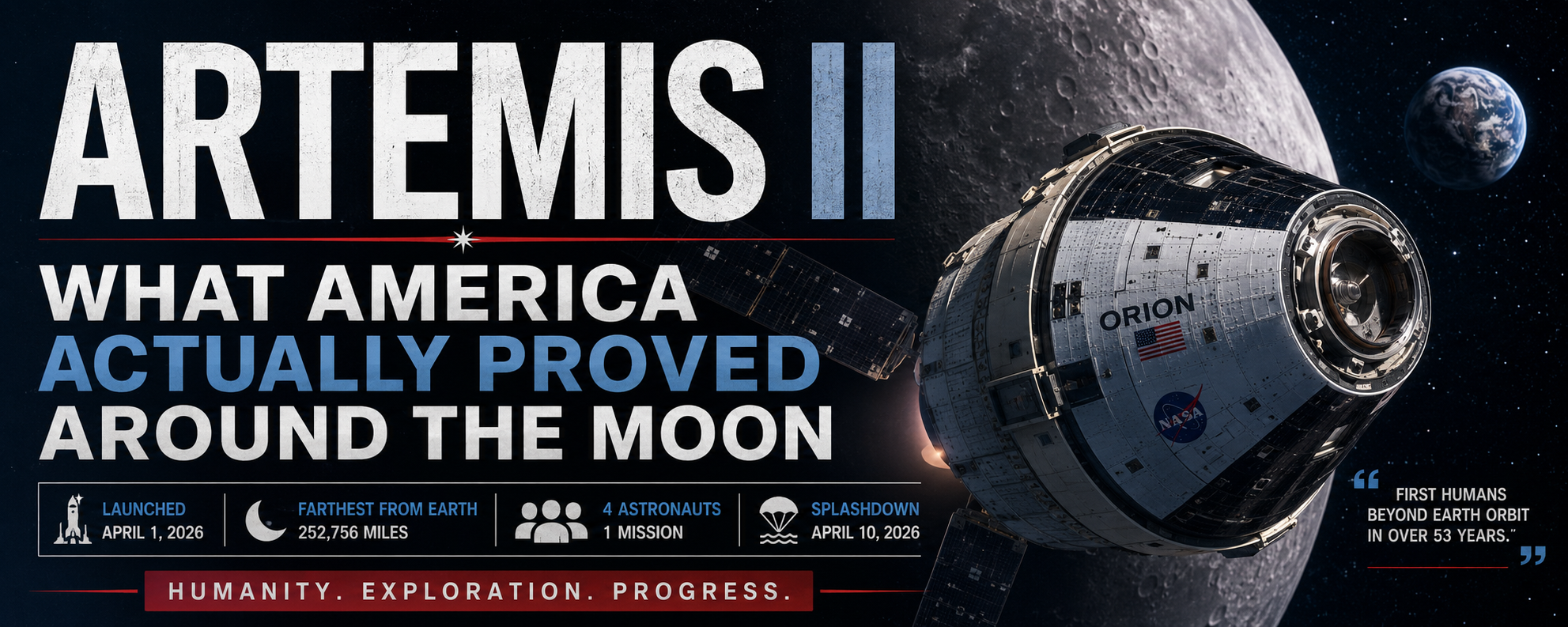
Artemis II was not a rehearsal on paper. From April 1 through April 10, 2026, four astronauts took NASA’s new human deep-space transportation system beyond Earth orbit, around the Moon, farther from Earth than any humans in history, and back through lunar-return reentry. The important question now is not what Artemis II was supposed to prove, but what it actually demonstrated in flight.
For decades, the American return to the Moon existed largely in the language of development programs, appropriations, test campaigns, design reviews and future mission architectures. Artemis I changed that equation in 2022 by sending an uncrewed Orion spacecraft around the Moon atop the first Space Launch System rocket. Artemis II changed it again, and more fundamentally. At 6:35 p.m. EDT on April 1, 2026, NASA astronauts Reid Wiseman, Victor Glover and Christina Koch, together with Canadian Space Agency astronaut Jeremy Hansen, lifted off from Launch Complex 39B aboard SLS and became the first humans to fly aboard the integrated SLS-Orion system. Nine days, one hour and thirty-two minutes later, Orion splashed down in the Pacific Ocean off San Diego. Between those events, the spacecraft traveled roughly 695,000 miles, crossed beyond the previous human distance record established by Apollo 13, passed behind the Moon, operated with a living crew in deep space and returned through the atmosphere at lunar velocity. Artemis II therefore deserves to be evaluated not as a ceremonial return to the vicinity of the Moon, but as an engineering qualification event conducted with four human beings inside the test article.
That distinction matters because Artemis II was never fundamentally about reaching lunar orbit or landing astronauts on the surface. It was a systems mission. Its purpose was to expose a crewed spacecraft, its launch vehicle, its propulsion, guidance, navigation, communications, environmental control, thermal protection, human-machine interfaces and mission-control architecture to the conditions for which they had been designed. A successful lunar flyby would be the visible result. The real product was data.
SLS Had to Become a Human Launch Vehicle
The Space Launch System had already flown successfully on Artemis I, but an un-crewed launch and a crewed launch are not operationally equivalent. Once astronauts are aboard, ascent performance is integrated with a much larger safety architecture, including crew displays, spacecraft monitoring, abort logic, mission-control decision making and the requirement that the booster place Orion into an extremely precise initial trajectory without creating conditions that force the crew or spacecraft to compensate later.
Artemis II began with approximately 8.8 million pounds of liftoff thrust. The twin five-segment solid rocket boosters and four RS-25 engines accelerated the stack through ascent before the boosters separated and the core continued toward orbital insertion. NASA's initial post-flight assessment found that SLS met its Artemis II mission objectives and accurately delivered Orion to the required position and velocity. At main engine cutoff, the vehicle was traveling more than 18,000 miles per hour, and NASA described the orbital insertion as effectively a bullseye against the intended target.
That may sound routine because successful rockets are expected to hit their trajectories. In a lunar architecture, however, injection accuracy is not merely an efficiency statistic. Every guidance error that the spacecraft must later correct consumes propellant, reduces operational margin and adds another maneuver whose execution can fail. Accurate ascent performance therefore protects the downstream mission.
The launch also tested something less glamorous but equally important, the ground infrastructure that has to survive repeated SLS operations. Artemis I caused more blast-related damage to the mobile launcher and pad systems than expected. Engineers reinforced or redesigned vulnerable hardware before Artemis II, making some structures more rigid, allowing others to flex and installing additional blast protection. Following the Artemis II launch, NASA reported substantially less damage, while critical pneumatic, cooling and washdown systems remained operational. That does not make SLS inexpensive, rapidly reusable or operationally mature, but it does demonstrate that engineers successfully converted Artemis I flight experience into physical improvements to the launch system.
Artemis II therefore retired an important category of uncertainty surrounding crewed SLS operations. America no longer merely possesses a heavy-lift rocket that calculations say can launch astronauts. It has now launched astronauts on one.
Orion Became a Crewed Deep-Space Spacecraft
Orion had flown before. It had survived Earth orbital reentry during Exploration Flight Test-1 in 2014 and completed a full lunar-distance mission during Artemis I. Until Artemis II, however, nobody had lived inside it. A spacecraft designed to support people is not fully demonstrated by replacing those people with instrumentation. Humans produce heat, humidity, carbon dioxide, wastewater, waste, movement, equipment loads and unpredictable operational demands. They sleep, eat, exercise, communicate, reconfigure equipment, perform procedures and occasionally encounter hardware that does not behave exactly as expected. Artemis II tested that environment continuously.
During the initial high-Earth-orbit checkout period, the crew activated and evaluated systems that would become essential once a quick return to Earth was no longer possible. Orion's potable-water system had to provide drinking water and rehydrate food. The atmospheric revitalization system had to remove carbon dioxide and maintain acceptable cabin conditions. Thermal control had to accommodate four astronauts living and working inside a compact pressure vessel. Exercise had to occur without creating unacceptable spacecraft motion or overwhelming environmental-control loads. The waste-management system had to function for nearly ten days in microgravity.
The mission also proved why crewed flight testing remains necessary. Orion's toilet produced a fault indication shortly after launch. The astronauts and flight controllers troubleshot the problem and restored normal operation. Later, the wastewater vent system developed another problem that prompted engineers to use heaters, spacecraft attitude changes and alternate procedures while investigating a possible obstruction. NASA subsequently identified the urine vent line as an item requiring post-flight investigation and corrective action before Artemis III.
That is not evidence that the mission failed to prove Orion. It is almost the opposite. Qualification flights are valuable precisely because they expose the difference between a system that functions in a test facility and a system that can be maintained by astronauts and controllers while hundreds of thousands of miles from Earth. Artemis II demonstrated not merely that Orion's life-support hardware could operate, but that the spacecraft, crew and ground teams constituted a functioning operational system capable of diagnosing anomalies and continuing the mission without losing its fundamental safety margins.
The crew also exercised the compact flywheel device intended to preserve physical conditioning during deep-space missions. Unlike the International Space Station, where astronauts have access to thousands of pounds of exercise equipment distributed through a comparatively enormous orbital laboratory, Orion has severe mass and volume constraints. Its roughly 30-pound flywheel device supports both aerobic and resistance exercise and can provide substantial resistance despite fitting within a volume comparable to carry-on luggage. Artemis II allowed engineers to observe both astronaut performance and the effect of exercise on spacecraft motion and atmospheric conditions.
The four astronauts additionally tested the Orion Crew Survival System suits, including donning, pressurization, leak checks, seat entry, mobility and the practical ability to eat and drink while suited. These are not secondary conveniences. The suits provide a survival environment during launch, entry and a cabin-depressurization emergency. Artemis II put four people through the complete sequence inside the actual spacecraft rather than relying entirely on terrestrial simulations.
The Crew Proved Orion Can Be Flown, Not Merely Ridden
One of the most consequential Artemis II objectives occurred only hours after launch. Orion is designed to conduct much of a lunar mission autonomously. That automation is necessary because complex deep-space missions cannot depend upon astronauts manually controlling every attitude change, trajectory correction or systems response. Future Artemis missions, however, will also require close interaction between crewed vehicles, lunar landers and potentially Gateway. NASA therefore had to establish that astronauts could take direct control of Orion and precisely maneuver it relative to another spacecraft.
The detached Interim Cryogenic Propulsion Stage became the first target. During an approximately 70-minute proximity-operations demonstration, the crew maneuvered Orion through controlled approaches and retreats relative to the upper stage, using onboard navigation sensors, reaction-control thrusters and Orion's manual control interfaces. At the conclusion of the test, Orion automatically departed the vicinity. The demonstration provided real flight data on vehicle handling during the kind of close-range maneuvering that becomes essential when one spacecraft must rendezvous with another rather than simply travel through empty space.
A separate deep-space manual-piloting demonstration later placed Christina Koch and Jeremy Hansen at the controls for approximately 41 minutes. They operated Orion using different thruster-control modes and exercised both rotational and translational control, effectively testing the spacecraft across six degrees of freedom. That data matters because spacecraft handling cannot be characterized exclusively by equations describing thruster impulse and vehicle inertia. Human pilots must be able to command a movement, perceive the response and make precise corrections without control laws or display behavior inducing excessive workload or oscillation.
Not every planned demonstration was completed. Mission controllers eventually elected to forgo an additional manual-piloting exercise late in the mission, and a planned radiation-shielding configuration demonstration was also dropped as teams prioritized spacecraft configuration for entry. That distinction is important when discussing risk retirement. Artemis II produced significant piloting and human-factors data, but it did not magically close every open qualification objective on the original test matrix. That is how a technically serious assessment should treat the mission. Artemis II proved a great deal. It did not prove everything.
Navigation Had to Work Where GPS Does Not
Deep-space navigation is easy to underestimate because modern life has made precise positioning seem automatic. Around Earth, spacecraft can take advantage of extensive tracking infrastructure and, depending on orbit, GPS-based navigation. A spacecraft operating between Earth and the Moon eventually leaves that familiar environment behind.
Artemis II tested the transition between NASA's Near Space Network and Deep Space Network, the tracking and communications infrastructure that must support Orion as it moves outward from Earth. During the proximity-operations demonstration, the crew also exercised navigation hardware that will inform future rendezvous operations in regions where GPS cannot simply provide position and velocity.
Trajectory performance during the lunar flight was particularly revealing. Several planned trajectory-correction opportunities could be skipped because Orion remained sufficiently close to its intended path. That is a quietly significant result. Mission designers schedule correction opportunities because errors accumulate, propulsion execution differs slightly from predictions, navigation solutions contain uncertainty and environmental forces perturb trajectories. A correction maneuver that does not need to be performed represents propellant retained, operational workload avoided and evidence that the integrated navigation and propulsion system is performing close to prediction.
On April 2, Orion's European Service Module performed the major translunar injection maneuver, firing its main engine for approximately six minutes and sending the spacecraft out of Earth orbit. For the first time since Apollo 17 in December 1972, human beings had physically departed Earth orbit for the Moon.
That sentence is historically dramatic. From an engineering standpoint, the more important fact is that the maneuver put Orion onto a trajectory from which celestial mechanics would do much of the remaining work. Artemis II used a free-return architecture in which the spacecraft's path around the Moon naturally bent back toward Earth. Such a trajectory does not eliminate propulsion or navigation requirements, but it provides an enormous safety advantage because a catastrophic loss of major propulsion capability does not necessarily strand the crew in lunar space.
252,756 Miles From Earth
On April 6, Orion entered the region where lunar gravity became the dominant gravitational influence on the spacecraft and continued toward the far side.
At 1:56 p.m. EDT, the Artemis II crew surpassed the distance reached by Apollo 13, whose 1970 emergency trajectory had held the human distance record for more than half a century. Later that evening, Orion reached its maximum Earth distance of approximately 252,756 miles, roughly 4,111 miles farther from Earth than Apollo 13's previous record. The spacecraft's closest lunar approach was approximately 4,067 miles above the surface.
The record itself has little engineering significance. An additional few thousand miles do not transform spacecraft capability. What the record represents, however, is substantial. Four humans were functioning inside a newly crewed spacecraft farther from terrestrial rescue, infrastructure and immediate support than any people had ever traveled. Orion maintained pressure, atmosphere, electrical power, thermal balance, communications, navigation and vehicle control while operating across that distance.
For approximately 40 minutes as the spacecraft passed behind the Moon, direct communication with Earth disappeared entirely. Mission Control could not intervene in real time. The spacecraft and crew had to function autonomously until line of sight was restored.
The lunar flyby also became an operational science exercise. Crew members photographed and described far-side terrain, conducted targeted observations and observed a solar eclipse from beyond the Moon. Those activities were scientifically useful, but they also exercised something Artemis will increasingly require, astronauts simultaneously functioning as vehicle operators and field scientists rather than merely passengers.
The Most Important Test Came on the Way Home
Every successful lunar mission eventually encounters the same unforgiving physics. It must give up enormous kinetic energy in Earth's atmosphere without destroying the spacecraft or its occupants.
For Orion, that issue carried particular significance because Artemis I exposed unexpected behavior in its Avcoat ablative heat shield. During the un-crewed 2022 mission, pieces of charred heat-shield material separated in a manner engineers had not predicted. NASA ultimately concluded that gases generated inside the Avcoat during heating could not escape efficiently enough, creating internal pressure, cracking and localized liberation of charred material. The Artemis I capsule remained thermally safe, but the phenomenon required extensive investigation before NASA would place astronauts behind the same basic heat-shield architecture.
NASA conducted more than one hundred specialized tests, revised its understanding of Avcoat behavior and altered the Artemis II entry trajectory to reduce the amount of time the spacecraft spent within the thermal regime associated with the Artemis I char-loss phenomenon. Critics correctly noted before launch that this approach would not by itself retire every thermal-protection-system issue relevant to later Artemis missions, particularly because future lunar-return profiles and heat-shield manufacturing changes create a somewhat different certification problem. NASA's own Office of Inspector General warned before Artemis II that successfully flying the modified trajectory would not automatically retire the heat-shield risk for Artemis III.
Then Artemis II provided the flight data.
On April 10, Orion struck Earth's atmosphere at nearly 35 times the speed of sound. The thermal protection system absorbed and rejected the enormous energy generated during deceleration, the spacecraft maintained the crew environment, the parachute system deployed and Orion landed only 2.9 miles from its targeted splashdown point. NASA's initial post-flight inspection found no unusual thermal-protection conditions. More importantly, the Avcoat char loss observed after Artemis I was substantially reduced in both size and quantity, and the observed Artemis II behavior was consistent with the arc-jet testing conducted during the investigation. Entry-interface velocity differed from prediction by approximately one mile per hour. That is one of Artemis II's most valuable engineering results.
NASA entered the mission with a thermal-protection anomaly discovered on the previous flight, a hypothesized physical mechanism, extensive ground-test data and a modified flight profile intended to mitigate the problem. Artemis II then supplied the real lunar-return environment needed to compare those models against reality. The result substantially strengthened NASA's understanding of the phenomenon.
It would still be incorrect to declare the Orion heat-shield problem universally closed. Artemis III and subsequent spacecraft incorporate their own configurations, missions and design changes. But Artemis II converted a major area of uncertainty into flight evidence. In engineering terms, that is real risk reduction.
What Artemis II Actually Retired
The phrase "risk retirement" can easily become program-management shorthand that obscures what actually happened. Artemis II did not eliminate the inherent danger of sending people around the Moon. No mission can. What it did was attack specific uncertainties that previously existed because no crew had ever operated this hardware in its intended environment.
It demonstrated crewed SLS ascent. It demonstrated the integrated transition from launch vehicle to crewed spacecraft operations. It demonstrated Orion environmental control and life support with four people aboard beyond low Earth orbit. It demonstrated crew exercise, suit operations, habitation procedures and emergency-related systems. It demonstrated that astronauts can manually maneuver Orion in close proximity to another object and control the spacecraft in deep space. It demonstrated navigation and communications across the transition from near-Earth infrastructure into the Deep Space Network. It demonstrated that Orion could execute translunar propulsion, remain accurately on its trajectory, operate autonomously behind the Moon and return to Earth. It demonstrated high-energy lunar-return entry with crew aboard and produced a second full-scale flight data set on the Avcoat heat shield. And finally, it demonstrated recovery of astronauts who had just spent more than nine days beyond Earth orbit.
It also identified work that remained. The urine and wastewater vent system demanded additional engineering investigation. Some planned test objectives were waived. Heat-shield data required continued analysis, and the successful Artemis II entry does not erase every thermal-protection question associated with later mission profiles. Human-performance studies continued for weeks after splashdown because the physiological consequences of deep-space flight cannot be completely measured during the flight itself. NASA researchers continued evaluating how rapidly the crew readapted to gravity and how their physical performance changed after the mission, information that becomes increasingly important when future astronauts must land on the Moon and begin operating without a carrier deck full of recovery personnel waiting for them. That combination, successful demonstrations alongside newly discovered problems, is exactly what a developmental flight should produce.
The Difference Between Artemis I and Artemis II
Artemis I proved that America's new lunar transportation system could fly. Artemis II proved that people could live inside it, operate it, troubleshoot it, navigate it through deep space and survive the complete voyage home. That difference is enormous.
The United States had not sent human beings beyond low Earth orbit since Apollo 17 departed the Moon in December 1972. For more than fifty-three years, every American astronaut mission remained within Earth's immediate orbital neighborhood. The International Space Station has produced an extraordinary body of knowledge about long-duration human spaceflight, but it circles only a few hundred miles above Earth. A crew aboard the ISS is moving extraordinarily fast, but it remains geographically close to the planet, protected substantially by Earth's magnetic field and supported by an enormous logistics infrastructure that has been exercised for decades. Artemis II broke that pattern.
Reid Wiseman, Victor Glover, Christina Koch and Jeremy Hansen did not simply orbit higher. They crossed the operational boundary between Earth-orbital human spaceflight and deep-space human exploration. They traveled more than a quarter-million miles from home, disappeared behind another celestial body, set a new human distance record and returned inside a spacecraft that had never previously carried a human being. That is what America actually proved around the Moon.
It did not prove that Artemis is finished. It did not prove that lunar landing is easy. It did not prove that every Orion problem is solved, that every SLS cost concern has disappeared or that later missions no longer carry substantial technical risk. Artemis II should not be inflated into something it was not. What it proved is more concrete.
America now possesses a flown, crewed deep-space spacecraft. It possesses a heavy-lift launch system that has carried astronauts. It has once again demonstrated the operational machinery required to send humans out of Earth orbit, navigate them through the Earth-Moon system and bring them home at lunar-return velocity. The environmental controls worked. The propulsion system worked. The navigation architecture worked. The crew could fly the vehicle. Mission Control could manage anomalies hundreds of thousands of miles from Earth. The thermal-protection system brought four people safely through reentry. The recovery architecture retrieved them from the Pacific.
Before April 1, 2026, those capabilities existed partly as hardware, partly as analysis and partly as promises.
After April 10, they existed as flight history