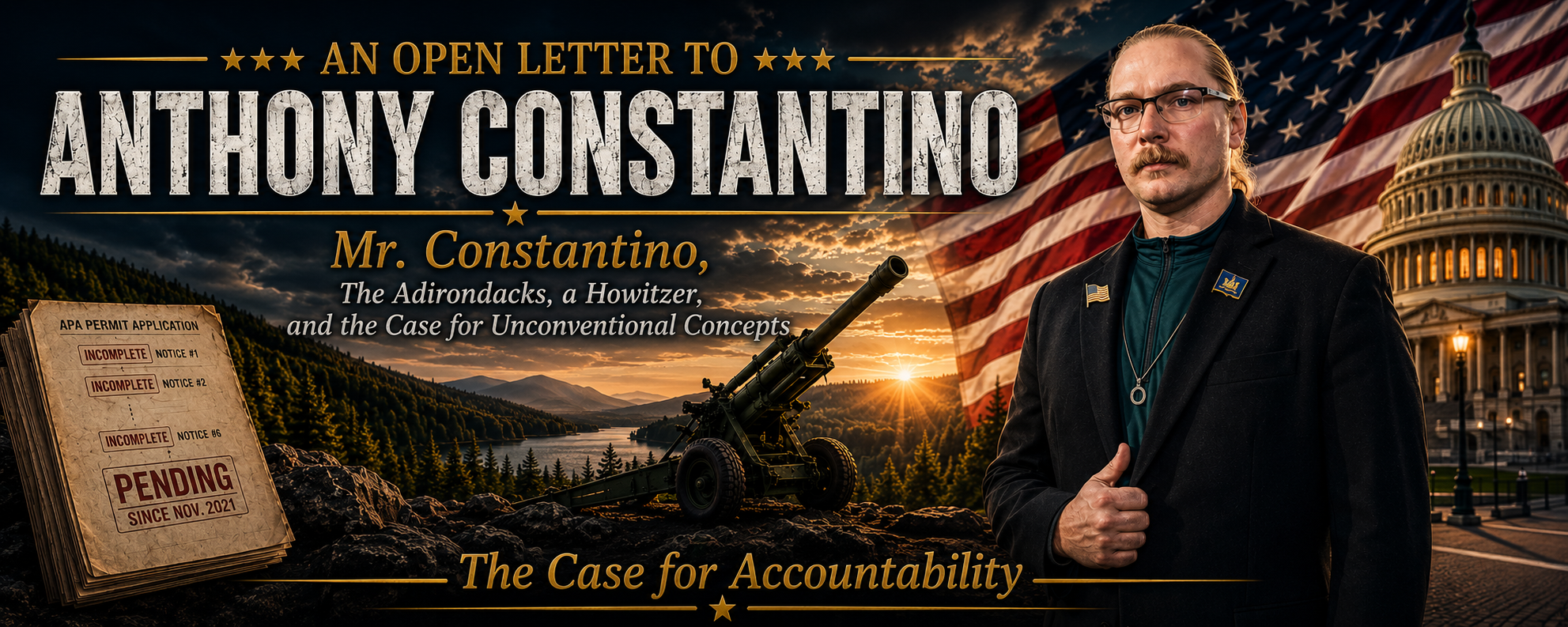
The Case for Accountability: The Adirondacks, a Howitzer, and the Case for Unconventional Concepts
Mr. Constantino,
I am writing to you as someone asking the people of New York's 21st Congressional District to trust you with the responsibility of representing them. Over the course of researching the dispute between the Adirondack Park Agency and Unconventional Concepts, Inc., I have become increasingly convinced that the controversy before us is about considerably more than a howitzer, a permit, or even the Adirondacks. It presents a much larger question about government accountability, and I believe anyone seeking to represent this district should be willing to examine that question carefully.
The underlying application was submitted in November 2021. What followed was a regulatory process stretching across years, including six Notices of Incomplete Permit Application before the APA determined the application complete in September 2025. The matter subsequently moved through public comment and into an adjudicatory proceeding. Nearly five years after the original submission, there is still no final permit determination.
I want to be clear about what I am asking you to consider, because this should not be reduced to whether you support firing a 155-millimeter howitzer in the Adirondacks. That is the sensational version of the story. It is also the least important part of it. The real question is what citizens and businesses are entitled to expect when government exercises regulatory power over them.
The Adirondack Park Agency has a legitimate mission. The Adirondacks deserve protection, and the state has an obligation to consider environmental impacts, public safety, neighboring property owners, and the long-term consequences of development within one of America's most extraordinary natural regions. Nothing about supporting government accountability requires abandoning those responsibilities. UCI should be required to comply with applicable law, demonstrate the safety of its proposed operation, substantiate its technical claims, and accept reasonable restrictions where those restrictions are supported by evidence. But government has responsibilities too.
A regulatory agency should be capable of identifying the standards an applicant must satisfy. It should be capable of explaining why information is required. It should be capable of evaluating technical claims using appropriate expertise. It should be capable of distinguishing a project that requires modification from a project that cannot legally be approved under any circumstances. Most importantly, after the required evidence has been collected and the necessary process completed, government should be capable of making a decision. That is where I believe this matter demands greater scrutiny.
Michael Hopmeier of UCI has told me that his company attempted on multiple occasions to engage the APA and other parties involved in the proceeding in discussions intended to determine whether mutually acceptable operating parameters could be established. According to Hopmeier, those efforts were rebuffed. He has also stated that opponents have not provided measurable alternatives describing what would make the proposed activity acceptable. If thirty firings are considered excessive, for example, would twenty be acceptable? If a projected sound level is unacceptable, what level would satisfy the concern? If the proposed procedures are inadequate, what technical standard should replace them?
Those are Hopmeier's representations, and I have deliberately treated them as such rather than presenting one party's statements as established fact. They should be tested against the administrative record, correspondence, testimony, technical evidence, and the accounts of the other parties. But they should be tested. They should not be ignored.
If UCI's characterization is wrong, the record should demonstrate that. If the APA and other parties have provided specific, measurable, technically supported conditions that UCI has refused or failed to satisfy, that evidence should be brought forward. If UCI itself bears substantial responsibility for the length of this proceeding, that fact should be established.
But if the record demonstrates something different—if UCI repeatedly attempted to determine what would constitute acceptable operation and could not obtain meaningful answers—then the people of this district deserve to know that as well. This is where government accountability becomes more than a campaign phrase. Government possesses an extraordinary advantage over the private citizen or business standing before it: government can wait.
An agency continues operating regardless of whether a permit dispute lasts six months or six years. Its authority remains. Its offices remain. The institution survives. A private company experiences time differently. Lawyers cost money. Engineers cost money. Consultants cost money. Delayed projects cost money. Lost opportunities cost money. Investors and business partners make decisions based on uncertainty. Eventually, a regulatory proceeding can become sufficiently expensive and prolonged that the applicant loses regardless of the final legal outcome. That possibility should concern anyone who believes in accountable government.
The state should not need to defeat an applicant through exhaustion. If UCI cannot satisfy the applicable legal and environmental standards, then the government should establish that failure on the record and deny the application. UCI can then accept the determination or challenge it through the courts. If the proposed activity can be conducted legally under enforceable conditions, those conditions should be established and the appropriate authorization issued. Either outcome requires the government to make a decision and accept responsibility for it.
The alternative is much more troubling: a system in which government possesses enough time, enough procedural leverage, and enough institutional power that eventually it does not need to say no because the process itself can produce the same result. That is the issue I am asking you to examine.
I am not asking you to interfere improperly with an adjudicatory proceeding. I am not asking you to order a state agency to approve a permit. I am certainly not asking you to substitute political pressure for environmental law or technical evidence. Those actions would contradict the accountability principles I am arguing for. I am asking for scrutiny.
Examine the timeline. Examine the six incomplete-application notices. Examine what information the APA requested and what UCI provided. Examine the technical objections. Examine whether those objections are supported by competent evidence. Examine UCI's claim that it attempted to engage the opposing parties in discussions about measurable operating limits. Examine whether any version of this proposed operation was ever realistically capable of satisfying the people opposing it.
Then ask the question that matters: Has the government handled this application fairly, competently, transparently, and within a reasonable period of time? That is a question a representative of this district should be willing to ask regardless of the answer.
There is also a national dimension that deserves consideration. The proposed activity involves defense-related research at a time when the United States is being forced to confront weaknesses in domestic manufacturing, weapons production, testing capacity, industrial readiness, and the infrastructure necessary to support national defense. That does not exempt UCI from New York law. National defense should never become a phrase private businesses invoke to escape legitimate regulation. But neither should defense-related research be treated casually when government decisions may determine whether technically sophisticated work can occur domestically.
The answer must be evidence. If UCI's proposal is unsafe, demonstrate it. If its environmental analysis is inadequate, demonstrate it. If the company has failed to meet the applicable legal standards, identify those standards and demonstrate the failure. But if the company has met those requirements—or can meet them through reasonable conditions—government should have the courage to acknowledge that as well.
This matters beyond UCI because very few of the people you hope to represent will ever find themselves trying to obtain authorization to conduct artillery research. Many of them will, however, find themselves standing before government.
They will try to build homes, expand businesses, purchase and develop property, obtain licenses, create manufacturing operations, hire employees, or pursue opportunities requiring government approval. When that happens, they will enter a relationship in which the balance of power is inherently unequal. The government will have institutional permanence. The citizen will have a mortgage, payroll, deadlines, savings, and a finite amount of time.
Those citizens need representatives who understand that accountability is not hostility toward government. Accountability is what makes legitimate government worthy of public trust.
The APA should be held accountable for the decisions it makes and for the process through which it makes them. UCI should be held accountable for the claims it makes and for its compliance with the law. Environmental organizations and other participants should be expected to substantiate the claims they advance when those claims influence governmental action. Nobody involved should receive immunity from scrutiny. That includes the people seeking elected office.
Mr. Constantino, you are asking the people of this district to give you their trust. I believe this case presents an opportunity to demonstrate what government accountability means before Election Day rather than merely discussing what it will mean afterward.
Read the record. Speak with UCI. Speak with the APA. Speak with the other parties. Ask for the technical evidence. Ask what standards the company was required to meet. Ask what standards remain unmet. Ask who was responsible for the years this process has consumed. And if the answers do not make sense, keep asking.
I have reached my own conclusions as I have worked through this matter, and I will continue presenting the evidence supporting those conclusions through The Case for Accountability. I do not expect you, your campaign, other elected officials, or my readers to adopt those conclusions merely because I hold them. I expect something much simpler.
Because if government can exercise enormous power over a citizen or business, consume years of that party's time, and never be required to explain clearly where the finish line is, then the problem before us is considerably larger than one company, one state agency, one application, or one howitzer. It becomes a question of who governs the government.
And that is a question every person seeking public office should be prepared to answer.
James M. Lacey