I have often wondered what an American academy built specifically for the space age would look like. I eventually went far enough to conceptualize my own. Now the United States government is beginning to ask many of the same questions.
For years, I have wondered what it would look like if the United States stopped treating the development of its future space workforce as a collection of separate educational pipelines and instead created an institution specifically designed around the realities of becoming a genuinely spacefaring nation. America already possesses extraordinary universities, NASA internships, military commissioning programs, research laboratories, astronaut training, technical colleges and a rapidly expanding commercial space industry, but these systems were created for different purposes and remain distributed across different institutions. There is no single federal academy whose central purpose is to educate, train and develop the engineers, scientists, astronauts, spacecraft operators, technicians and leaders who may eventually be responsible for maintaining a permanent American presence beyond Earth. I have often wondered what such a place would look like, what it would teach and, perhaps more importantly, what kind of people it should produce.
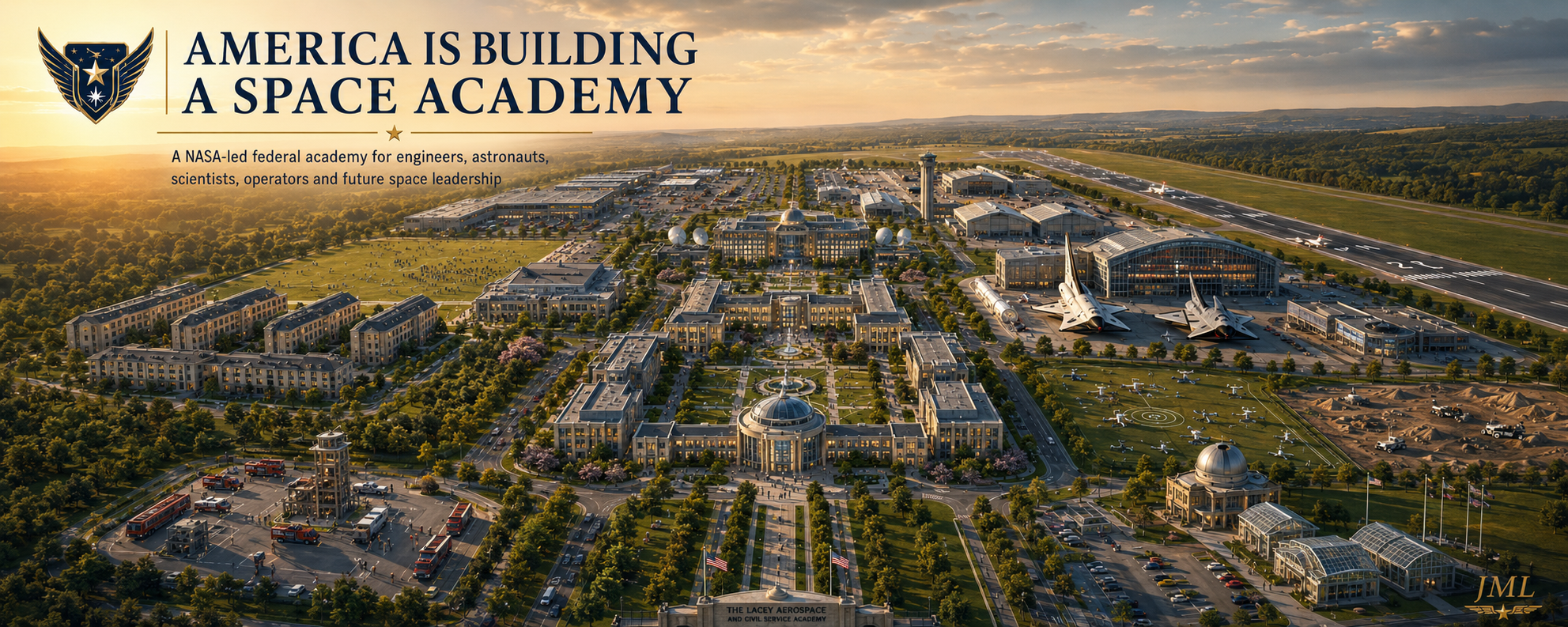
I eventually took that question far enough to conceptualize my own version. I called it the Lacey Aerospace and Civil Service Academy, not because I expected the federal government to adopt my personal blueprint, but because actually designing an academy forced me to confront the practical questions hidden behind the increasingly common phrase, a “West Point for space.” It is easy to imagine impressive buildings, futuristic spacecraft parked outside a glass hangar and students wearing immaculate uniforms. It is much harder to determine what those students should actually do for four years, what facilities they would need, how civilian and military career paths should coexist, what obligations graduates would owe the country and how an academy dedicated to space would differ from universities and federal institutions that already exist.
My conceptual campus therefore became more than a collection of classrooms. I imagined a central academic quadrangle surrounded by laboratories and technical departments, but also a mission command complex, an engineering works district, cadet living areas, a parade and drill field, a dedicated flight operations center, an active runway, a space systems and spaceplane research facility, drone testing grounds, rover-development areas, an observatory and science zone, and dedicated emergency-response training facilities. The campus was built around the assumption that an aerospace education should involve far more than lectures and examinations. Students would study mathematics, physics, engineering and policy, but they would also fly, build hardware, operate complex systems, work around machine tools, test autonomous vehicles, participate in simulated missions and learn from the technicians and operators who turn theoretical designs into functioning machines.
The philosophy behind the concept was simple: education, training, service and leadership should occur together. A student preparing to design spacecraft should understand how spacecraft are manufactured. Someone preparing for mission operations should understand what happens when mechanical, electrical or software systems begin to fail. A future program manager should know what occurs on a factory floor and inside a test cell, not merely what appears on a briefing slide. An institution intended to prepare people for one of the most technically demanding environments imaginable should be designed around the reality that engineering theory, operational judgment and practical competence are inseparable.
That is why the announcement of the proposed United States Space Academy immediately caught my attention. On August 28, 2026, President Donald Trump signed an executive order establishing the Presidential Commission on the United States Space Academy, beginning the federal process of determining how a NASA-led academy could actually be created. NASA Administrator Jared Isaacman is to chair the commission, with NASA Deputy Administrator Matt Anderson serving as executive director, while senior officials from across the federal government participate in developing recommendations concerning governance, curriculum, accreditation, admissions, leadership development, service obligations, security requirements, location, legislation and implementation. The commission has been given 120 days to develop those recommendations.
That distinction is important because America has not yet opened a Space Academy. There is no incoming class, permanent campus, established degree catalogue or dedicated congressional appropriation. What exists today is a formal federal effort to determine whether such an academy should be built and, if so, what institutional form it should take. That is still a significant development because it moves the idea out of the realm of speculative discussion and into actual government planning. Washington is now asking whether the United States should establish a permanent federal institution dedicated specifically to developing the people required for the next era of American space activity.
I believe it should, and my principal concern is not that the proposal may become too ambitious. My concern is that Washington may make it too conventional. If the Space Academy becomes little more than another four-year aerospace engineering university carrying NASA branding, there is little reason to spend billions of dollars creating it. The United States already possesses some of the greatest engineering universities in the world. If it becomes primarily another military commissioning source for the Space Force, the country already has the United States Air Force Academy, ROTC programs and other commissioning pipelines capable of producing Guardians. If it becomes an undergraduate astronaut school, it would misunderstand how astronauts are actually developed, because NASA selects experienced professionals who have already accumulated advanced education, technical expertise and substantial professional achievement.
The academy becomes truly valuable only if it occupies a space that existing institutions do not. It should not merely be a school associated with space. It should become the national academy of the American space enterprise, an institution whose mission extends across civil exploration, scientific research, engineering, operations, national security and the increasingly important commercial space economy. Its purpose should be to develop people capable of understanding not only individual technical disciplines, but also the enormous system of organizations, technologies and professions required to keep a spacefaring nation operating.
That mission is increasingly necessary because space is no longer simply a distant destination for occasional government expeditions. Modern American life already depends on orbital infrastructure for communications, navigation, weather forecasting, military operations, financial systems, agriculture, transportation, disaster response and scientific observation. Meanwhile, the physical space economy is becoming larger and more complicated. Reusable launch systems are becoming normal. Commercial space stations are being developed. Lunar infrastructure is moving from speculative discussion toward actual engineering requirements. Nuclear space power and propulsion are again serious areas of federal research. Autonomous spacecraft, orbital servicing, large satellite constellations, robotic exploration, lunar transportation and eventually in-space manufacturing will require a workforce substantially larger and more diverse than the traditional public image of a few astronauts sitting on top of a rocket.
Astronauts will remain extraordinarily important, but astronauts alone do not make a space program. Every person who leaves Earth depends on thousands of people who remain on the ground. A sustainable American space enterprise requires aerospace engineers, mechanical engineers, electrical engineers, nuclear engineers, software developers, materials scientists, roboticists, physicians, geologists, flight controllers, mission planners, cybersecurity specialists, program managers, acquisition professionals, propulsion experts and spacecraft operators. It also requires machinists, welders, electronics technicians, precision manufacturers, nondestructive-testing specialists, maintenance personnel and skilled tradespeople capable of turning an engineer’s drawings into hardware that can survive launch loads, vacuum, radiation, thermal extremes and years of operation without convenient access to a repair shop.
That broader workforce is where I believe the Space Academy could become genuinely transformative. The proposed institution is not being framed exclusively around astronauts or military officers, but around astronauts, scientists, engineers, operators, civil servants, entrepreneurs and warfighters. That broader language opens the possibility of something substantially more useful than a narrow service academy. A NASA-led institution could become the place where future technical leaders develop a common understanding of the entire American space ecosystem before separating into specialized professional tracks.
Some graduates could enter NASA as engineers, scientists, flight controllers, mission planners or program managers. Others could accept commissions in the United States Space Force. Some could enter federal laboratories, national-security organizations or other agencies whose work directly supports American space capabilities. Graduate programs could eventually develop specialists in nuclear propulsion, advanced materials, spacecraft autonomy, space medicine, planetary science or orbital logistics. Carefully structured industry partnerships could expose students to the commercial space sector without converting a federally funded academy into a taxpayer-financed recruiting program for private corporations.
For that reason, national service should remain central to the institution. If taxpayers provide a student with an elite technical education, access to federal laboratories, specialized training and potentially extremely expensive flight or research experience, the country should receive a meaningful return on that investment. A graduate should not receive four years of federal education, walk across the stage debt-free and immediately disappear into an unrelated private-sector career. A five-year federal service obligation would be a reasonable starting point, although different professional tracks could satisfy that requirement differently. A NASA civil servant would serve the country in a different capacity than a commissioned Guardian, while additional graduate education or particularly expensive technical training could reasonably carry a longer obligation.
At the same time, the academy should preserve NASA’s civilian identity. NASA and the Space Force operate in the same physical domain, and their technologies, launch systems, communications networks and industrial suppliers will inevitably overlap, but their missions remain different. Scientific exploration, astronomy, Earth science, planetary research and civilian human spaceflight should not become subordinate to military priorities simply because space is increasingly contested. A well-designed academy could strengthen rather than blur these boundaries by allowing civilian and military students to share a common technical foundation while maintaining clearly differentiated professional tracks and service responsibilities.
Future Guardians should understand the civilian scientific and commercial environment surrounding their operations. Future NASA engineers should understand national-security requirements without automatically becoming military officers. Scientists should understand the engineering constraints imposed on their instruments. Operators should understand the machines they command. Engineers should understand how acquisition, regulation, budgets and organizational decisions affect whether their designs ever reach the launch pad. The goal should not be to produce graduates who know everything, but to produce professionals who understand how their expertise fits into the much larger system that makes American spaceflight possible.
The curriculum therefore needs to be exceptionally demanding and intentionally interdisciplinary. Every graduate should possess a serious foundation in mathematics, physics, systems engineering, computer science, thermodynamics, materials, electronics, orbital mechanics and spacecraft fundamentals. From that common foundation, students could specialize in propulsion, guidance and navigation, robotics, autonomous systems, nuclear power and propulsion, communications, spacecraft structures, cybersecurity, remote sensing, human factors, space medicine, planetary science, mission operations, advanced manufacturing or orbital logistics. Different paths could lead to very different careers, but every student should understand the fundamental technical language of space systems.
The academy should also resist one of the persistent weaknesses of modern technical education, the tendency to separate engineering theory from practical manufacturing and operations. A mechanical engineering student should machine components. A propulsion student should understand pumps, valves, pressure systems, combustion hardware and test equipment rather than encountering propulsion only as equations. A software engineer should understand that flight code controls physical machines operating under unforgiving physical constraints. A spacecraft operator should understand enough engineering to recognize when telemetry suggests that something is actually beginning to fail. An engineer designing hardware should spend time beside machinists and technicians who can explain why an elegant-looking design may be unnecessarily difficult, expensive or impossible to manufacture.
That relationship between theory and practice was central to my own academy concept. The engineering works district was not included simply because an industrial section looked impressive on a master plan. It represented the idea that future engineers should regularly encounter fabrication, machining, assembly, inspection and testing. The mission command complex existed because spacecraft operations cannot be understood entirely from textbooks. The flight operations center and runway existed because aerospace professionals should understand flight as an operating discipline. The drone and rover fields reflected the growing importance of autonomous systems, while the observatory preserved the academy’s scientific mission and the emergency-response yard acknowledged the uncomfortable reality that aerospace systems involve fuel, high voltage, pressure vessels, hazardous materials, fire, mechanical failure and human risk.
A real federal Space Academy would not need to reproduce every specialized capability on one campus because NASA already possesses extraordinary infrastructure across the country. Johnson Space Center offers human-spaceflight operations, astronaut training and mission-control expertise. Kennedy Space Center provides launch and spacecraft-processing experience. Marshall possesses deep experience in propulsion and large space systems. Goddard is deeply involved in scientific spacecraft and instrumentation. Other NASA centers, federal laboratories, military installations and commercial facilities offer capabilities that would be enormously expensive and unnecessary to duplicate.
The academy should therefore incorporate mandatory rotations throughout the national space enterprise. A mechanical or propulsion student might spend one summer around test hardware, another observing launch processing and a later rotation supporting spacecraft integration or mission operations. A computer engineering student could rotate between spacecraft autonomy, cybersecurity and mission-control environments. A planetary scientist could work alongside the engineers responsible for transforming scientific requirements into instruments capable of surviving launch and operating millions of miles from Earth. By graduation, students should understand that the American space program is not one agency, one campus or one profession, but an interconnected technical and industrial system.
I would also go beyond the traditional four-year academy model by creating a serious technical education pathway for the skilled workforce that actually builds aerospace systems. The person welding a flight structure, machining a turbine component, assembling avionics or performing nondestructive inspection may not require a bachelor’s degree, but that person’s competence can be every bit as mission-critical as the work of the engineer who designed the system. America cannot become a sustainable spacefaring civilization if it produces excellent engineers while failing to produce enough machinists, welders, technicians, inspectors and advanced manufacturing specialists capable of turning those designs into reliable hardware.
The Space Academy should therefore eventually include either a federal technical institute or a formal national network of partner schools offering two-year degrees, apprenticeships and advanced certifications in aerospace manufacturing, electronics, machining, welding, composites, inspection, maintenance and related fields. The academy could then serve as the centerpiece of a broader national workforce structure rather than an isolated institution intended only for a small academic elite. A serious space program requires both people who can calculate the stresses inside a pressure vessel and people who can manufacture, weld and inspect that vessel correctly.
Admissions should reflect the same philosophy. Academic achievement, particularly in mathematics and science, should matter greatly, but traditional classroom performance should not be the only measure of technical potential. A student who has built robots, programmed autonomous systems, restored machinery, flown aircraft, conducted independent research, competed in engineering projects or accumulated significant manufacturing experience may possess exactly the practical intelligence the academy needs. Different professional tracks should also carry different physical and medical requirements. There is no logical reason to impose astronaut medical standards on someone preparing to design nuclear-electric propulsion systems, just as there would be no justification for weakening standards in career fields where demanding physical capability is genuinely required.
The academy should likewise never promise that graduation leads directly to becoming an astronaut. A Space Academy graduate could eventually become an exceptional astronaut candidate, and the institution might someday provide one of the strongest pipelines into the astronaut corps, but NASA selection should remain extremely competitive. Human spaceflight is too consequential for institutional entitlement. Astronaut selection should continue to depend on demonstrated competence, professional experience, judgment, leadership and the specific needs of the astronaut corps.
Leadership education should be treated with equal seriousness because technical brilliance does not automatically produce sound judgment. Some graduates of this academy may eventually make decisions involving billion-dollar programs, national-security systems, human lives and spacecraft operating hundreds of thousands or millions of miles from Earth. They should study engineering ethics, program management, acquisition, contracting, public administration, international space law, communication, organizational failure and the history of American aerospace programs. They should study Apollo, but they should also study Challenger and Columbia, because the history of spaceflight demonstrates that technological failure and institutional failure are often inseparable.
Then there is the politically difficult question of where such an academy should be located. Houston has an obvious argument because of Johnson Space Center and its relationship with human spaceflight. Florida possesses Kennedy Space Center and the nation’s most recognizable launch infrastructure. Huntsville has generations of propulsion and aerospace experience. Colorado Springs sits inside a major Space Force ecosystem and already hosts the Air Force Academy. Other locations will undoubtedly present strong arguments, and Congress will inevitably become involved.
That decision should not become a political trophy. If the academy succeeds, its location could shape the institution for a century. Access to aerospace infrastructure, research capabilities, available land, transportation, industrial partnerships, security requirements, construction costs and the ability to support a permanent student and faculty population should matter more than which congressional delegation campaigns most aggressively for the project. The ideal solution may be one principal campus tied to mandatory rotations through NASA centers, laboratories and operational installations around the country.
There is also no reason to wait for an enormous permanent campus before testing the concept. An initial Space Academy cohort could be assembled through existing universities and NASA facilities. Students could receive federal scholarships, follow a common technical and leadership curriculum, rotate through government space centers and accept federal service obligations after graduation. That pilot program would allow Washington to identify what works before committing billions of dollars to concrete, dormitories and laboratories. A permanent campus could then be designed around actual institutional experience rather than assumptions made entirely inside conference rooms.
Congress will ultimately have to make the academy durable. An executive order can begin the process, but a serious federal institution requires lasting legal authority, appropriations, governance, degree-granting authority, accreditation, enforceable service commitments and a clearly defined relationship with NASA, the Space Force and other federal agencies. If the objective is to create an institution with the longevity of West Point or Annapolis, its existence cannot depend entirely upon the preferences of whichever administration occupies the White House at a particular moment.
The funding should also be new funding. Creating the Space Academy by cutting existing NASA science missions, spacecraft development, propulsion research or exploration hardware would undermine the entire purpose of the institution. If America concludes that developing a permanent national space workforce is important enough to justify a federal academy, then it should fund that academy as an additional national capability. A school intended to strengthen American spaceflight should not be built by cannibalizing American spaceflight.
When I first began conceptualizing my own aerospace academy, it was fundamentally an exercise in imagining the institutional architecture of a truly spacefaring America. I pictured students moving between classrooms and engineering facilities, aircraft operating from the academy runway, spacecraft systems being tested in dedicated laboratories, drones flying over test grounds, rovers crawling through artificial terrain, engineers working alongside technicians, mission operators training in realistic control rooms and future leaders being taught from their first day that technical authority carries public responsibility. I did not imagine the academy because America needed another impressive collection of buildings. I imagined it because a civilization preparing to operate permanently beyond Earth will eventually need institutions specifically designed to prepare people for that responsibility.
That is why I find the proposed United States Space Academy so compelling. The federal government is beginning to ask a question that I have often asked myself: if America is serious about becoming a permanent spacefaring nation, where do we deliberately prepare the people who will make that possible? The commission’s 120-day process will not answer every question, but it could determine whether the Space Academy becomes another temporary Washington proposal or the beginning of an institution capable of shaping American spaceflight for generations.
The commission should therefore think considerably bigger than another university. It should design an institution where future engineers understand operations, where operators understand engineering, where scientists work beside manufacturers, where civilians and military personnel understand one another’s missions, and where every student is reminded that extraordinary technical capability exists for a purpose larger than individual advancement. America has spent more than half a century learning how to build remarkable spacecraft. The next stage requires us to become equally deliberate about building the people, professional culture and institutions that will design, manufacture, operate and lead what comes next.
I have often wondered what that academy might look like. I eventually went far enough to conceptualize my own version of it. Now, for the first time, the United States may actually build one.