There are legitimate arguments to be made about land use in the Adirondack Park. There are legitimate environmental concerns, legitimate questions about noise and safety, legitimate interests held by neighboring property owners, and legitimate reasons for the Adirondack Park Agency to scrutinize an unusual proposal involving the testing of a 155-millimeter howitzer. None of those concerns should be dismissed merely because the proposed activity involves defense research, nor should Unconventional Concepts, Inc. be exempted from the laws and regulations that apply to activity within the Adirondack Park. The Adirondacks are an extraordinary resource, and the state has both the authority and the responsibility to protect them. But regulatory authority carries a corresponding responsibility. Government must exercise its power competently, consistently, transparently, and within reasonable limits. That is where this story begins.
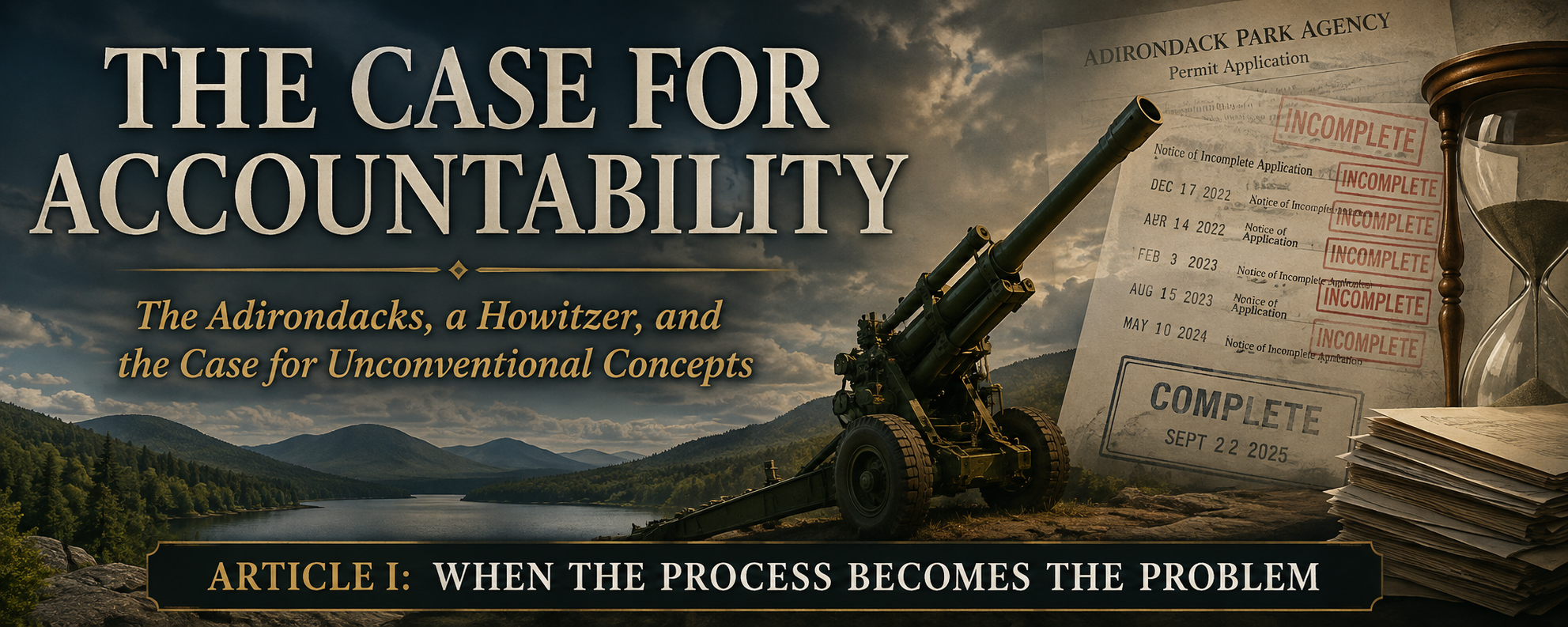
In November 2021, Unconventional Concepts, Inc., or UCI, submitted what the Adirondack Park Agency formally identifies as Project P2021-0276. The application concerns a proposed research-and-development operation on private land in the Town of Lewis, Essex County, involving limited testing of 155-millimeter artillery systems. According to the application materials and representations made in connection with the proceeding, the proposed work concerns research involving internal ballistics, barrel performance, wear, and related engineering questions. The proposed testing would use steel projectiles rather than explosive warheads, with the surrounding terrain incorporated into the site's safety design. It is an unusual proposal, and unusual proposals deserve careful scrutiny. What they do not deserve is an administrative process without a discernible end.
From this point forward, I will refer to it simply as the application, because the application number is not what matters. Neither, ultimately, is the howitzer. The howitzer makes this story unusual enough to attract attention, but it is not what makes this story important. What makes it important is what happened after the application entered the machinery of New York State government.
Between the original submission in November 2021 and the Agency's eventual determination that the application was complete in September 2025, the APA issued six Notices of Incomplete Permit Application. Nearly four years therefore passed before the application reached the point at which the Agency considered it complete. The matter subsequently proceeded through public comment and into an adjudicatory hearing. We are now approaching five years since the original submission without a final permit determination. That timeline should concern people regardless of whether they support UCI's proposal.
Government has the authority to say no. That point needs to be made clearly because accountability does not mean that every applicant is entitled to receive the answer it wants. If an application fails to satisfy New York law, environmental requirements, safety standards, or other applicable regulations, the responsible agency should identify those deficiencies, establish them through the administrative record, and deny the application. The applicant can then accept that determination or challenge it through whatever legal remedies are available. Likewise, if a proposed activity can be conducted lawfully subject to enforceable restrictions, government can impose appropriate conditions. What government should not be allowed to do is accomplish through years of administrative attrition what it has been unwilling or unable to accomplish through an actual decision. That distinction is at the heart of The Case for Accountability.
I initially became interested in this matter because the proposal itself was extraordinary. A private defense-research company seeking authorization to conduct limited 155-millimeter howitzer testing in the Adirondacks is naturally going to attract attention. It sounds dramatic because it is dramatic. But the more I examined the dispute, the less interested I became in the artillery and the more interested I became in the regulatory process surrounding it. A howitzer may have opened the door to this story, but what stands on the other side is a much larger question about the relationship between citizens, businesses, private property, and the administrative state.
That question is particularly important in the Adirondack Park. The APA exercises substantial authority because the region it protects is unlike almost anywhere else in the country. That authority exists for legitimate reasons. The Adirondacks deserve protection, and economic development cannot be permitted to disregard legitimate environmental consequences simply because development creates jobs or serves an interesting technological purpose. But extraordinary regulatory authority should demand extraordinary accountability. The greater the power government possesses over the use of private property, the greater its obligation to explain how that power is being exercised and what standards a regulated party is expected to satisfy. The dispute surrounding UCI raises precisely those questions.
Michael Hopmeier of UCI has told me that the company has attempted on several occasions to engage both the APA and other parties involved in the proceeding in an effort to understand their positions and determine whether mutually acceptable operating parameters could be negotiated. According to Hopmeier, those efforts were rejected. He has further stated that opponents have not provided UCI with measurable alternative conditions under which they would consider the proposed activity acceptable. Those statements are Hopmeier's account, not findings that I am asking readers to accept without scrutiny, and that distinction will remain important throughout this series.
Nevertheless, his account raises a straightforward question that government and the parties opposing the application should be capable of answering: What would compliance look like?
If the proposed number of firings is excessive, what number would be acceptable? If the anticipated noise is unacceptable, what measurable sound threshold would satisfy the concern? If the proposed operating schedule creates an unacceptable impact, what schedule would not? If the safety methodology is deficient, what recognized technical standard should replace it? If additional environmental analysis is required, what information remains necessary? These are not rhetorical questions. They are the kinds of questions a functioning regulatory process should eventually answer.
There is an important difference between establishing demanding standards and establishing moving standards. A business may dislike a regulation and still comply with it because the requirement is identifiable. It can change its design, alter its operations, spend additional money, provide additional evidence, or determine that compliance makes the project economically impossible and walk away. Every one of those outcomes depends upon the regulated party being able to determine what the government actually requires.
The alternative is regulation through uncertainty. Under that model, an applicant continues providing information, responding to objections, hiring professionals, paying attorneys and consultants, modifying proposals, participating in proceedings, and waiting without ever knowing whether there is a destination at the end of the process. At some point, the distinction between regulatory review and regulatory punishment begins to disappear. That is why the passage of time matters.
Five years is not simply a number on a calendar. For a business, time represents money, personnel, planning, investment, contracts, legal expenses, engineering work, opportunity costs, and uncertainty. A government agency does not experience delay the same way an applicant does. The institution remains. Its employees continue receiving salaries. Its offices remain open. Its regulatory authority survives another year. The private party on the other side of the table absorbs the economic consequences of every additional month. This creates an enormous imbalance of power, and that imbalance is precisely why procedural accountability matters.
None of this proves that UCI is entitled to a permit. That conclusion must rest on the applicable law, technical evidence, environmental record, and facts developed through the proceeding. Nor does criticism of the regulatory process establish that every objection raised against the application is illegitimate. Some may be entirely justified. The purpose of this series is not to replace one predetermined institutional conclusion with another. It is to examine whether the government and the participants wielding influence over this process can substantiate their positions and whether the treatment of this application reflects the standards we should expect from government.
There is another dimension that cannot simply be ignored. The proposed work involves defense-related research. The United States is again confronting difficult questions about domestic manufacturing capacity, weapons development, testing infrastructure, industrial readiness, and the ability to develop and evaluate military technology at home. Invoking national defense does not exempt a private company from environmental law. It does, however, increase the importance of understanding exactly what is being proposed and ensuring that decisions affecting such work are based on evidence rather than assumption, politics, or institutional inertia.
This is also why elected officials should pay attention. They do not need to decide the application themselves, and they should not improperly interfere with an adjudicatory proceeding. They should, however, care whether government agencies operating within their districts exercise authority transparently and responsibly. They should care when a regulatory proceeding consumes years. They should care when businesses allege that they cannot obtain meaningful answers about what would constitute acceptable operation. And they should care whether agencies entrusted with enormous authority remain accountable to the people affected by their decisions. The principle extends far beyond UCI.
Most New Yorkers will never submit an application involving a howitzer. They may, however, try to build a home, expand a business, purchase property, open a manufacturing operation, develop land, obtain a professional license, or navigate any of the countless other circumstances in which government stands between an individual and something that individual is legally attempting to accomplish. In those moments, the balance of power is rarely equal. Government has institutional permanence, lawyers, regulatory authority, and time. The citizen or business has bills to pay. That is why this case matters even to people who could not care less about artillery.
A regulatory system worthy of public confidence must be capable of reaching decisions. If UCI cannot meet the lawful requirements governing its proposed operation, then the state should establish that fact and deny the application. If UCI can satisfy those requirements under reasonable and enforceable conditions, then the state should establish those conditions and allow the process to move forward. Either result represents government actually governing.
There is, however, a third possibility, and it is the one that deserves the greatest scrutiny: that government never needs to definitively win its case because it possesses enough time, enough process, and enough institutional power to simply outlast the person standing on the other side.
If that is what happened here, or if the evidence ultimately demonstrates that this process was allowed to drift toward that result, then this is no longer merely a dispute over a permit. It is a case for accountability.
Over the articles that follow, I will examine how this application moved through the Adirondack Park Agency, what the parties have argued, what evidence supports those arguments, what UCI has been asked to demonstrate, and whether the regulatory process has provided meaningful answers in return. I will distinguish documented facts from allegations, allegations from analysis, and analysis from my own conclusions. The objective is not to ask readers to trust UCI, distrust the APA, or accept my position because I have written it. The objective is to put the record on the table.
Then we can ask the question government should always be prepared to answer:
Who is accountable?
Take action
Send the prepared letter to county leaders or add your name to the petition.